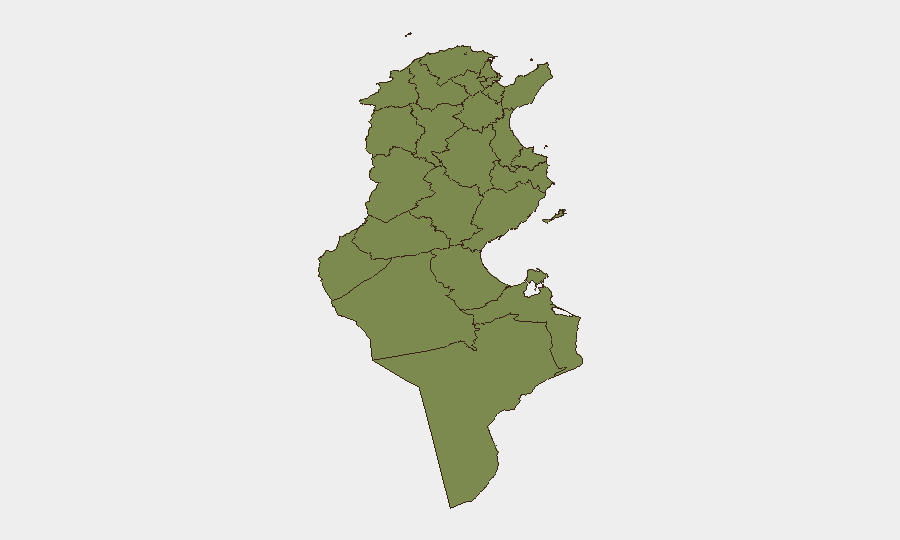
Situation Summary
Tunisia's composite threat score of 7 reflects a fragmented security landscape dominated by localized risks rather than nationwide instability. The country remains under a state of emergency with ongoing counterterrorism operations, but open-source reporting over the past 24–48 hours is sparse, suggesting no acute nationwide escalation. Sub-national concentration of risk in Kébili and Kairouan—coupled with persistent border security challenges—indicates that threats are geographically bounded rather than systemic across the country. The security trajectory remains stable but requires continued monitoring of militant activity and cross-border organized crime, particularly in southern and central regions.
Key Developments
Current 24–48 hour event reporting from Tunisia is extremely limited in open sources. GeoBit's multi-language OSINT and global event feeds have identified no reliably dated, multiply-confirmed discrete security incidents (civil unrest, attacks, infrastructure disruption, or sudden policy changes) occurring on 18–19 June 2026. The most recent clearly dated Tunisia-specific operational activity in open sources is the 17 June repatriation of 91 sub-Saharan migrants through Tunis–Carthage International Airport as part of a wider voluntary return program—a state-managed operation rather than a security incident. General background includes ongoing counterterrorism raids and organized-crime dismantling reported throughout mid-June, but without precise incident dates these cannot be presented as current developments.
Assessment: The absence of high-confidence recent event signals is itself noteworthy and suggests no major escalation has occurred in the past 48 hours. Duty-of-care teams should interpret this as relative calm rather than a data gap indicating hidden activity.
Highest-Risk Areas
Kébili and Kairouan account for the majority of tracked risk, with composite scores of 31.3 and 23.8 respectively—far exceeding all other regions. These governorates are in southern and central-southern Tunisia and align historically with militant recruitment networks, cross-border trafficking (particularly from Libya), and state-of-emergency security operations. Kébili's sharp elevation suggests either active counterterrorism sweeps, border incursions, or organized-crime activity; Kairouan's secondary ranking indicates similar vulnerabilities. Tunis (8.8) remains the capital and carries diplomatic, political, and infrastructure significance, but its score is proportionally lower, reflecting stable governance and security force presence. All other regions rank at 1.3, suggesting either minimal tracked activity or baseline ambient risk.
How GeoBit Would Assist
Corporate security teams should leverage GeoBit's AOI (Area-of-Interest) Monitoring & Early Warning capability to establish persistent watch over Kébili and Kairouan, with automated alerting on militant or organized-crime signals. OSINT Fusion & Corroboration across multi-language feeds, Telegram/X intelligence, and conflict event databases will bridge current reporting gaps and provide earlier warning of unrest, border crossings, or state operations. GIS & Spatial Analysis combined with border & disputed-territory search enables mapping of high-risk corridors (Libyan and Algerian borders) and checkpoint locations, informing route planning and duty-of-care protocols for personnel in southern Tunisia.
7-Day Outlook
Tunisia's threat environment is expected to remain stable over the next week, with no indicators of sudden escalation in violence or civil unrest. Persistent low-level counterterrorism operations and border-security actions will likely continue, particularly in Kébili and Kairouan. Security teams should maintain heightened vigilance in southern governorates and monitor diplomatic or cross-border developments involving Libya, which could indirectly affect Tunisia's border stability.
Highest-Risk Areas — Ranked
| # | State / Region | Risk |
|---|---|---|
| 1 | Kébili | 31.3 |
| 2 | Kairouan | 23.8 |
| 3 | Tunis | 8.8 |
| 4 | Tataouine | 1.3 |
| 5 | Nabeul | 1.3 |
| 6 | Monastir | 1.3 |
| 7 | Sfax | 1.3 |
| 8 | Mahdia | 1.3 |
| 9 | Médenine | 1.3 |
| 10 | Jendouba | 1.3 |
| 11 | Béja | 1.3 |
| 12 | Bizerte | 1.3 |
Sources
Previous Daily Briefs
A new Tunisia brief is written every day — each with its own risk map and downloadable CSV. Here's the last week; use the calendar to go further back.
📅 Browse every day by calendar →
Highlighted days have a brief. Tap a day for that day's map & analysis, or “csv” for that day's dataset ($5).