Situation Summary
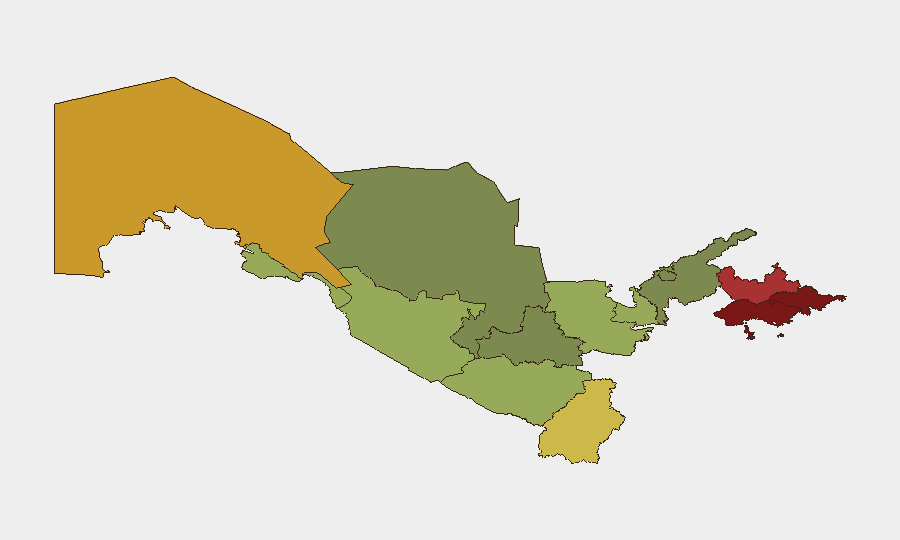
Uzbekistan remains stable at the national level with no verified security incidents, civil unrest, or infrastructure disruptions reported in the last 24–48 hours. The country's composite threat score of 5 reflects a baseline security environment characterized by low frequency of tracked events. However, sub-national risk is highly concentrated in the Fergana Valley region (Andijan, Fergana, and Namangan oblasts), where historical instability, militant activity, and border tensions persist as chronic drivers of elevated threat.
Key Developments
No verified security, conflict, civil-unrest, crime, political-instability, infrastructure, or travel-risk incidents were identified in Uzbekistan during the 24–48 hour reporting window. Open-source monitoring detected only one Uzbekistan-related security incident: screening of the Uzbekistan national football team at a New York City airport (U.S. location, not in-country). This incident involved routine U.S. security procedures and does not reflect conditions within Uzbekistan. Absent corroborated, time-stamped reporting of discrete security events in-country for this period, no additional developments can be responsibly attributed to the current 24–48 hour window.
Highest-Risk Areas
Risk in Uzbekistan is geographically skewed toward the Fergana Valley. Andijan (risk 88), Fergana (82), and Namangan (78) oblasts dominate the sub-national ranking and account for the majority of historical militant activity, trafficking, and inter-ethnic tension. These regions share porous borders with Tajikistan and Kyrgyzstan, limited state capacity in remote areas, and lingering legacy grievances from 1990s conflict. The Republic of Karakalpakstan (72) presents secondary concern due to historical separatist sentiment and socioeconomic stress. All other regions score substantially lower, with the capital region and major urban centers (Samarqand, Bukhara, Navoiy) presenting minimal tracked risk.
How GeoBit Would Assist
A security team protecting people or assets in Uzbekistan should employ AOI Monitoring & Early Warning on the Fergana Valley oblasts to generate alerts on emerging protests, militant activity, or border incidents before they escalate. Multi-language OSINT (Intel Sweep, X/Twitter & Telegram monitoring, sentiment analysis) on Uzbek, Russian, and regional Tajik/Kyrgyz sources will capture early signals of unrest, trafficking, or jihadist recruitment that English-language sources often miss. Routing & Network Analysis should be used to pre-plan alternative travel corridors and secure movement in and out of high-risk regions, and GIS & Spatial Analysis can map physical proximity of personnel or assets to known militant-activity hotspots and border-transit routes.
7-Day Outlook
No acute security catalyst is evident on the near-term horizon. Barring unforeseen border escalation with Tajikistan or Kyrgyzstan—a chronic but low-frequency risk—the national security posture is expected to remain stable. However, teams should maintain persistent monitoring of the Fergana Valley, where seasonal activity spikes and border incidents can occur with minimal warning.
Highest-Risk Areas — Ranked
| # | State / Region | Risk |
|---|---|---|
| 1 | Andijan Region | 88 |
| 2 | Fergana Region | 82 |
| 3 | Namangan Region | 78 |
| 4 | Republic of Karakalpakstan | 72 |
| 5 | Surxondaryo Region | 65 |
| 6 | Qashqadaryo Region | 58 |
| 7 | Sirdaryo Region | 55 |
| 8 | Jizzakh Region | 48 |
| 9 | Xorazm Region | 45 |
| 10 | Bukhara Region | 42 |
| 11 | Navoiy Region | 38 |
| 12 | Samarqand Region | 35 |
Sources
Previous Daily Briefs
A new Uzbekistan brief is written every day — each with its own risk map and downloadable CSV. Here's the last week; use the calendar to go further back.
📅 Browse every day by calendar →
Highlighted days have a brief. Tap a day for that day's map & analysis, or “csv” for that day's dataset ($5).