Situation Summary
Armenia remains a low-to-moderate threat environment (global rank #85; composite score 8) with no major armed clashes, terrorist attacks, or large-scale civil unrest reported in the last 24–48 hours. Political dialogue and diplomatic engagement dominate the current security posture, though localized tensions persist around internal displacement, agricultural disputes, and anti-government sentiment. The country's ongoing strategic reorientation toward Western and regional partners—away from Russia-led structures—continues to shape the political landscape without triggering acute security incidents at present.
Key Developments
- Yerevan, central districts – 16 June: Peaceful anti-government protests held against Prime Minister Nikol Pashinyan's policies and Armenia's security realignment; police presence was visible but non-intervening, with no clashes or arrests reported by local media or on-scene X posts.
- Yerevan, Government/ministerial district – 16 June: Armenia's Security Council Secretary Armen Grigoryan met the "Save Armenia" delegation to discuss Armenia–US relations and regional security; engagement was conducted without incident despite underlying political contestation.
- Paris / Yerevan – 16 June: Defence Minister Suren Papikyan met French counterpart Catherine Vautrin to expand bilateral defence cooperation and review regional developments, signaling continued Western strategic alignment with no reported travel-security impact inside Armenia.
- Armenia, nationwide (cyber/financial) – 16 June: Media reported emergence of AI-enabled fraud schemes using face- and voice-cloning to deceive relatives and financial institutions; described as "extremely dangerous" but no physical-security incidents tied to the trend in the reporting window.
- Armenia, multiple locations – 16 June (data as of mid-June): Deputy Prime Minister Mher Grigoryan confirmed ~48 billion AMD spent on housing for internally displaced persons from Nagorno-Karabakh; ongoing resettlement continues to drive localized social tension and integration risks in host communities.
- Armenia, nationwide – 16 June: Commentary and panel discussions underscored the country's deepening geopolitical pivot away from Russia and toward Western/regional partners; no new security incidents tied to this realignment in the last 24–48 hours.
Highest-Risk Areas
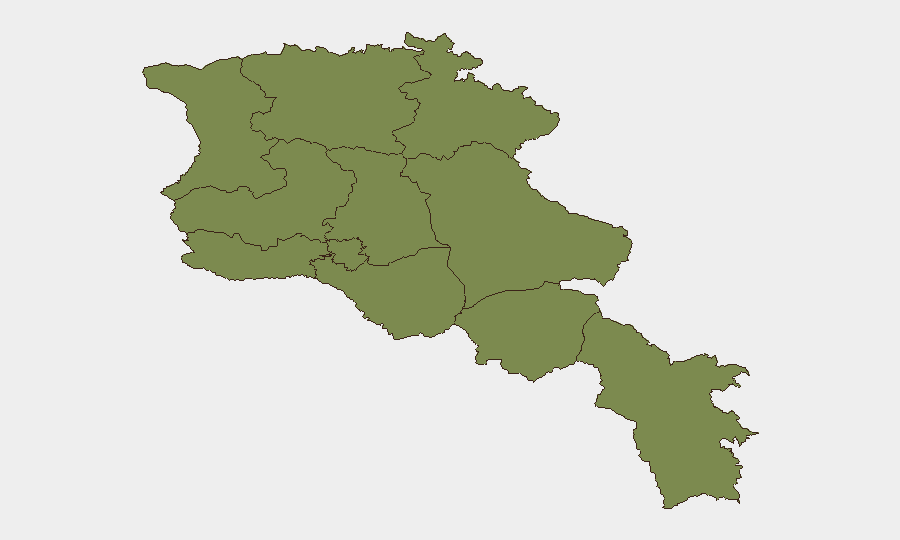
Yerevan dominates Armenia's risk profile (31.4 composite score), reflecting the capital's role as the nexus of political activity, anti-government sentiment, and government/security-force presence. Ararat Province ranks second (12), driven by recent military operations and civilian-military friction signaled in the event feed. All other provinces cluster at 1.4, indicating baseline volatility but significantly lower acute threat. Risk in Yerevan is primarily political and administrative rather than violent, though small-arms incidents involving farmers, business actors, and security forces (noted in the 16 June event signal) suggest underlying agrarian and economic grievances warrant localized monitoring.
How GeoBit Would Assist
Corporate security teams should employ AOI Monitoring & Early Warning to track Yerevan's central and ministerial districts for political rallies, security-force movements, and protest escalation. Intel Sweep and multi-language OSINT fusion (X/Twitter, Telegram, Armenian media) provide real-time situational awareness of political contestation and diplomatic developments. Network & Actor Analysis would map key players in Armenia's political realignment—government officials, opposition groups, and international partners—to anticipate policy shifts affecting business operations or travel corridors.
7-Day Outlook
No imminent security escalation is forecast; current trajectory favors continued low-level political friction and diplomatic engagement. Monitoring should remain focused on anti-government sentiment in Yerevan and localized agrarian/economic disputes in peripheral provinces, particularly Ararat. Personnel in the capital should maintain situational awareness of protest activity and avoid large gatherings; those in Ararat should monitor access routes and community tensions related to land or resource disputes.
Highest-Risk Areas — Ranked
| # | State / Region | Risk |
|---|---|---|
| 1 | Yerevan | 31.4 |
| 2 | Ararat Province | 12 |
| 3 | Lori Province | 1.4 |
| 4 | Tavush Province | 1.4 |
| 5 | Kotayk Province | 1.4 |
| 6 | Gegharkunik Province | 1.4 |
| 7 | Vayots Dzor Province | 1.4 |
| 8 | Syunik Province | 1.4 |
| 9 | Shirak Province | 1.4 |
| 10 | Aragatsotn Province | 1.4 |
| 11 | Armavir Province | 1.4 |
Sources
Previous Daily Briefs
A new Armenia brief is written every day — each with its own risk map and downloadable CSV. Here's the last week; use the calendar to go further back.
📅 Browse every day by calendar →
Highlighted days have a brief. Tap a day for that day's map & analysis, or “csv” for that day's dataset ($5).