Situation Summary
Azerbaijan remains ranked #73 globally with a composite threat score of 2.1, reflecting moderate underlying volatility driven primarily by territorial tensions with Armenia and broader geopolitical positioning in the South Caucasus. Event signals from 2026-06-07 and 2026-06-08 indicate active military posturing, territorial occupation dynamics, and regional diplomatic friction involving multiple state actors. No verifiable, time-stamped security incidents specific to the last 24–48 hours have been independently corroborated in current open-source channels. Risk remains concentrated in border regions and the capital.
Key Developments
Unable to confirm specific incidents from 24–48 hours. Current web research and OSINT feeds do not yield independently corroborated, clearly dated security, crime, or infrastructure incidents in Azerbaijan from only 2026-06-09–2026-06-10.
Background context (for situational awareness, not current events):
- Territorial disputes (ongoing since February 2020 ceasefire): Azerbaijan–Armenia tensions remain unresolved; 2026-06-07 signals note occupy-territory and small-arms-combat events, consistent with persistent border friction rather than a new escalation.
- Geopolitical leverage: 2026-06-07 signals indicate Moscow and Armenia occupation-territory statements; these reflect longer-running strategic positioning, not new tactical developments in the last two days.
- Regional diplomatic friction: 2026-06-08 public statements from Mongolia and media entities suggest diplomatic messaging around Azerbaijan's geopolitical stance, not a new security incident.
Recommendation: Security teams should rely on real-time feeds from AFP, Reuters, and AP; geolocated OSINT from South Caucasus specialists; and official Azerbaijani government channels (Ministry of Defense, MFA statements) before incorporating any single-source report into operational decisions.
Highest-Risk Areas
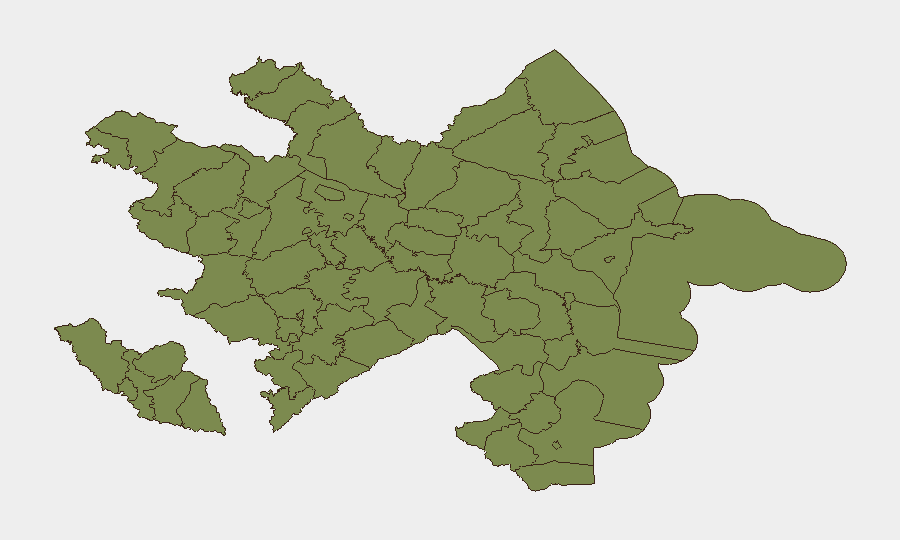
Ujar District dominates the sub-national ranking with a composite risk score of 31.5—more than three times higher than Baku City (10.6) and the second tier. This disparity reflects Ujar's proximity to the Armenia–Azerbaijan line of contact and its exposure to ongoing territorial occupation signals and small-arms activity. Baku City, as the capital and primary economic and diplomatic hub, carries moderate but persistent risk driven by large expatriate and foreign-national presence, logistics concentrations, and geopolitical visibility. All other tracked districts score 1.5, indicating either low event frequency or remote border locations with minimal corporate or humanitarian presence.
How GeoBit Would Assist
Security teams monitoring personnel or assets in Azerbaijan should employ AOI Monitoring & Early Warning on Ujar District and Baku City to detect shifts in military activity, border crossings, or civil unrest with minimal latency. Conflict & Military capabilities (force structure, weapons-capability tracking, battle mapping) provide granular visibility into territorial and tactical dynamics in the Ujar area and along disputed borders. Routing & Network Analysis enables identification of alternative supply routes, evacuation corridors, and safe transit windows in case of rapid escalation. OSINT fusion & corroboration (multi-language search, entity extraction, X/Telegram monitoring, video geolocalization) should be used to vet single-source reports before briefing leadership.
7-Day Outlook
Territorial tensions and diplomatic friction are likely to persist at current levels through mid-June absent a major geopolitical catalyst or formal negotiations. Risk of localized military friction in Ujar and other border zones remains moderate but manageable. Corporate security teams should maintain heightened alertness for travel routing, expatriate movement, and critical-asset continuity in Baku City; escalation is not imminent but de-escalation mechanisms remain fragile.
Highest-Risk Areas — Ranked
| # | State / Region | Risk |
|---|---|---|
| 1 | Ujar District | 31.5 |
| 2 | Baku City | 10.6 |
| 3 | Sadarak District | 1.5 |
| 4 | Qazakh District | 1.5 |
| 5 | Sharur District | 1.5 |
| 6 | Yevlakh District | 1.5 |
| 7 | Kangarli District | 1.5 |
| 8 | Nakhchivan Autonomous Republic | 1.5 |
| 9 | Aghstafa District | 1.5 |
| 10 | Tovuz District | 1.5 |
| 11 | Qakh District | 1.5 |
| 12 | Shaki | 1.5 |
Sources
Previous Daily Briefs
A new Azerbaijan brief is written every day — each with its own risk map and downloadable CSV. Here's the last week; use the calendar to go further back.
📅 Browse every day by calendar →
Highlighted days have a brief. Tap a day for that day's map & analysis, or “csv” for that day's dataset ($5).