Situation Summary
Belize remains a mid-tier crime-driven risk environment (global rank #107, threat score 17), with armed robbery, homicide, and kidnapping concentrated in urban and northern districts. The past week saw continuation of violent crime patterns alongside a notable shift in the national security apparatus: consolidation of Home Affairs and Defence under a new Ministry of National Security signals institutional recalibration in response to sustained pressure on law enforcement capacity. No escalation in frequency or severity of incidents is evident from available reporting, though the kidnapping arrests in Corozal District (October 3–5) represent a relatively rare organized abduction case warranting monitoring.
Key Developments
- San Andres, Corozal District (October 3): Police intercepted a red pickup truck and arrested two suspects in connection with the forcible detention of two men, Ricardo Zetina and Walter Pineda; both occupants were recovered.
- Corozal District (October 5): Alex Marcus Lewis and Brian Ezikel Dena were formally charged with kidnapping and threat of death in relation to the San Andres abduction.
- Belize City / National Level (October 5–8): Prime Minister John Briceño consolidated Home Affairs and Defence portfolios into a new Ministry of National Security, appointing Michel Chebat as minister—a structural response to sustained security-institution pressure.
- National Border Areas (October 5): Opposition Leader Tracy Panton publicly presented a six-point border-security plan encompassing surveillance enhancement, inter-agency intelligence-sharing, infrastructure upgrades, corruption mitigation, border-community protection, and parliamentary oversight mechanisms.
- Corozal District (October 10): Police preventive patrol resulted in arrest of a father and son; three long firearms and one handgun were seized.
Highest-Risk Areas
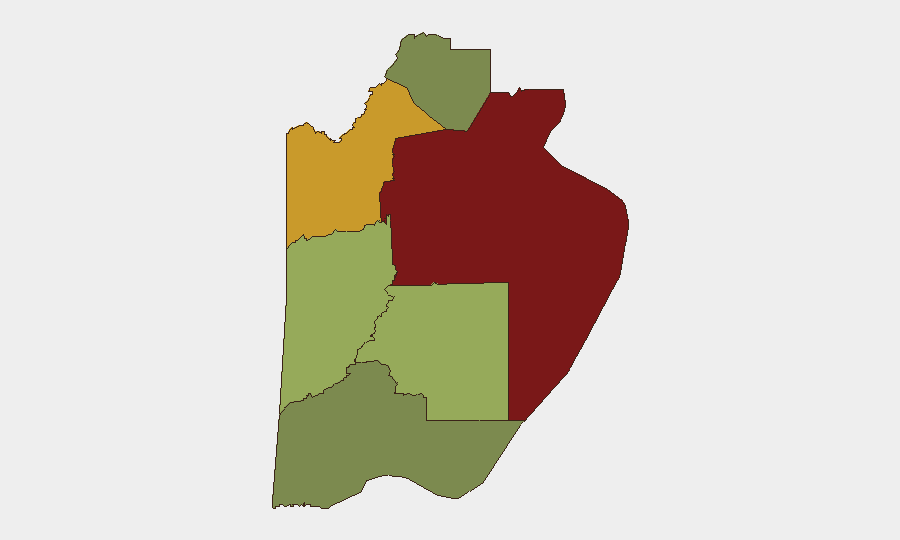
Belize District (risk 95) and Orange Walk District (risk 72) dominate the threat landscape, driven by armed robbery, territorial gang activity, and homicide concentrated in Belize City and northern urban corridors. Cayo District (58) presents moderate but sustained risk from both street crime and organized activity; southern districts (Stann Creek, Toledo) show lower baseline risk but remain vulnerable to trafficking-related exploitation and spillover violence. Corozal District's risk score (22) is lowest nationally, yet recent kidnapping arrests indicate pockets of organized criminal capability that do not reflect lower-order reporting patterns.
How GeoBit Would Assist
Security teams managing personnel or assets in Belize would deploy AOI Monitoring & Early Warning on high-risk districts (Belize District, Orange Walk, Cayo) to track incident clustering and identify emerging hotspots; Network & Actor Analysis to map kidnapping and armed-robbery cells operating across district boundaries; and Intel Sweep combined with multi-language OSINT and sentiment analysis to detect trafficking networks and corruption within security institutions before they affect duty-of-care obligations. GIS & Spatial Analysis would support route planning and movement risk assessment for staff travel, particularly in northern and central corridors.
7-Day Outlook
Incident reporting volume is expected to remain consistent with baseline patterns; no triggering events suggest imminent escalation. The institutional recalibration at the national level (Ministry consolidation, border-security policy articulation) may gradually improve inter-agency coordination but will not produce immediate crime reduction. Continued vigilance on organized-crime signaling—particularly kidnapping, firearm trafficking, and corruption indicators—remains justified.
*GeoBit Weekly Security Brief | Belize | 2026-10-12*
Highest-Risk Areas — Ranked
| # | State / Region | Risk |
|---|---|---|
| 1 | Belize District | 95 |
| 2 | Orange Walk District | 72 |
| 3 | Cayo District | 58 |
| 4 | Stann Creek District | 48 |
| 5 | Toledo District | 35 |
| 6 | Corozal District | 22 |
Sources
Previous Weekly Briefs
A new Belize brief is written every Monday, covering the week — each with its own risk map and downloadable CSV. Use the calendar to go further back.
- October 5, 2026
- September 28, 2026
- September 21, 2026
- September 14, 2026
- September 7, 2026
- September 1, 2026
- August 30, 2026
📅 Browse past briefs by calendar →
Highlighted days have a brief. Tap a day for that day's map & analysis, or “csv” for that day's dataset ($5).
Atlas — our AI intelligence desk — emails them this snapshot personally. Nothing else, no list.