Situation Summary
Cyprus remains a lower-tier global security concern (composite threat score 3) but faces localized volatility concentrated in the Turkish-controlled north and Nicosia. Over the past 24–48 hours, security events have included a stabbing attack on foreign nationals in central Nicosia, petty arson in Limassol, drug-lab operations, and widespread police enforcement activity—a pattern consistent with routine crime rather than organized instability. However, prison overcrowding warnings and the absence of rapid de-escalation mechanisms underscore institutional strain that could amplify risk if triggered by larger civil or political events.
Key Developments
- Nicosia stabbing attack (1 August 2026, 14:00–16:00 local estimate). Police investigated a knife assault on a group of Israeli citizens in central Nicosia (Ledra/city center area); one victim sustained a sharp-object injury to the ear. Assailants remain unidentified. Motive unclear—attack signals either targeted hostility or random street crime; status of ongoing investigation not confirmed.
- Limassol tire arson (night of 1 August 2026, Linopetra road). Hooded youths deliberately set fire to roadside tires, causing brief traffic obstruction and local disturbance before fleeing police. No injuries reported; motivation unknown (protest, gang activity, or mischief unconfirmed).
- Limassol cannabis lab bust (1 August 2026). Anti-Narcotics Unit (YKAN) raided a cultivation laboratory in Limassol; one 38-year-old arrested, plants and cannabis seized. Consistent with ongoing drug-enforcement operations; no indication of larger trafficking network or violence.
- Nationwide overnight police operations (31 July–1 August 2026). Coordinated checks across Cyprus resulted in multiple arrests for illegal stay, hundreds of vehicle stops, and traffic violations (speeding, drink-driving, drug-driving). Operations were routine preventive security measures; no major incidents reported.
- Prison system overcrowding alert (statement published 1 August 2026). Cypriot prison officers publicly warned President Nikos Christodoulides that facilities are at "breaking point" due to overcrowding and staff shortages, with safety risks to officers explicitly flagged. This signals institutional vulnerability to rapid escalation if custody volumes surge.
- Cyprus–France firefighting deployment (1 August 2026). Two Cypriot aerial firefighting aircraft deployed to southern France for wildfire support, temporarily reducing local emergency-response aerial capacity. Logistical note; no immediate operational risk, but reinforces dependency on external resource flows during summer peak-hazard season.
Highest-Risk Areas
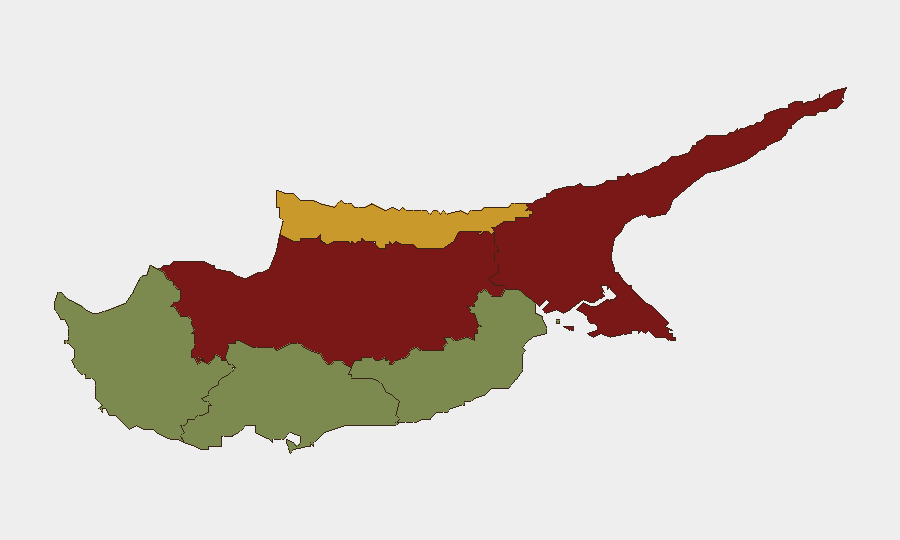
Nicosia (risk 92) and Famagusta (risk 88) dominate the risk profile, driven by the partition's unresolved status, Turkish-controlled administrative zones, and historic intercommunal tensions. The stabbing attack in central Nicosia exemplifies the volatility of mixed-population areas and foreign nationals in high-traffic zones. Kyrenia (risk 72) follows, reflecting similar partition-related instability. Larnaca, Limassol, and Paphos (risks 28, 22, and 18 respectively) show substantially lower exposure, though routine crime (narcotics, petty arson) continues. The south–north risk gradient mirrors political fragmentation and enforcement-capacity disparities.
How GeoBit Would Assist
A corporate security team would deploy AOI Monitoring & Early Warning on Nicosia's city center and Famagusta districts to detect emerging protest, assembly, or intercommunal activity in real time. OSINT fusion across Telegram, X, and local media would surface radicalization signals or gang communication preceding violence. Network & Actor Analysis on recent detainees (Limassol drug bust, illegal-stay arrests) would map organized crime or smuggling routes affecting Larnaca port and transit corridors.
7-Day Outlook
Current trajectory suggests continued low-level crime and enforcement activity without systemic escalation. However, prison overcrowding warnings and the unresolved Nicosia stabbing investigation create friction points; if the attack is attributed to a political or communal actor, rapid escalation in Nicosia is plausible within 5–10 days. Summer heat, tourist-season congestion, and ferry/air choke points warrant sustained monitoring.
Highest-Risk Areas — Ranked
| # | State / Region | Risk |
|---|---|---|
| 1 | Nicosia | 92 |
| 2 | Famagusta | 88 |
| 3 | Kyrenia | 72 |
| 4 | Larnaca | 28 |
| 5 | Limassol | 22 |
| 6 | Paphos | 18 |
Sources
Previous Daily Briefs
A new Cyprus brief is written every day — each with its own risk map and downloadable CSV. Here's the last week; use the calendar to go further back.
📅 Browse every day by calendar →
Highlighted days have a brief. Tap a day for that day's map & analysis, or “csv” for that day's dataset ($5).
Atlas — our AI intelligence desk — emails them this snapshot personally. Nothing else, no list.