Situation Summary
Fiji remains a low-threat environment globally (rank #74, composite score 28) with no discrete security events recorded in the current reporting window. However, the government has elevated focus on terrorism prevention and public-health emergency response, while underlying vulnerabilities in water security, maritime domain awareness, and infectious-disease control persist. The Western region continues to present elevated risk (85), suggesting localized governance, infrastructure, or criminal challenges warranting corporate monitoring. Overall trajectory is stable but conditional on sustained interagency coordination and continued absence of cross-border extremist activity.
Key Developments
- Batiki Island — 21 September: Government launched emergency water-supply operation after critical community shortages; supplies delivered by sea with priority to school and health centre, signalling infrastructure gaps in outer islands.
- Suva High Court — 21 September: Court rejected former Deputy Prime Minister Biman Prasad's application for permanent stay of criminal proceedings; case continues, maintaining political-accountability focus.
- Nadi — 22 September: Fiji Airports extended five-year agreement with Radiola for aviation-safety flight-inspection services, reinforcing critical aviation-sector operational continuity.
- Fiji-wide — 25–27 September: Government unveiled new counter-terrorism strategy emphasizing criminal and financial-network disruption, border controls, financial intelligence, maritime-domain awareness, and interagency coordination.
- Fiji-wide — 26 September: Government assessed terrorist attack as unlikely in foreseeable future but identified transnational terrorism and violent extremism as regional security concerns requiring enhanced international cooperation and intelligence-sharing.
- Fiji-wide — 26 September: Government declared national emergency in response to sharp rise in HIV infections; reported twelvefold increase in cases linked to crystal-meth use between 2010 and 2025, straining healthcare and public-order capacity.
Highest-Risk Areas
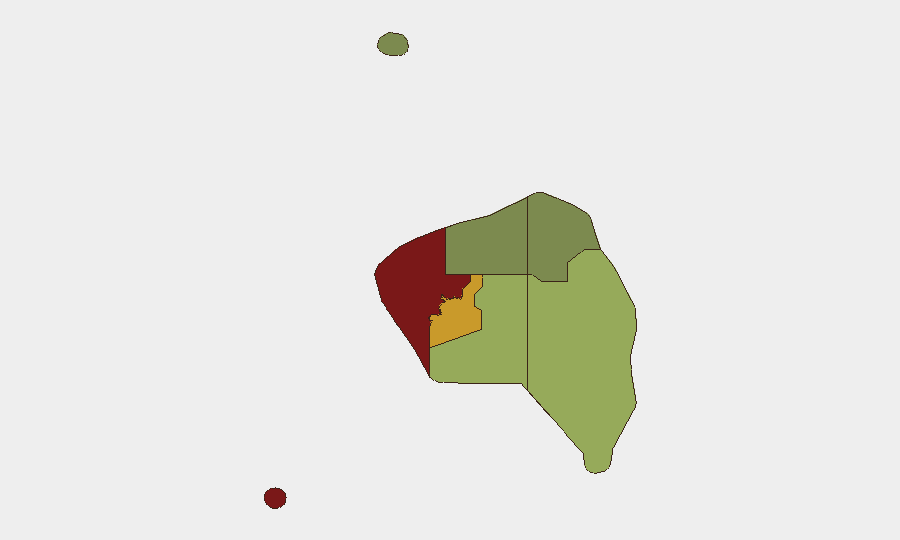
The Western region (risk 85) significantly outpaces other divisions and warrants priority monitoring; Central (72) also presents material concern. The disparity suggests Western region faces compounded challenges—likely spanning infrastructure resilience, water/resource security, healthcare access, or organized-crime activity. Eastern, Northern, and Rotuma regions present materially lower risk profiles. Corporate assets and personnel concentrated in Western and Central divisions should expect elevated operational friction around service delivery, logistics, and emergency-response capability.
How GeoBit Would Assist
A Fiji security program would employ AOI Monitoring & Early Warning to track Western and Central divisions for water-security incidents, health-system strain, and crime signals; OSINT fusion and multi-language search to monitor government counter-terrorism and health-emergency communications for policy shifts affecting business continuity; and Maritime & Aviation tracking to corroborate border-control and maritime-domain-awareness effectiveness, particularly around transnational threat flows. Integrated sentiment and temporal analysis of government announcements would flag escalation in threat perception or resource reallocation that might affect duty-of-care obligations.
7-Day Outlook
The government's elevated counter-terrorism posture and emergency health declaration are unlikely to produce immediate operational disruption to commercial activity but signal heightened state engagement with security and public-health infrastructure. Water-security gaps on outer islands and health-system strain in high-prevalence areas may continue to affect service reliability and workforce availability. No imminent violence, political instability, or travel restrictions are anticipated; corporate focus should remain on continuity planning for infrastructure and healthcare dependencies.
Highest-Risk Areas — Ranked
| # | State / Region | Risk |
|---|---|---|
| 1 | Western | 85 |
| 2 | Central | 72 |
| 3 | Eastern | 45 |
| 4 | Northern | 38 |
| 5 | Rotuma | 12 |
Sources
Previous Weekly Briefs
A new Fiji brief is written every Monday, covering the week — each with its own risk map and downloadable CSV. Use the calendar to go further back.
- September 21, 2026
- September 14, 2026
- September 7, 2026
- September 2, 2026
- August 31, 2026
- August 29, 2026
- August 27, 2026
📅 Browse past briefs by calendar →
Highlighted days have a brief. Tap a day for that day's map & analysis, or “csv” for that day's dataset ($5).
Atlas — our AI intelligence desk — emails them this snapshot personally. Nothing else, no list.