Situation Summary
Lithuania faces an intensifying hybrid-security challenge from Belarus, characterized by repeated aerial incursions (drones and contraband balloons), smuggling activity, and instrumentalized migration pressure along the eastern border. The incidents have disrupted civil aviation, prompted formal diplomatic protests, and triggered public-alert systems and emergency-preparedness exercises. The threat environment remains below conflict threshold but is generating sustained operational strain on border and air-defense resources and drawing attention to NATO air-coverage gaps.
Key Developments
- Vilnius airspace, 23 September: Lithuania's Foreign Ministry summoned Belarus's chargé d'affaires and issued a formal diplomatic protest after contraband balloons crossed from Belarus overnight, temporarily restricting civil aviation and disrupting scheduled flights. The ministry characterized the incidents as systematic hybrid activity.
- Šalčininkai District (Liškiava/Liškūniškės), 22–23 September: Border guards intercepted and brought down a drone that had entered from Belarus carrying approximately 1,000 packs of Minsk Superslims cigarettes, valued at €5,500–€5,510, highlighting organized smuggling operations using aerial vectors.
- Vilnius, Trakai, Elektrėnai, and Kaunas region, 22–23 September: Public air-threat alerts were issued after a drone incursion from Belarus; residents were instructed to identify safe locations while the military tracked and neutralized the aircraft.
- Lithuanian airspace, 23–25 September: Government and defense officials characterized the past week as marked by a series of drone, contraband balloon, and migration-related incidents, signaling a broader pattern of Belarusian hybrid activity and prompting calls for stronger NATO air-defense coverage.
- Lithuania's eastern border, 24–25 September: Security assessments framed recent aerial incursions and smuggling activity as part of a hybrid-security challenge affecting border control and civil aviation operations.
- Nationwide, 25–29 September: The government launched its largest annual national mobilization exercise, including a scenario involving possible military incursion from Belarus, with testing of public-warning systems (sirens, mobile emergency alerts, and the LT72 preparedness application) and drills focused on critical-infrastructure protection and public order.
- Lazdijai District, 29 September: The Lithuanian Riflemen's Union conducted the *Tvirtas dzūkas 2026* exercise, focused on critical-infrastructure resilience, coordination with local authorities, and public-order maintenance.
Highest-Risk Areas
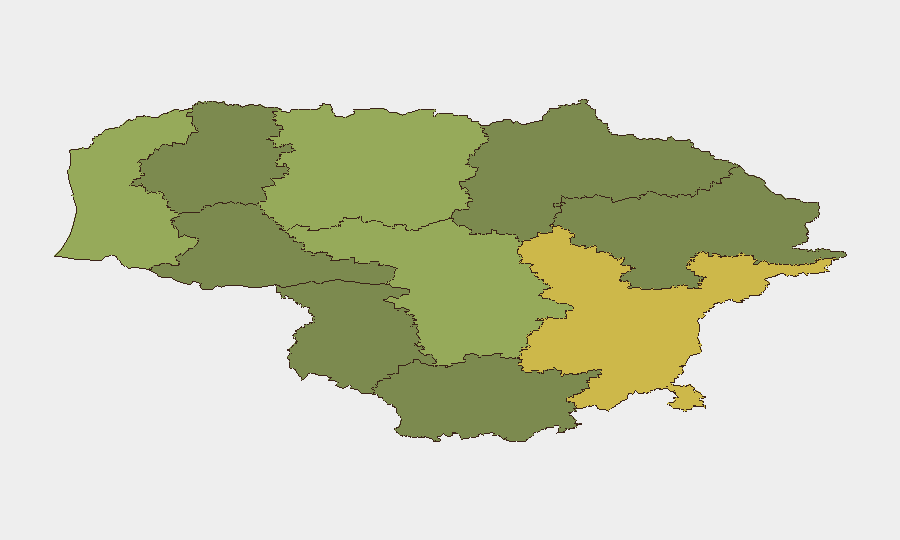
Vilnius County (risk 68) and Kaunas County (risk 58) represent the dominant risk drivers, reflecting both proximity to Belarus and concentration of critical infrastructure, population, and civil aviation hubs. Klaipeda County (risk 52), while maritime-focused, remains exposed to aerial and hybrid threats. The eastern border counties—Šalčininkai, Utena, and Alytus—face direct pressure from contraband and migration activity but rank lower in composite score, likely reflecting lower population and asset density; nevertheless, their role as ingress points for hybrid operations warrants sustained monitoring.
How GeoBit Would Assist
Security teams monitoring Lithuania should deploy AOI Monitoring & Early Warning capabilities on the eastern border and Vilnius airspace to provide persistent, real-time alerting on drone and balloon activity; OSINT fusion (X/Twitter, Telegram, local news aggregation, and multi-language search) to track hybrid-activity patterns, diplomatic responses, and public-alert cycles; and Conflict & Military force-structure and weapons-capability tracking to monitor Belarusian air and border resources. Routing & Network Analysis can support alternative travel and supply-chain planning for personnel and assets in high-risk counties.
7-Day Outlook
Hybrid incursions are likely to continue at current or elevated tempo through autumn, with drones and smuggling activity persisting as Belarus tests Lithuanian defenses and NATO response. National mobilization exercises and enhanced public alerting will remain visible through late September and October. Civil aviation disruptions and border-security resource strain should be expected as baseline operational risk.
Highest-Risk Areas — Ranked
| # | State / Region | Risk |
|---|---|---|
| 1 | Vilnius County | 68 |
| 2 | Kaunas County | 58 |
| 3 | Klaipeda County | 52 |
| 4 | Siauliai County | 42 |
| 5 | Panevezys County | 38 |
| 6 | Taurage County | 35 |
| 7 | Utena County | 33 |
| 8 | Alytus County | 32 |
| 9 | Telsiai County | 28 |
| 10 | Marijampole County | 25 |
Sources
Previous Weekly Briefs
A new Lithuania brief is written every Monday, covering the week — each with its own risk map and downloadable CSV. Use the calendar to go further back.
- September 22, 2026
- September 15, 2026
- September 8, 2026
- September 1, 2026
- August 30, 2026
- August 28, 2026
- August 25, 2026
📅 Browse past briefs by calendar →
Highlighted days have a brief. Tap a day for that day's map & analysis, or “csv” for that day's dataset ($5).
Atlas — our AI intelligence desk — emails them this snapshot personally. Nothing else, no list.