Situation Summary
Mauritania remains under moderate composite security stress (global rank #null; threat score 7), with no major armed incidents, terror attacks, or large-scale unrest confirmed in the past 24–48 hours. However, recent developments point to fragmentation along three vectors: political-judicial tensions (court sanctions on opposition MPs; reported targeting of civil-rights figures), elevated cyber-threat activity in government and private networks, and persistent instability in the northeastern border regions. Economic uncertainty around currency depreciation and cost-of-living pressures create secondary risk of protest activity, particularly among constituencies affected by the recent court rulings.
Key Developments
- Nouadhibou (2026-07-28, reported): Opposition MP and abolitionist leader Biram Dah Abeid reported nearly struck by a vehicle allegedly piloted by individuals linked to police, per the Initiative for the Resurgence of the Abolitionist Movement (IRA). Incident signals heightened tension between security services and prominent opposition figures and raises protest/confrontation risk around the port city.
- Nouakchott (2026-07-27, reported): Court of Appeal issued final ruling barring MPs Mariem Cheikh and Gamu Ashour from political and civil rights for five years and reducing prison sentences from four to two years on charges of insulting the president and inciting violence. Decision reinforces political factionalism and may trigger supporter mobilization.
- Route Nouakchott–Atar, Tiris Zemmour (2026-07-27, reported): Wali (governor) of Tiris Zemmour Idrissa Demba Korera sustained injuries in traffic accident on main road linking capital and northern region. Incident reflects ongoing road-safety hazard on critical corridor and potential administrative disruption in highest-risk sub-national region.
- Nouakchott (mid-July 2026, re-circulated 2026-07-27/28): PAFIID cyber-security program reported detection and removal of over 10,000 cyber-threats and 470 confirmed malicious artifacts during first half of 2026 in government and private networks. Re-circulation in local media highlights sustained and elevated cyber-risk to critical infrastructure and corporate IT systems.
- Nouakchott (2026-07-22, re-circulated 2026-07-27/28): Gendarmerie announced dismantling of major alcohol-trafficking network, arresting 13 suspects and seizing 218 bottles plus narcotics and drug paraphernalia. Operation reflects ongoing organized-crime activity and enforcement volatility in the capital.
- National (2026-07-27, re-circulated): IMF resident representative publicly denied causal link between recent ouguiya depreciation and IMF program conditionality, attributing decline to global market dynamics. Statement addresses latent economic-anxiety narrative and potential soft-unrest risk tied to cost-of-living concerns.
Highest-Risk Areas
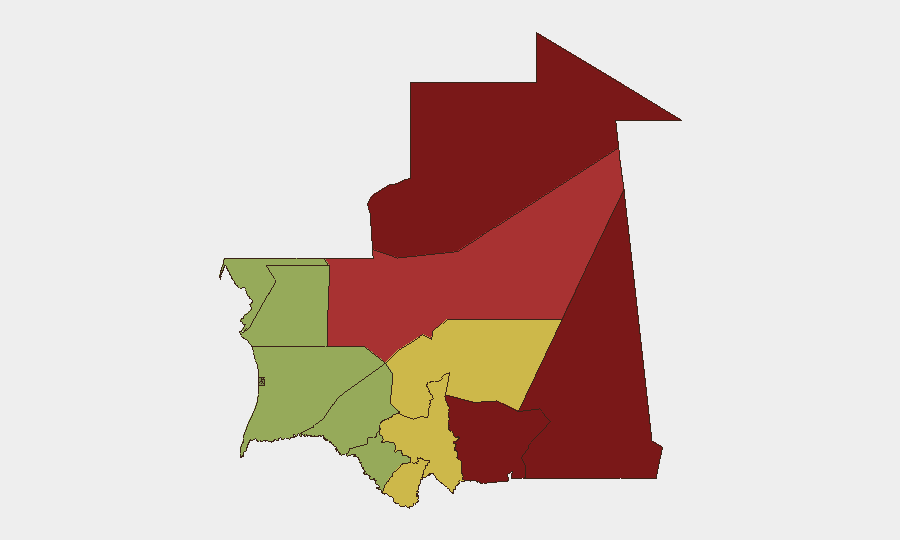
Tiris Zemmour (risk 95), Hodh Ech Chargui (85), and Hodh El Gharbi (80) dominate the sub-national ranking, reflecting persistent armed-group presence, border-region instability, and cross-border militant/trafficking networks in the eastern and northeastern hinterland. Adrar (78) and Tagant (68) face similar pressures. The capital Nouakchott and port zone Dakhlet Nouadhibou (45) are significantly lower-ranked but remain focal points for political tension, cyber-threat activity, and organized crime, creating dual urban-security exposure for corporate and official assets.
How GeoBit Would Assist
Teams with personnel or assets in Mauritania would prioritize AOI Monitoring & Early Warning on Tiris Zemmour, Hodh Ech Chargui, and Nouadhibou to detect militant activity and protest flashpoints in real time. Cyber threat intelligence and OSINT fusion would track the ongoing network intrusions affecting government and corporate systems. Network & Actor Analysis and Regime-Stability Search would flag factional tensions, court-ruling fallout, and opposition-figure targeting for escalation risk assessment.
7-Day Outlook
Political friction from the court rulings and alleged targeting of opposition figures is likely to generate localized protest activity in Nouakchott and Nouadhibou over the next week, with elevated security-force presence and potential confrontations. Cyber-threat activity is expected to remain sustained; organizations should assume heightened credential-harvesting and malware campaigns against corporate and government networks. No imminent shift in armed-group activity in the northeast is expected absent major political or external trigger.
Highest-Risk Areas — Ranked
| # | State / Region | Risk |
|---|---|---|
| 1 | Tiris Zemmour | 95 |
| 2 | Hodh Ech Chargui | 85 |
| 3 | Hodh El Gharbi | 80 |
| 4 | Adrar | 78 |
| 5 | Tagant | 68 |
| 6 | Guidimaka | 65 |
| 7 | Assaba | 62 |
| 8 | Gorgol | 58 |
| 9 | Trarza | 55 |
| 10 | Inchiri | 52 |
| 11 | Brakna | 48 |
| 12 | Dakhlet Nouadhibou | 45 |
Sources
Previous Daily Briefs
A new Mauritania brief is written every day — each with its own risk map and downloadable CSV. Here's the last week; use the calendar to go further back.
📅 Browse every day by calendar →
Highlighted days have a brief. Tap a day for that day's map & analysis, or “csv” for that day's dataset ($5).
Atlas — our AI intelligence desk — emails them this snapshot personally. Nothing else, no list.