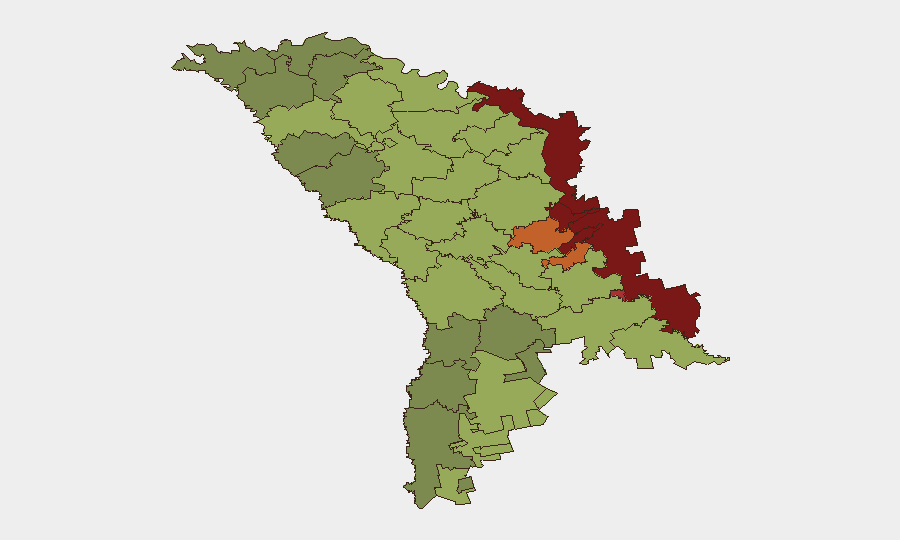
Situation Summary
Moldova entered a critical political transition on 3 July 2026 following Prime Minister Alexandru Munteanu's resignation, triggered by a corruption scandal at state-owned air-navigation company MoldATSA and broader governance failures. A caretaker cabinet with constitutionally limited powers now manages the state while President Maia Sandu nominates a successor within 1–3 weeks, creating a window of reduced institutional capacity and policy uncertainty. No imminent physical security threats or mass unrest are reported, but analysts assess elevated hybrid-threat and disinformation risk given Moldova's geopolitical position between Russia and the EU and its ongoing security vulnerabilities in Transnistria.
Key Developments
- Chișinău, national (3 July 2026): Prime Minister Alexandru Munteanu submitted his resignation, dissolving the entire government amid corruption allegations and political tension over EU accession preparedness. A caretaker cabinet assumes limited executive authority pending nomination of a new prime minister within 1–3 weeks.
- Chișinău, MoldATSA / air-traffic control (late June, intensified 3 July 2026): Corruption scandal involving irregular senior appointments, inflated compensation packages, and the hiring of a relative of President Sandu has escalated into a major public and institutional controversy, directly contributing to the government's fall and raising reputational and operational risk around Moldova's civil-aviation infrastructure.
- Chișinău, political commentary (3–4 July 2026): International media and regional analysts have characterized the resignation as a crisis moment for a "frontline state" facing Russian pressure and hybrid threats, emphasizing that internal political rifts could be exploited by external actors seeking to destabilize Moldova's EU accession path and security alignment.
- National security context (3–4 July 2026, reiterated in coverage): Analysis of the political transition has re-highlighted Moldova's strategic push to expel Russian peacekeepers from Transnistria and deny Russia a "second front" on Ukraine's flank, framing the caretaker period as a sensitive moment for that security agenda.
- Civil order and protest activity (last 48 hours): No credible reports of large-scale protests, riots, violent clashes, or terrorism linked to the government change; current risk is primarily political and institutional rather than street-level disruption.
Highest-Risk Areas
The Dniester Left Bank (risk 85), Dubăsari (82), and Bender (79) remain Moldova's most volatile sub-national zones, reflecting the frozen Transnistria conflict, Russian military presence, and weak state control. The government transition amplifies concern in these territories: a caretaker cabinet has reduced capacity to enforce sovereignty, monitor separatist actors, or respond to provocation. Secondary elevated-risk districts—Criuleni (75), Rezina (58), Taraclia (55), and Gagauzia (54)—lie along or near the Russian border or have significant Russian-aligned populations, increasing exposure to disinformation and external interference during political uncertainty. Chișinău itself (49) faces institutional and reputational risk from the corruption scandal but remains under greater state control than eastern and southern border regions.
How GeoBit Would Assist
Corporate security teams should deploy GeoBit's Intel Sweep and multi-language OSINT (Telegram, X, local media) to monitor political messaging, protest signals, and disinformation narratives targeting the caretaker government in real time. AOI Monitoring and Early Warning on Transnistria, Bender, Dubăsari, and border crossings will provide alerting if Russian actors move to exploit the political vacuum. Network & Actor Analysis linked to regime-stability and hybrid-threat signals will help distinguish routine political transition churn from coordinated destabilization campaigns.
7-Day Outlook
The caretaker government is expected to function under constitutional constraints while President Sandu nominates a successor within 1–3 weeks. Near-term risk is primarily political (policy delays, delayed investment decisions, reduced state capacity) rather than kinetic, but the window of reduced executive authority creates tactical opportunity for hybrid-threat operations and Russian-linked disinformation. Watch for any escalation in Transnistria or border incidents, and monitor EU/NATO statements on continuity of Moldova's accession process.
Highest-Risk Areas — Ranked
| # | State / Region | Risk |
|---|---|---|
| 1 | Administrative-Territorial Units of the Left Bank of the Dniester | 85 |
| 2 | Dubăsari | 82 |
| 3 | Bender | 79 |
| 4 | Criuleni | 75 |
| 5 | Rezina | 58 |
| 6 | Taraclia | 55 |
| 7 | Gagauzia | 54 |
| 8 | Căușeni | 53 |
| 9 | Soroca | 52 |
| 10 | Ștefan Vodă | 51 |
| 11 | Orhei | 50 |
| 12 | Chișinău | 49 |
Sources
Previous Daily Briefs
A new Moldova brief is written every day — each with its own risk map and downloadable CSV. Here's the last week; use the calendar to go further back.
📅 Browse every day by calendar →
Highlighted days have a brief. Tap a day for that day's map & analysis, or “csv” for that day's dataset ($5).
Atlas — our AI intelligence desk — emails them this snapshot personally. Nothing else, no list.