Situation Summary
Portugal remains a low-threat environment globally (ranked #86 with composite score 14), with no active conflict, mass civil unrest, or terrorism campaigns. The security landscape is stable but regionally uneven, with Portalegre district substantially elevated above baseline and Lisbon and Porto presenting moderate urban-specific risks typical of large capitals. No discrete security events have been recorded in the current tracking window; the threat profile reflects baseline criminal, infrastructure, and public-order vulnerabilities rather than acute incidents.
Key Developments
No discrete security incidents were confirmed in Portugal during the 24–48 hour window prior to 2026-07-01. Available open-source feeds and OSINT signals did not surface recent crime, protest, infrastructure failure, cyber incidents, or travel disruptions affecting the country. Duty-of-care teams should note that absence of reported incidents does not indicate zero risk; rather, Portugal's sub-national variance (noted below) suggests localized vulnerabilities that may not trigger media coverage until materialization.
Highest-Risk Areas
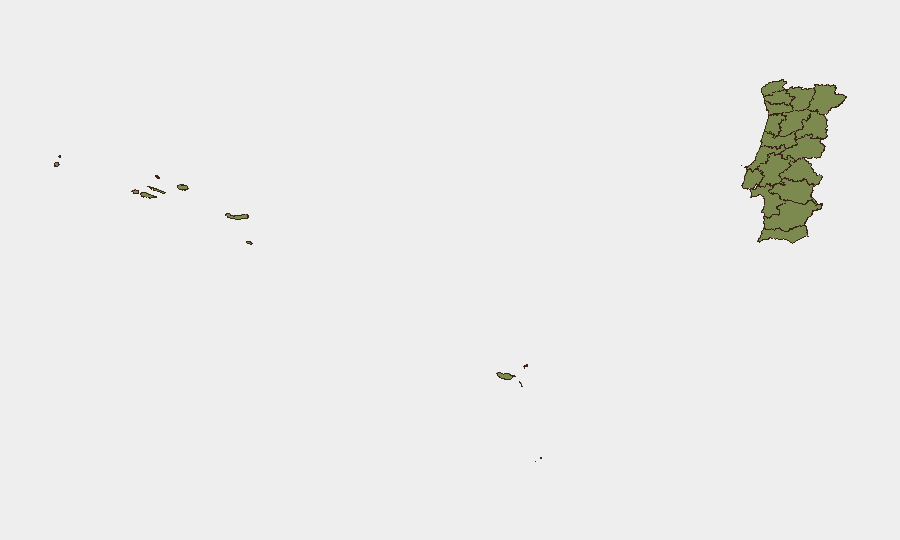
Portalegre district in eastern central Portugal carries a composite risk score of 31.8—roughly 5.7× the national baseline—and warrants priority monitoring. The elevated score likely reflects structural factors (limited law enforcement density, border-region smuggling routes, socioeconomic stress) rather than acute instability; however, the gap between Portalegre and all other districts is substantial. Lisbon and Porto, at 5.6 each, reflect typical metropolitan risks: petty crime, organized retail theft, occasional protest activity, and tourism-zone targeting. All other districts score below 2.2, indicating minimal tracked risk drivers.
Corporate teams with operations or personnel in Portalegre should implement enhanced supply-chain vetting, staff movement protocols, and liaison with local authorities; those in Lisbon and Porto should apply standard capital-city duty-of-care (awareness of crowded venues, transit hubs, and commercial districts).
How GeoBit Would Assist
AOI Monitoring & Early Warning would enable persistent watch on Portalegre, Lisbon, and Porto with threshold-based alerting for emerging crime clusters, protest activity, or infrastructure alerts. OSINT Fusion & Corroboration across web, social media, and open law-enforcement feeds would provide real-time contextualization of localized incidents before they escalate. Routing & Network Analysis would support security and logistics teams in identifying alternative transport corridors and venue access in high-risk districts, ensuring continuity of operations and staff safety.
7-Day Outlook
Portugal's security trajectory remains stable. Seasonal summer tourism influx (July peak) may increase petty crime and crowd-management incidents in Lisbon and Porto but is not expected to trigger systemic disruption. Portalegre's elevated baseline risk is structural and unlikely to shift sharply absent new border or criminal-network developments; routine monitoring and local intelligence partnership remain the appropriate response posture.
Highest-Risk Areas — Ranked
| # | State / Region | Risk |
|---|---|---|
| 1 | Portalegre | 31.8 |
| 2 | Porto | 5.6 |
| 3 | Lisbon | 5.6 |
| 4 | Setúbal | 2.2 |
| 5 | Madeira | 1.8 |
| 6 | Azores | 1.8 |
| 7 | Viana do Castelo | 1.8 |
| 8 | Braga | 1.8 |
| 9 | Vila Real | 1.8 |
| 10 | Bragança | 1.8 |
| 11 | Aveiro | 1.8 |
| 12 | Viseu | 1.8 |
Sources
Previous Daily Briefs
A new Portugal brief is written every day — each with its own risk map and downloadable CSV. Here's the last week; use the calendar to go further back.
📅 Browse every day by calendar →
Highlighted days have a brief. Tap a day for that day's map & analysis, or “csv” for that day's dataset ($5).