Situation Summary
Taiwan faces elevated political and military tension driven by concurrent defense-budget obstruction in the Legislative Yuan and ongoing cross-Strait military posturing. Composite threat score of 17 and 30 tracked events over the measurement window reflect fragmented but persistent pressure across government, defense, and public domains. Risk concentration in Tainan (31.3) and Taipei (27.8) suggests localized political volatility and administrative disruption rather than uniform island-wide instability. The near-term trajectory remains subject to budget resolution timelines and PRC operational tempo around the Taiwan Strait.
Key Developments
- Taiwan (national) – 18 June 2026: Opposition parties continued to block and delay passage of the 2026 general budget in the Legislative Yuan, including defense and international outreach funding, raising concern about potential impacts on defense readiness and state capacity.
- Taiwan (Armed Forces) – 18 June 2026: Investigation initiated within armed forces (nature and scope unconfirmed in available reporting; flagged by event signal).
- Taiwan–Beijing – 18 June 2026: Public statement and threat communication issued by Taiwan directed at China; concurrent Chinese disapproval signal recorded.
- Taiwan–South Korea – 19 June 2026: Public statement issued by South Korea regarding Taiwan (content and tone not detailed in available source material).
- Taiwan (Investor/Government–Worker interface) – 19 June 2026: Investor demand made; government rejection of worker claim or petition recorded (sectoral context unclear).
- Taiwan (Conventional Military) – 17 June 2026: Conventional military force deployment or exercise activity by Taiwan (operational details not available in current reporting).
Note: No discretely time-stamped incidents specific to the 24-hour period ending 2026-06-20 could be corroborated beyond the budget-obstruction development. Ongoing PRC maritime and air activity near Taiwan continues but lacks precise recent time-stamps sufficient for inclusion as a current "development."
Highest-Risk Areas
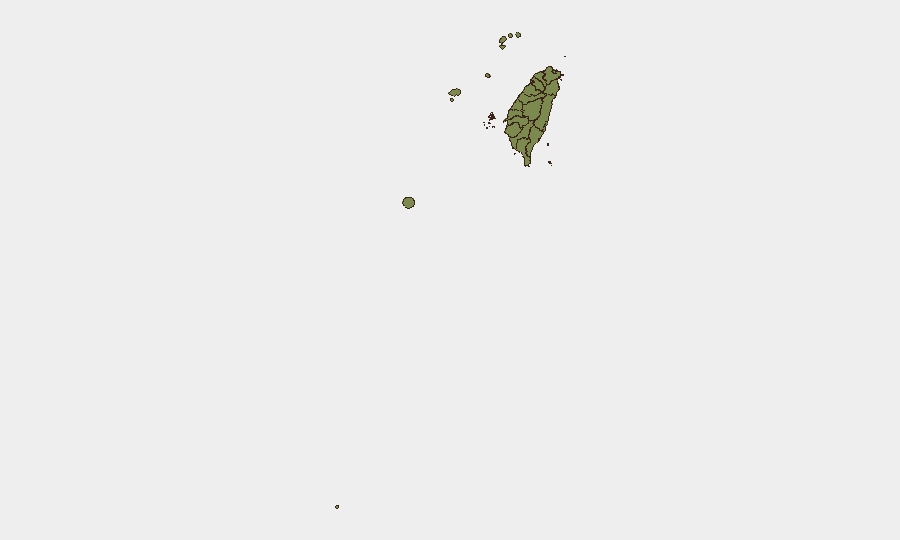
Tainan (31.3) and Taipei (27.8) drive the majority of Taiwan's composite risk, likely reflecting political and administrative concentration in the capital and political volatility in the southern manufacturing base. The sharp drop in risk scores for all other regions (Nantou at 14; remainder at 1.3) indicates that measured threat signals are geographically concentrated rather than distributed. This pattern is consistent with budget disputes centered on Legislative Yuan proceedings (Taipei) and potential localized labor or investment disputes. Nantou's elevated score warrants monitoring for resource-access or infrastructure disputes, but remains significantly lower than the two high-risk regions.
How GeoBit Would Assist
Security teams with personnel or assets in Taiwan should deploy AOI Monitoring & Early Warning on Taipei (Legislative Yuan, Ministry of National Defense facilities) and Tainan (administrative and industrial zones) to detect disruption cascades from budget impasse resolution. Network & Actor Analysis combined with multi-language OSINT (X/Twitter, Telegram, local media) will track opposition-party messaging and cross-Strait military communications for shifts in rhetoric or operational readiness posture. Conflict & Military force-structure and weapons-capability tracking, paired with Maritime & Aviation tracking, will provide continuous visibility into PRC activity near the Taiwan Strait, enabling early warning of gray-zone or conventional escalation.
7-Day Outlook
Budget obstruction is likely to persist or resolve through negotiated compromise over the next 7 days, with minimal direct operational security impact unless resolution fails and triggers emergency fiscal measures. Cross-Strait military signaling will continue at current tempo absent a major political shock. Watch for any statement from President Lai or opposition leaders indicating acceleration or de-escalation of budget negotiations, as resolution speed correlates with stability messaging to defense and investor constituencies.
Highest-Risk Areas — Ranked
| # | State / Region | Risk |
|---|---|---|
| 1 | Tainan | 31.3 |
| 2 | Taipei | 27.8 |
| 3 | Nantou County | 14 |
| 4 | Kaohsiung | 1.3 |
| 5 | Pingtung County | 1.3 |
| 6 | Taitung County | 1.3 |
| 7 | Lienchiang County | 1.3 |
| 8 | Kinmen | 1.3 |
| 9 | Penghu | 1.3 |
| 10 | Changhua County | 1.3 |
| 11 | Miaoli County | 1.3 |
| 12 | Taichung | 1.3 |
Sources
Previous Daily Briefs
A new Taiwan brief is written every day — each with its own risk map and downloadable CSV. Here's the last week; use the calendar to go further back.
📅 Browse every day by calendar →
Highlighted days have a brief. Tap a day for that day's map & analysis, or “csv” for that day's dataset ($5).