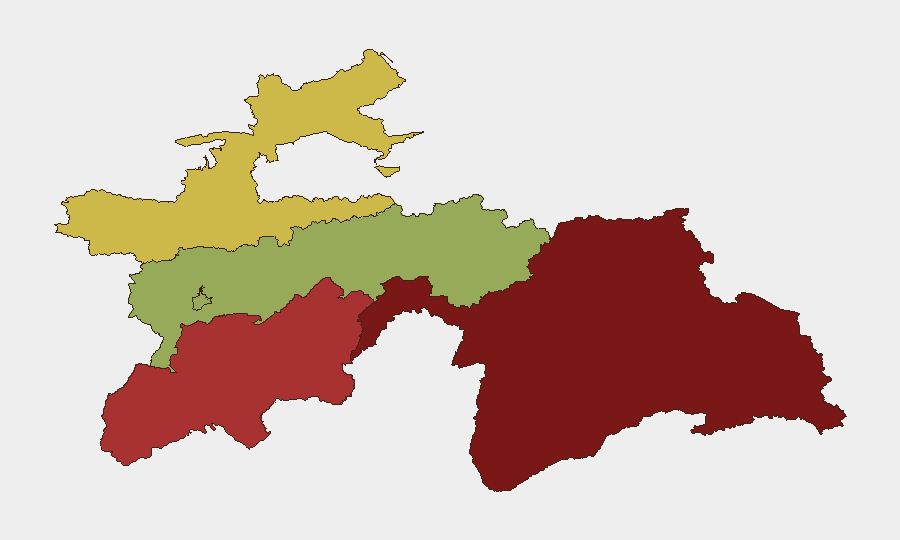
Situation Summary
Tajikistan remains at a relatively low global threat ranking (composite score 14) with no discrete security events recorded in the current monitoring window. However, sub-national risk is highly concentrated: the Gorno-Badakhshan Autonomous Region presents substantially elevated danger (risk 92), followed by Khatlon and Sughd regions. The security picture reflects persistent geopolitical fragmentation and border tensions rather than acute destabilization, with risk inversely correlated to government control and proximity to disputed territories.
Key Developments
No discrete security events have been recorded in the last 24–48 hours. Web research conducted on 22 June 2026 returned no verified Tajikistan-specific incident reporting from open sources. Duty-of-care teams should note that absence of event signals does not indicate absence of underlying risk; rather, baseline conditions in high-risk regions (particularly Gorno-Badakhshan and Khatlon) remain tense and subject to rapid escalation without advance warning.
Highest-Risk Areas
Gorno-Badakhshan Autonomous Region dominates the risk profile at a score of 92—nearly double that of Khatlon (78) and well above the national average. This reflects its geography (remote, mountainous, bordering Afghanistan and Kyrgyzstan), limited state presence, and history of militant activity and trafficking networks. Khatlon and Sughd regions (78 and 65 respectively) present secondary but material risk, driven by border instability, ethnic tensions, and porous boundaries. Dushanbe (42) and Districts of Republican Subordination (58) carry notably lower risk, indicating that state capacity and security infrastructure concentrate in the capital and central administration areas.
How GeoBit Would Assist
Security teams operating in or with personnel in Tajikistan should deploy AOI Monitoring & Early Warning on Gorno-Badakhshan, Khatlon, and Sughd—persistent watch with alert thresholds to catch emerging incidents before they scale. Multi-language OSINT (news, Telegram, X, local radio) would capture sub-national reporting often missed by English-language feeds. Network & Actor Analysis and entity extraction would map militant, trafficking, and opposition networks operating across borders, informing movement planning and personnel vetting. GIS & Spatial Analysis combined with alternative route planning tools help operations teams identify safe transit corridors and backup logistical networks.
7-Day Outlook
Near-term trajectory remains stable but fragile. Absent new border incidents or spillover from Afghanistan, risk levels should hold. However, the concentration of threat in remote, porous regions—combined with minimal event granularity in open-source intelligence—means escalation could occur with limited advance notice. Teams should assume seasonal patterns (summer travel, cross-border activity) will sustain baseline tension, particularly in Gorno-Badakhshan.
ANALYST NOTE: This brief reflects available intelligence as of 22 June 2026. Web research for last-24–48-hour events did not yield Tajikistan-specific incident reporting. For real-time alerting and deeper regional intelligence fusion, activate persistent AOI monitoring on highest-risk administrative divisions. GeoBit's Intel Sweep and early-warning capabilities are calibrated to flag sub-national escalation in advance of mainstream media coverage.
Highest-Risk Areas — Ranked
| # | State / Region | Risk |
|---|---|---|
| 1 | Gorno-Badakhshan Autonomous Region | 92 |
| 2 | Khatlon Region | 78 |
| 3 | Sughd Region | 65 |
| 4 | Districts of Republican Subordination | 58 |
| 5 | Dushanbe | 42 |
Previous Daily Briefs
A new Tajikistan brief is written every day — each with its own risk map and downloadable CSV. Here's the last week; use the calendar to go further back.
📅 Browse every day by calendar →
Highlighted days have a brief. Tap a day for that day's map & analysis, or “csv” for that day's dataset ($5).