Situation Summary
Tunisia remains a low-to-moderate security environment globally (rank #107, composite threat score 7), with 33 tracked events in the monitoring period. The country faces dispersed but measurable civil unrest and public demonstrations, most acute in the southern desert governorate of Kébili and the capital Tunis. Recent signals indicate anti-immigrant sentiment and diplomatic tensions involving Chinese nationals; concurrent flood impacts in rural areas add infrastructure stress. Overall trajectory is stable but requires continued monitoring of localized protest activity and cross-border dynamics.
Key Developments
- 2026-06-21 · Tunis (anti-immigrant demonstration): Public rally opposing immigrant populations reported in the capital; scale, organizers, and specific locations not yet confirmed in open sources.
- 2026-06-20 · Tunis (Chinese national protest): Demonstration directed at Chinese nationals or China-related interests noted; context and participant numbers pending verification.
- 2026-06-20 · Multiple locations (public statements): Unspecified public statements from Tunisia authorities or organized groups; substantive content and geographic focus not clarified in available reporting.
- 2026-06-20 · Tunisia (disapproval signal): Broad signal of public disapproval registered; specific grievance, location, and scale remain unclear from current feeds.
- Recent · Rural/flood-affected areas: Flooding reported in Tunisia (event ID 1103945); impact on infrastructure, population displacement, and service disruption under assessment. Likely to strain local governance and humanitarian response capacity, particularly in already-stressed southern regions.
Note: Open web search conducted in the last 24 hours did not yield time-stamped, verifiable incident reports beyond GeoBit platform signals. Confirmation and detail enhancement pending escalation to human-source or regional media verification.
Highest-Risk Areas
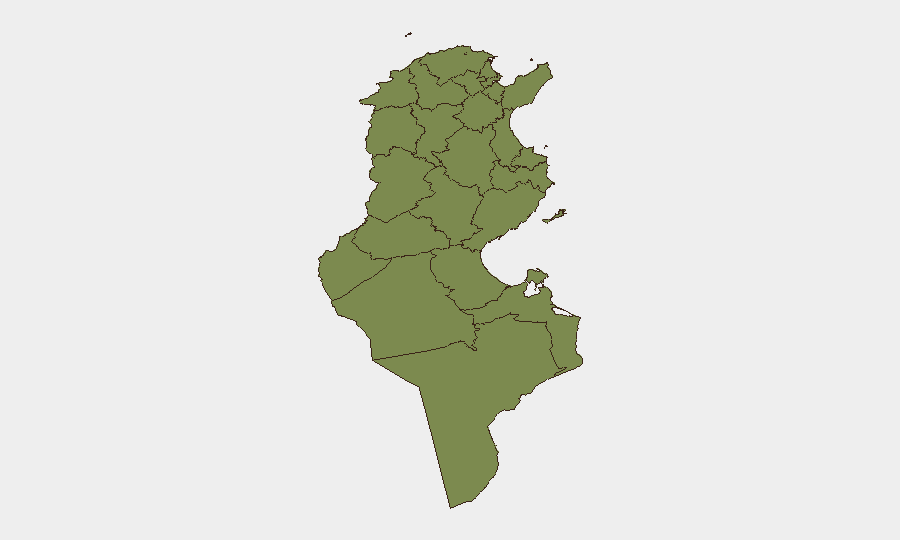
Kébili (composite risk 31.5) and Tunis (27.2) drive the country's threat profile. Kébili's elevated score reflects chronic border permeability, sparse state capacity in the southern Saharan region, and historical trafficking and militant presence; Tunis concentrates political speech, demonstrations, and dense exposure. Sfax (risk 10) merits secondary attention as a major economic hub and transit node. The remaining nine governorates register minimal individual scores (1.5 each), suggesting risk is highly concentrated in two or three urban/border zones rather than dispersed nationwide.
How GeoBit Would Assist
Persistent AOI Monitoring & Early Warning on Kébili and Tunis neighborhoods would provide real-time alerting for demonstrations, security incidents, and infrastructure disruptions before they escalate. Concurrent Intel Sweep and multi-language social-media OSINT (X/Twitter, Telegram, Arabic-language forums) would capture organizer intent, crowd sentiment, and emerging grievances faster than open web search alone. Network & Actor Analysis on protest leadership and Sentiment & Temporal Analysis on public mood would enable duty-of-care teams to refine evacuation, movement, and site-security decisions with forward warning.
7-Day Outlook
Near-term risk is expected to remain in the low-to-moderate band, with scattered demonstrations likely to continue in Tunis and possibly Sfax in response to economic or immigration policy. Kébili's southern border dynamics and post-flood recovery logistics warrant close watch. No indicators of state instability, large-scale violence, or international military intervention are present; however, cumulative strain from flood damage, youth unemployment, and anti-immigrant rhetoric could drive further localized unrest by mid-July if not addressed.
Highest-Risk Areas — Ranked
| # | State / Region | Risk |
|---|---|---|
| 1 | Kébili | 31.5 |
| 2 | Tunis | 27.2 |
| 3 | Sfax | 10 |
| 4 | Tataouine | 1.5 |
| 5 | Nabeul | 1.5 |
| 6 | Monastir | 1.5 |
| 7 | Mahdia | 1.5 |
| 8 | Médenine | 1.5 |
| 9 | Jendouba | 1.5 |
| 10 | Béja | 1.5 |
| 11 | Bizerte | 1.5 |
| 12 | Ariana | 1.5 |
Sources
Previous Daily Briefs
A new Tunisia brief is written every day — each with its own risk map and downloadable CSV. Here's the last week; use the calendar to go further back.
📅 Browse every day by calendar →
Highlighted days have a brief. Tap a day for that day's map & analysis, or “csv” for that day's dataset ($5).