Situation Summary
The UAE remains operationally stable with no reported attacks, civil unrest, or internal political crises in the last 24–48 hours. However, the country faces sustained regional security pressure stemming from the ongoing US–Iran conflict, manifested in partial airspace closures, active air-defense operations, and ongoing diplomatic and investigative responses to prior incidents. Risk to corporate operations and travellers is currently contained but elevated relative to baseline, driven by logistics disruption and precautionary measures rather than direct threats to population centers or critical infrastructure on UAE soil.
Key Developments
- Dubai & UAE national airspace (27 July, ongoing): Civil aviation authorities maintain partial airspace closures as a precautionary measure in response to regional security threats; airlines continue contingency planning for flight cancellations, rerouting, and delays affecting passenger and cargo operations.
- Dubai (recent, within 24–48h reference window): Government of Dubai Media Office reported debris from an intercepted aerial threat, with no injuries and no operational impact on Dubai International Airport; statement denied social-media rumors of airport incidents, indicating active air-defense interception but limited ground-level consequences.
- UAE maritime approaches & territorial airspace (ongoing, referenced in latest advisories): UKMTO reported a vessel struck by an unknown projectile 17 nautical miles east of Dibba; broader reporting indicates recent Iranian missile and drone activity targeting UAE waters and airspace, underpinning current heightened security posture.
- Abu Dhabi & UAE government (late July, investigative update): UAE defense ministry and IAEA confirmed that drones targeting an electrical generator near Barakah Nuclear Power Plant on 17 May originated from Iraqi territory; ongoing investigation and international nuclear-safety review continue to inform infrastructure-security assessments.
- UAE travel advisories (25–27 July, circulating in last 24–48h): Government and media channels reiterated that the country remains safe while new travel advisories recommend passengers monitor airline communications and official notices due to possible flight-schedule disruptions linked to regional escalation.
Highest-Risk Areas
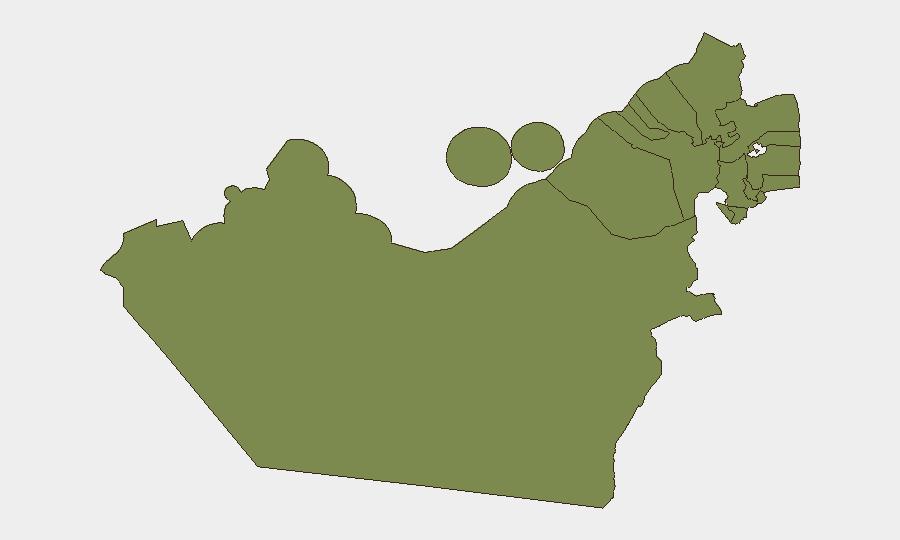
Dubai's composite risk score (31.3) is notably elevated relative to all other emirates, reflecting its role as the primary international aviation and logistics hub and its greater exposure to regional air-defense activity and flight disruptions. All other emirates register minimal differential risk (1.3 each), indicating that the threat landscape is geographically concentrated rather than dispersed; Abu Dhabi's nuclear and energy infrastructure and maritime approaches warrant monitoring, but daily security posture across the northern emirates remains low-intensity. Risk is primarily operational and logistical rather than kinetic.
How GeoBit Would Assist
Teams should deploy AOI Monitoring & Early Warning on Dubai and Abu Dhabi airports, airspace sectors, and maritime zones to track real-time flight disruptions, air-defense events, and vessel incidents. Aviation & Maritime Tracking combined with Intel Sweep across regional event feeds, X/Twitter OSINT, and official UAE government channels will provide early visibility of airspace reopenings, new flight restrictions, or escalated regional activity. Routing & Network Analysis capabilities enable corporate security to model alternative travel and logistics paths for personnel and cargo, reducing exposure to disrupted corridors.
7-Day Outlook
Partial airspace restrictions are likely to persist or ease incrementally as regional tensions fluctuate; no near-term resolution of the US–Iran conflict is evident from open-source reporting. Corporate operations should anticipate continued flight delays and route changes affecting Dubai and Abu Dhabi hubs, with heightened air-defense vigilance remaining the baseline security posture. Direct threat to personnel or assets on UAE soil remains low, but logistics resilience and travel-contingency planning are operationally essential.
Highest-Risk Areas — Ranked
| # | State / Region | Risk |
|---|---|---|
| 1 | Dubai | 31.3 |
| 2 | Sharjah Emirate | 1.3 |
| 3 | Ajman Emirate | 1.3 |
| 4 | Ras al-Khaimah | 1.3 |
| 5 | Fujairah Emirate | 1.3 |
| 6 | Umm al-Quwain | 1.3 |
| 7 | Abu Dhabi Emirate | 1.3 |
Sources
Previous Daily Briefs
A new United Arab Emirates brief is written every day — each with its own risk map and downloadable CSV. Here's the last week; use the calendar to go further back.
📅 Browse every day by calendar →
Highlighted days have a brief. Tap a day for that day's map & analysis, or “csv” for that day's dataset ($5).
Atlas — our AI intelligence desk — emails them this snapshot personally. Nothing else, no list.