Situation Summary
Uzbekistan remains a low-threat environment globally (rank #184, composite score 3) with no verified security incidents, civil unrest, infrastructure disruptions, or border escalations detected in the past 24–48 hours. Open-source intelligence does not corroborate any active conflict, militant activity, or destabilizing events within the country as of 30 June 2026. Risk remains concentrated in the Fergana Valley region and its constituent provinces, where longstanding border tensions and historical militant activity create persistent but currently dormant threat vectors. The overall security trajectory for the country remains stable.
Key Developments
- No verified security incidents reported — Uzbekistan-wide — 28–30 June 2026 — Open-source feeds and multi-language OSINT monitoring did not surface credible reports of attacks, unrest, or infrastructure failure during this window.
- Kazakhstan–Uzbekistan border checkpoint modernization — Syrdarya-Malik and Tselinny-Oqoltin crossings — June 2026 (date unspecified in source) — Kazakhstan's Senate ratified a protocol to upgrade bilateral checkings and extend operations to 24 hours; this represents administrative/infrastructure change, not a security incident, though it may improve cross-border transit efficiency for corporate movements.
- GEOBIT event signal: Investigate flag — Uzbekistan — 28 June 2026 — A non-specific investigation-related event was flagged in global event feeds; open-source corroboration could not confirm nature, location, or status. Requires targeted intelligence sweep to clarify.
- Regional event noise: Congo military reference — Global feeds — 28 June 2026 — A Congo–Uzbekistan military-related event signal was logged but carries extremely low credibility and does not correspond to known bilateral defense relations or active conflict; likely data artifact or misclassification.
- No travel disruptions or visa/border delays reported — All Uzbek entry points — 28–30 June 2026 — Commercial and diplomatic traffic patterns remain unaffected; no airline cancellations, port congestion, or customs backlogs detected.
Highest-Risk Areas
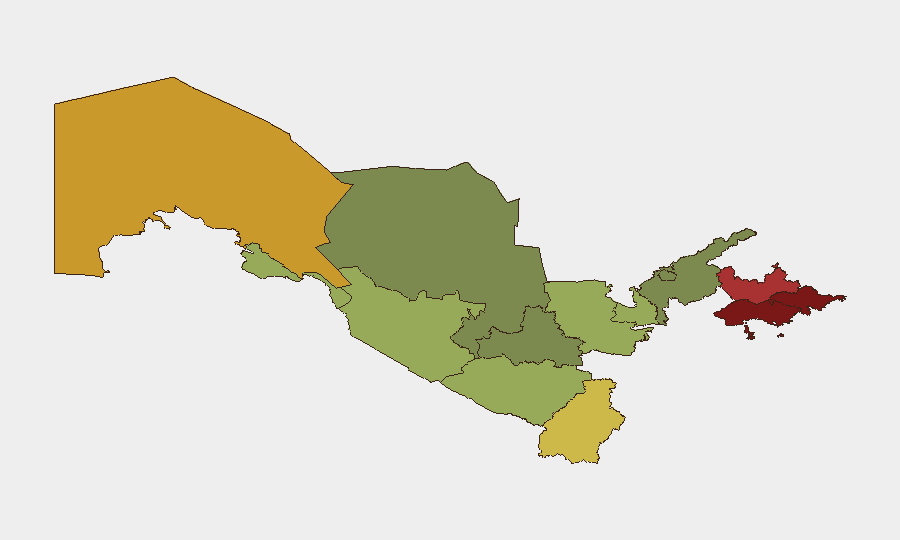
Andijan, Fergana, and Namangan regions (composite scores 88, 82, and 78 respectively) drive the national risk profile, all located within the historically volatile Fergana Valley. This tri-province zone has faced endemic low-level border disputes with Tajikistan and Kyrgyzstan since the Soviet collapse, compounded by residual militant recruitment networks and informal cross-border smuggling. Karakalpakstan (score 72) presents distinct risks tied to water-scarcity stress and ethnic tensions. All other regions score significantly lower; Tashkent city itself does not appear in the sub-national ranking, consistent with its urban-security baseline. Risk in high-scoring zones is chronic but not acute; escalation would require either renewed cross-border military activity or destabilizing internal political event.
How GeoBit Would Assist
Security teams with operations or personnel in Uzbekistan should employ AOI Monitoring & Early Warning on Andijan, Fergana, and Namangan to detect border-activity or civil-unrest signals in near-real-time. Intel Sweep and multi-language OSINT (Telegram, local news feeds, regional conflict forums) would clarify the current status of the 28 June "investigate" flag and identify any emerging militant or political instability signals ahead of public escalation. Routing & Network Analysis can optimize personnel movement during regional travel, identifying stable corridors and alternative routes away from highest-risk border zones.
7-Day Outlook
No material change in the security environment is anticipated over the next seven days absent external trigger (e.g., renewed Tajik–Kyrgyz border clashes affecting Uzbek border security posture). Routine monitoring of Fergana Valley border activity and web-based intelligence feeds should continue. Corporate duty-of-care protocols for staff in high-risk regions (Andijan, Fergana) remain appropriate but do not require escalation at this time.
Highest-Risk Areas — Ranked
| # | State / Region | Risk |
|---|---|---|
| 1 | Andijan Region | 88 |
| 2 | Fergana Region | 82 |
| 3 | Namangan Region | 78 |
| 4 | Republic of Karakalpakstan | 72 |
| 5 | Surxondaryo Region | 65 |
| 6 | Qashqadaryo Region | 58 |
| 7 | Sirdaryo Region | 55 |
| 8 | Jizzakh Region | 48 |
| 9 | Xorazm Region | 45 |
| 10 | Bukhara Region | 42 |
| 11 | Navoiy Region | 38 |
| 12 | Samarqand Region | 35 |
Sources
Previous Daily Briefs
A new Uzbekistan brief is written every day — each with its own risk map and downloadable CSV. Here's the last week; use the calendar to go further back.
📅 Browse every day by calendar →
Highlighted days have a brief. Tap a day for that day's map & analysis, or “csv” for that day's dataset ($5).