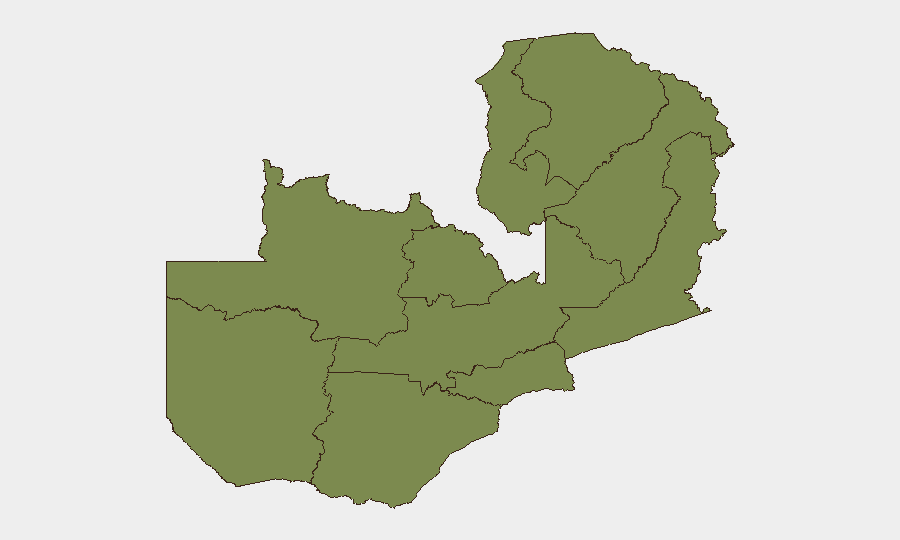
Situation Summary
Zambia remains a stable, low-threat environment globally ranked #131 on the composite threat index (score 7). No significant security incidents, civil unrest, infrastructure disruption, or travel-risk events have been reliably reported in the last 24–48 hours across verified open-source channels. The overall security posture is consistent with recent historical patterns, with localized risk concentrated in the Northern Province.
Key Developments
- No verified security incidents reported in the last 24–48 hours. Major international and regional news outlets, local social media, and travel-advisory services have not flagged protests, violence, political instability, infrastructure disruption, or notable crime events in Zambia as of 2 July 2026.
- Northern Province remains the primary geographic risk driver, with a composite risk score of 31.8—approximately 18 times higher than all other provinces. The specific drivers of this elevated score warrant direct intelligence collection and area-of-interest monitoring to establish current threat vectors.
- Nine of ten provinces report uniform, low risk (1.8 composite score), indicating either stable security conditions or limited incident reporting in those regions. Lusaka Province, the capital and economic hub, is among the lowest-risk zones.
Highest-Risk Areas
Northern Province is the sole significant geographic concentration of risk in Zambia, with a composite score substantially above the national average and all other provinces. The specific nature of threats driving this elevation—whether transnational crime, cross-border activity, political tension, resource-conflict dynamics, or limited reporting infrastructure—requires targeted intelligence collection to clarify and assess impact on corporate operations or personnel movement. All remaining provinces show parity at low-risk levels, suggesting either stable conditions or uniform under-reporting. Security teams operating or transiting in Northern Province should prioritize AOI monitoring and real-time incident alerting; operations in Lusaka, Copperbelt (mining-sector hubs), and Southern Province face materially lower direct security risk based on current data.
How GeoBit Would Assist
AOI Monitoring & Early Warning should be established over Northern Province's major population centers and transport corridors to enable real-time alerting on emerging incidents, civil unrest, or crime clusters; this provides duty-of-care protection for personnel and assets in high-risk zones. Multi-language OSINT fusion—including local news, radio SIGINT, X/Telegram monitoring, and sentiment analysis—would strengthen confidence in the current stable assessment and flag early shifts in stability. Routing & Network Analysis can generate real-time alternative journey planning for personnel transiting Northern Province or cross-border zones, reducing exposure to unpredictable risk areas.
7-Day Outlook
No major escalation vectors are evident in the current 24–48 hour window, and Zambia's baseline stability is expected to persist. Continued monitoring of Northern Province for emerging political, resource-conflict, or transnational crime signals is warranted given the province's persistent risk elevation relative to the rest of the country. A shift in the risk profile would likely be preceded by localized incidents (roadblocks, strike activity, criminal organization activity) detectable via OSINT and AOI alerting.
Highest-Risk Areas — Ranked
| # | State / Region | Risk |
|---|---|---|
| 1 | Northern Province | 31.8 |
| 2 | North-Western Province | 1.8 |
| 3 | Western Province | 1.8 |
| 4 | Eastern Province | 1.8 |
| 5 | Muchinga Province | 1.8 |
| 6 | Luapula Province | 1.8 |
| 7 | Copperbelt Province | 1.8 |
| 8 | Southern Province | 1.8 |
| 9 | Central Province | 1.8 |
| 10 | Lusaka Province | 1.8 |
Sources
Previous Daily Briefs
A new Zambia brief is written every day — each with its own risk map and downloadable CSV. Here's the last week; use the calendar to go further back.
📅 Browse every day by calendar →
Highlighted days have a brief. Tap a day for that day's map & analysis, or “csv” for that day's dataset ($5).