Situation Summary
Armenia faces elevated political tension following the 17 June finalization of parliamentary election results, in which the ruling Civil Contract party secured a working majority but fell short of constitutional supermajority, triggering formal rejection by six opposition blocs and allegations of systemic electoral violations. Simultaneous escalation of criminal proceedings against opposition figures—including former President Robert Kocharyan and businessman Gagik Tsarukyan—combined with confrontational rhetoric from PM Pashinyan signals a widening elite-level political crisis and heightened risk of street-level mobilization in Yerevan. Military activity signals detected on 15–16 June and an emerging cyber-fraud threat add tactical complexity to an already volatile security picture.
Key Developments
- 17 June, Yerevan (National Assembly): Central Election Commission confirmed final parliamentary results; six opposition coalitions formally rejected the outcome, alleging "systemic and organized violations" and denying legitimacy of the 7 June vote.[1][4]
- 17 June, Yerevan: Prime Minister Pashinyan delivered a confrontational parliamentary address targeting opposition figures and oligarchs as national-security threats and endorsed a bill to restrict voting rights to citizens present in Armenia for ≥183 days in the preceding year, escalating political polarization.[1]
- 17 June, Yerevan (and nationwide): Authorities initiated or intensified criminal cases against Kocharyan (Central Electoral Commission-authorized) and Tsarukyan (tax investigations, with reported travel restrictions), signaling legal pressure on top opposition figures and raising risk of elite confrontation or protest mobilization.[1][5]
- 15–16 June, Yerevan and rural areas: Multiple signals of conventional military force and small-arms combat involving army units and armed civilians recorded; specific triggers and scale remain unclear but indicate tactical-level instability alongside political crisis.[Event signals, GEOBIT platform]
- 17 June, nationwide: ArmInfo reported emergence of an AI-enabled fraud scheme in which scammers clone victims' appearance and voice to deceive relatives; reflects growing cyber-crime and financial-fraud risk to individual citizens and corporate personnel.[7]
- 17 June, Paris/Yerevan: Armenian Defense Minister Papikyan met French counterpart Vautrin to review bilateral defense cooperation and discuss regional security; reflects ongoing re-alignment of Armenia's external partnerships amid internal political strain.[3]
- 17 June, social media (unverified): A widely shared post claimed imminent US troop deployment to Armenia and Armenian exit from CSTO by early 2026; no confirmation from official Armenian, US, or major news sources—treat as unverified rumor with potential for fueling conspiracy narratives.[6]
Highest-Risk Areas
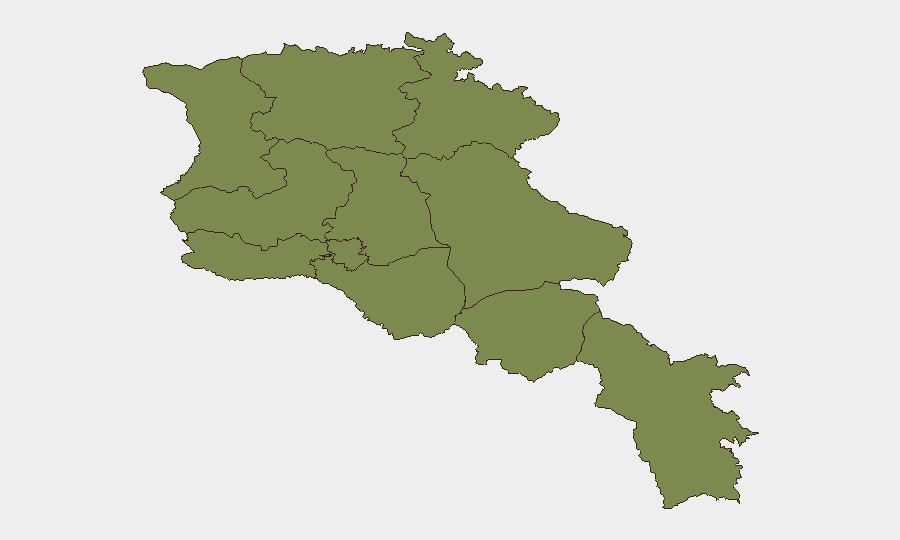
Yerevan dominates the risk landscape (composite score 31.5), driven by concentration of government institutions, opposition headquarters, and street-protest potential in the capital following the election crisis and arrest/detention signals. Ararat Province (score 13) represents a secondary concern, likely reflecting border proximity and historical flashpoints. All other provinces score substantially lower (1.5–2.5), indicating that immediate threats are concentrated in and around the capital and major urban centers; however, the rural military-activity signals of 15–16 June warrant monitoring of Tavush and Syunik provinces given their proximity to active military zones and Azerbaijan.
How GeoBit Would Assist
Election Monitoring & OSINT Fusion capabilities would track ongoing opposition organizational activity, street-level sentiment, and regime communications to forecast protest timing and scale. AOI Monitoring & Early Warning on Yerevan's central districts and opposition party offices would provide real-time alerts on gatherings or security-force activity. Entity Extraction & Network Analysis would map relationships between Kocharyan, Tsarukyan, and allied figures to anticipate elite fractures or coalition-building. Cyber-threat & Fraud tracking would help corporate teams identify and defend against the reported AI-cloning scam.
7-Day Outlook
The combination of finalized election results, opposition rejection, and legal pressure on top figures suggests high probability of street protests in Yerevan within 7 days, particularly around National Assembly or key opposition venues. Simultaneous military-activity signals and unverified rumors of foreign-troop deployment create secondary risk of escalation or misinformation-driven civil unrest. Corporate security teams should expect increased checkpoint activity, potential road disruptions, and heightened scrutiny of foreign nationals in the capital.
Highest-Risk Areas — Ranked
| # | State / Region | Risk |
|---|---|---|
| 1 | Yerevan | 31.5 |
| 2 | Ararat Province | 13 |
| 3 | Syunik Province | 2.5 |
| 4 | Lori Province | 1.5 |
| 5 | Tavush Province | 1.5 |
| 6 | Kotayk Province | 1.5 |
| 7 | Gegharkunik Province | 1.5 |
| 8 | Vayots Dzor Province | 1.5 |
| 9 | Shirak Province | 1.5 |
| 10 | Aragatsotn Province | 1.5 |
| 11 | Armavir Province | 1.5 |
Sources
Previous Daily Briefs
A new Armenia brief is written every day — each with its own risk map and downloadable CSV. Here's the last week; use the calendar to go further back.
📅 Browse every day by calendar →
Highlighted days have a brief. Tap a day for that day's map & analysis, or “csv” for that day's dataset ($5).