Situation Summary
Azerbaijan faces elevated regional security exposure rather than acute domestic threat. The primary drivers are ongoing Iran–Azerbaijan border tensions, international diplomatic controversy over alleged Israeli operations from Azerbaijani territory during the Iran conflict, and emerging concerns about use of Azerbaijani territory by foreign non-state actors (Khalistan networks). No corroborated reports of large-scale domestic violence, protest, or infrastructure attack within Azerbaijan itself have emerged in the last 24–48 hours; risk remains concentrated in border districts and tied to regional conflict dynamics rather than internal instability.
Key Developments
- Baku, 9–10 June – Azerbaijan's Foreign Ministry issued a public warning about "rising global security tensions" and signaled active monitoring of the international security environment, indicating heightened state-level alert posture amid regional conflicts.
- Southern Azerbaijan border region, reported 9–10 June – CNN reported allegations that Israeli special forces and intelligence units operated from multiple locations in southern Azerbaijan near the Iran border during the Iran war, conducting surveillance and drone activity. Azerbaijani officials and media have disputed the report; the allegation itself is driving current diplomatic controversy and reputational risk.
- Baku and diaspora networks, 9–10 June – Indian media highlighted Azerbaijan as an emerging hub for Khalistan-linked coordination, citing intelligence concerns about anti-India networks using Azerbaijani territory for information operations and logistics. No specific violent incident reported.
- Tokyo, 10 June – Azerbaijani Foreign Minister Jeyhun Bayramov met Japanese Foreign Minister Toshimitsu Motegi to discuss maritime security cooperation, reflecting Azerbaijan's engagement on regional energy and transport route security amid broader conflict.
- NATO HQ, Brussels, 10 June – Mission of Azerbaijan to NATO participated in a NATO Charity Bazaar, underscoring Azerbaijan's active alignment with NATO partnership frameworks during a period of elevated regional tension.
- Regional travel advisory, 9–10 June – Azerbaijani authorities circulated updated guidance urging citizens and residents to avoid conflict zones and carefully assess security risks in light of the Iran war and surrounding regional instability.
Highest-Risk Areas
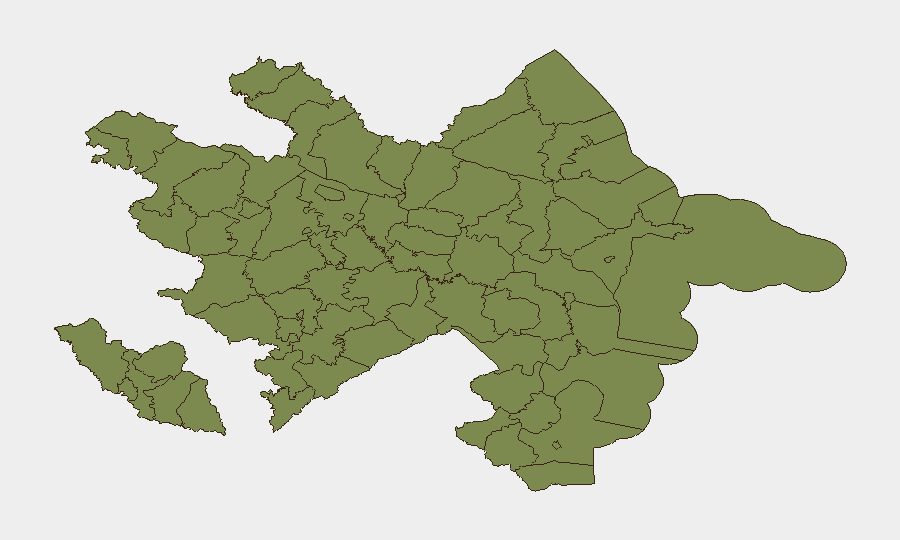
Ujar and Agdere districts (risk scores 31.3 and 23.8, respectively) dominate the sub-national ranking, reflecting their proximity to active or disputed border zones and history of conflict. Baku (14.8) carries moderate risk tied to its status as the capital, energy hub, and diplomatic center; risk there is predominantly geopolitical rather than rooted in domestic unrest. All other tracked regions score 1.3, indicating minimal localized threat. The concentration of risk in border districts reflects Azerbaijan's exposure to Iran and Armenia-linked tensions rather than internal security breakdown.
How GeoBit Would Assist
Corporate security teams should deploy AOI Monitoring & Early Warning on Ujar and Agdere districts to detect movement, infrastructure changes, or escalation in real time. Intel Sweep and X/Twitter OSINT with multi-language capability will track emerging Khalistan-network or Israeli-operation allegations and Azerbaijani state response, supporting reputation and sanctions-risk assessment. Border & Disputed-Territory Search and GIS & Spatial Analysis will enable alternative routing and journey planning for personnel traveling to or within southern Azerbaijan, with persistent alerting on cross-border incident activity.
7-Day Outlook
Regional diplomatic tension is likely to remain elevated, with ongoing controversy over alleged foreign military use of Azerbaijani territory and continued Iran border volatility. No significant escalation in domestic unrest or terror activity is anticipated in the coming week; however, personnel in Ujar, Agdere, and southern border areas should maintain heightened situational awareness and adhere to corporate travel protocols. Monitoring of official Azerbaijani MFA statements and border-zone activity will remain critical for early warning.
Highest-Risk Areas — Ranked
| # | State / Region | Risk |
|---|---|---|
| 1 | Ujar District | 31.3 |
| 2 | Agdere District | 23.8 |
| 3 | Baku City | 14.8 |
| 4 | Sadarak District | 1.3 |
| 5 | Qazakh District | 1.3 |
| 6 | Sharur District | 1.3 |
| 7 | Yevlakh District | 1.3 |
| 8 | Kangarli District | 1.3 |
| 9 | Nakhchivan Autonomous Republic | 1.3 |
| 10 | Aghstafa District | 1.3 |
| 11 | Tovuz District | 1.3 |
| 12 | Qakh District | 1.3 |
Sources
Previous Daily Briefs
A new Azerbaijan brief is written every day — each with its own risk map and downloadable CSV. Here's the last week; use the calendar to go further back.
📅 Browse every day by calendar →
Highlighted days have a brief. Tap a day for that day's map & analysis, or “csv” for that day's dataset ($5).