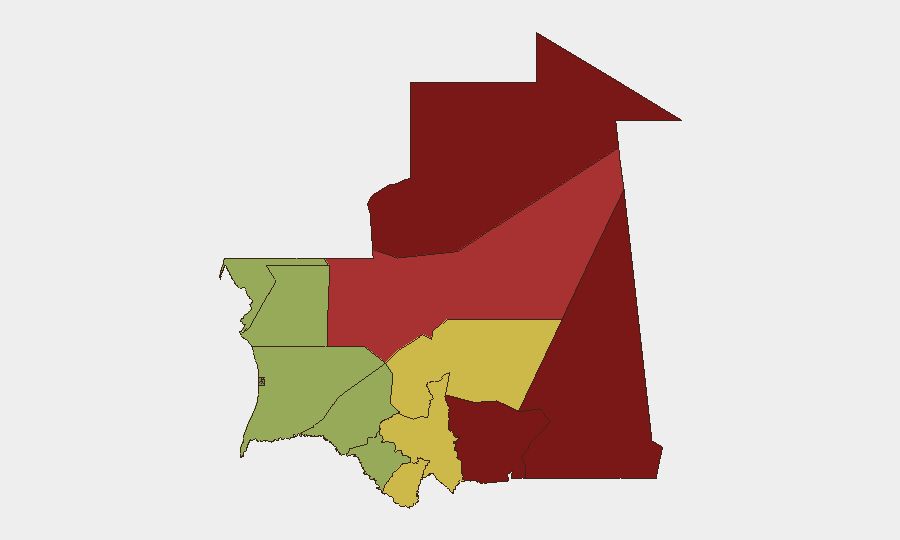
Situation Summary
Mauritania's overall threat environment remains modest (composite score 5), with no confirmed armed attacks, major civil unrest, or infrastructure disruptions reported in the last 24–48 hours. However, recent developments signal underlying political tensions and localized security concerns in the capital and key northern regions. Risk remains concentrated in the eastern and southern border zones—particularly Tiris Zemmour and Hodh Ech Chargui—where transnational militant activity and cross-border trafficking present persistent hazards. Near-term trajectory suggests low acute risk, but political friction and potential cyber vulnerabilities warrant continued monitoring.
Key Developments
- Nouakchott – Appellate Court Ruling (27–28 July). Court of Appeal reduced prison sentences for parliamentarians Mariem Mint Cheikh and Ghamou Achour from four to two years while imposing five-year civil and political rights bans, a decision likely to inflame political sentiment and risk localized protest activity.
- Nouadhibou – Alleged Attack on Opposition MP (within last 24–48h). Human rights organization IRA reported that opposition leader Biram Dah Abeid was targeted in an attempted vehicle ramming allegedly involving police personnel, raising concerns about politically motivated intimidation and potential escalation in the coastal city.
- Nouakchott – National Guard Command Disciplinary Action (reported very recently). Commander and deputy commander of the presidential guard unit protecting former President Mohamed Ould Abdel Aziz were arrested and placed under administrative discipline with no official explanation, signaling possible internal security friction within elite protection units.
- Nouakchott – Food Safety Enforcement (24–48h cycle). Ministry of Trade and Tourism confiscated and destroyed 42 tons of expired food products over three days, including 1 ton "yesterday," indicating routine market-inspection operations with no broader security implications.
- Nouakchott-to-Atar Highway, Tiris Zemmour (reported very recently). Governor of Tiris Zemmour, Idrissa Demba Korera, sustained minor injuries in a traffic accident and was transported to Atar hospital, causing temporary administrative disruption but no wider security impact.
- Nationwide Cyber Threat Surge (first half 2026, disclosed recently). National innovative financing program (PAFIID) identified more than 10,000 cyber-security threats and confirmed/removed 470 in H1 2026, indicating significant cyber risk to government and commercial networks across the country.
Highest-Risk Areas
Tiris Zemmour (risk 95) and Hodh Ech Chargui (risk 85) dominate the risk landscape, driven by proximity to Mali and Algeria, where transnational militant networks, cross-border smuggling, and trafficking in persons remain endemic. Hodh El Gharbi (80) and Adrar (78) present similarly elevated hazards due to remote terrain, weak state presence, and historical Al-Qaeda–affiliated activity. The southern and central regions—Guidimaka, Assaba, Gorgol, Trarza—carry moderate risk (55–65), primarily reflecting petty crime, banditry, and migration-related tensions. Nouakchott and coastal Dakhlet Nouadhibou, while lower-ranked (45–55), concentrate political and administrative friction, as recent events confirm.
How GeoBit Would Assist
Security teams with personnel or assets in Mauritania should employ AOI Monitoring & Early Warning focused on Tiris Zemmour, Hodh Ech Chargui, and Nouakchott to detect emerging protest, militant, or crime signals in real time. Network & Actor Analysis combined with multi-language OSINT fusion would track political factions, opposition networks, and security-force dynamics to anticipate intimidation campaigns or internal instability. Cyber threat intelligence and Shodan monitoring would assess exposure of corporate and operational networks to the confirmed surge in state-level and criminal cyber activity.
7-Day Outlook
No major escalation is anticipated in the near term; political tensions will likely remain rhetorical and localized to Nouakchott and Nouadhibou. Continued monitoring of court proceedings, opposition activity, and internal security-force discipline is warranted to detect early signs of broader instability. Border regions will require sustained attention to transnational militant and trafficking movements.
Highest-Risk Areas — Ranked
| # | State / Region | Risk |
|---|---|---|
| 1 | Tiris Zemmour | 95 |
| 2 | Hodh Ech Chargui | 85 |
| 3 | Hodh El Gharbi | 80 |
| 4 | Adrar | 78 |
| 5 | Tagant | 68 |
| 6 | Guidimaka | 65 |
| 7 | Assaba | 62 |
| 8 | Gorgol | 58 |
| 9 | Trarza | 55 |
| 10 | Inchiri | 52 |
| 11 | Brakna | 48 |
| 12 | Dakhlet Nouadhibou | 45 |
Sources
Previous Daily Briefs
A new Mauritania brief is written every day — each with its own risk map and downloadable CSV. Here's the last week; use the calendar to go further back.
📅 Browse every day by calendar →
Highlighted days have a brief. Tap a day for that day's map & analysis, or “csv” for that day's dataset ($5).
Atlas — our AI intelligence desk — emails them this snapshot personally. Nothing else, no list.