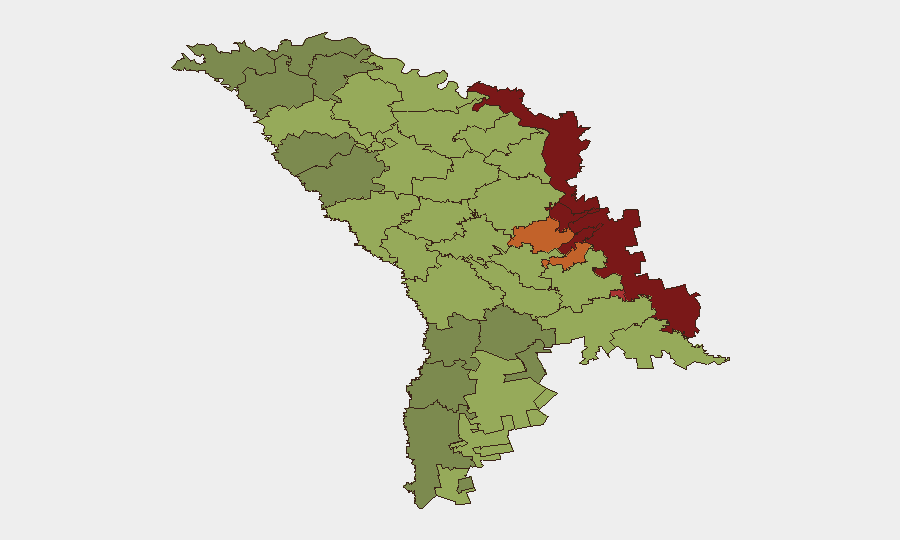
Situation Summary
Moldova remains a low-to-moderate threat environment (global rank #102) with acute risk concentrated in separatist-controlled and border-adjacent territories on the left bank of the Dniester River and in isolated southern enclaves. The last 48 hours show no major security incidents within government-controlled Moldova, though diplomatic tension with Russia has intensified following the closure of the Russian cultural centre on 4 July, and a public-health incident in Chişinău continues to develop. The overall security trajectory remains stable but dependent on regional geopolitical developments, particularly drone incursions and Russian military activity in adjacent airspace.
Key Developments
- Russian Centre for Science and Culture closure (Chişinău, 4 July 2026): Moldova's government formally shut the Russian cultural centre, citing recent Russian drone incursions into Moldovan airspace and debris impact as the security rationale. Risk of pro-Russian counter-demonstrations remains, though none reported as of publication.
- Salmonella outbreak at hotel (Chişinău, reported 4–5 July 2026): The National Agency for Public Health confirmed a food-poisoning incident at Radisson Blu Leogrand involving 26 people sickened and hospitalized during events held 22–26 June; laboratory testing confirmed *Salmonella Enteritidis* in seven patients. Risk to business travelers and conference participants at central Chişinău venues.
- Anti-corruption detention (Ministry of Agriculture, Chişinău, 2 July 2026): Tatiana Nistorica (State Secretary, Ministry of Agriculture and Food Industry) and a private-sector associate were detained on corruption suspicion. Potential trigger for political friction and media narratives, though no public unrest reported.
- Judicial control order (Chişinău, 3 July 2026): Former Democratic Party MP Vladimir Andronachi transferred from prison to judicial control status, advancing a political-corruption case. May sustain elite tensions but no immediate safety impact reported.
- Energy security legislation (national, early July 2026): Parliament adopted a law mandating petroleum-product reserves equal to at least 90 days of net imports, reducing medium-term supply-disruption risk rather than addressing an acute incident.
- Nationwide crime trend (police reporting, last 24 hours): No new telephone-fraud cases registered in the most recent police reporting period—a temporary decline in one common fraud category; overall crime patterns unchanged.
Highest-Risk Areas
The left-bank Dniester region (risk 85), including Dubăsari (82) and Bender (79), drives Moldova's sub-national threat profile; these areas remain outside Chişinău's effective control and are vulnerable to Russian influence, military activity, and arms trafficking. Criuleni (75) and Rezina (58) follow as secondary high-risk zones due to proximity to Ukraine and historical instability. Even the capital, Chişinău (49), ranks lower, reflecting that Moldova's threat concentration lies in separatist-held and border-adjacent territory rather than the government-controlled urban centre.
How GeoBit Would Assist
Security teams with personnel or assets in Moldova would use GeoBit's AOI Monitoring & Early Warning to track developments in the Dniester region and border zones for renewed military activity or arms movement; Intel Sweep and OSINT fusion to corroborate official sources on drone incursions and geopolitical escalation; and Routing & Network Analysis to identify secure transit corridors away from high-risk administrative units. Periodic Conflict & Military tracking and Satellite & Imagery analysis would provide situational awareness of Russian force posture near Moldova's border.
7-Day Outlook
No major security incidents are forecast in the immediate term; however, diplomatic friction with Russia may intensify if drone activity continues or if the Russia House closure triggers organized pro-Russian protests. The Salmonella outbreak will likely remain a public-health concern for 5–7 days. Risk in separatist territories and border regions remains persistently elevated but stable, absent a broader Ukraine-Russia escalation.
Highest-Risk Areas — Ranked
| # | State / Region | Risk |
|---|---|---|
| 1 | Administrative-Territorial Units of the Left Bank of the Dniester | 85 |
| 2 | Dubăsari | 82 |
| 3 | Bender | 79 |
| 4 | Criuleni | 75 |
| 5 | Rezina | 58 |
| 6 | Taraclia | 55 |
| 7 | Gagauzia | 54 |
| 8 | Căușeni | 53 |
| 9 | Soroca | 52 |
| 10 | Ștefan Vodă | 51 |
| 11 | Orhei | 50 |
| 12 | Chișinău | 49 |
Sources
Previous Daily Briefs
A new Moldova brief is written every day — each with its own risk map and downloadable CSV. Here's the last week; use the calendar to go further back.
📅 Browse every day by calendar →
Highlighted days have a brief. Tap a day for that day's map & analysis, or “csv” for that day's dataset ($5).
Atlas — our AI intelligence desk — emails them this snapshot personally. Nothing else, no list.