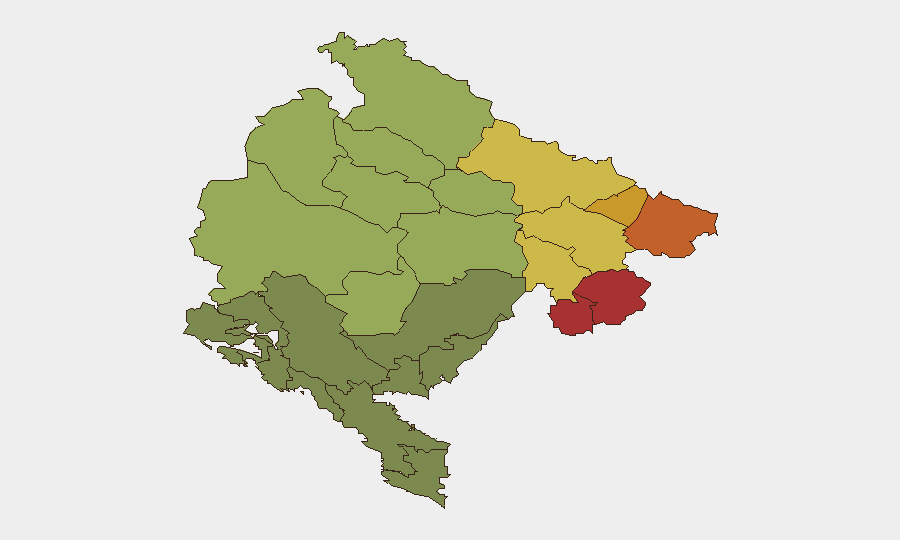
Situation Summary
Montenegro remains a low-threat environment at the national level, with no major security incidents, civil unrest, or terrorism events recorded in the past 24–48 hours. Baseline criminal activity and organized-crime enforcement operations are ongoing, and wildfire-related infrastructure disruptions (power and water outages) have largely stabilized as of 2026-08-20 but may persist into late August. The recent constitutional amendments adopted 2026-08-25 strengthen judicial independence and central bank autonomy, supporting institutional stability. Overall trajectory is stable with no imminent escalation indicators.
Key Developments
- Tuzi, near Podgorica (2026-08-24, reported 2026-08-26): Four individuals—two adults and two minors (one an Albanian citizen)—were charged with misdemeanor offenses after placing an Albanian flag on a parked police vehicle during a public gathering, making hand symbols, and posting video on TikTok. Police reported the incident caused public alarm and disturbed order; immigration proceedings are underway for the foreign minor, and parents of the juveniles face neglect charges.
- Montenegro nationwide (announced 2026-08-20, ongoing through 2026-08-26): The Interior Ministry and Police Directorate posted a €500,000 reward for information leading to the arrest of Radoje Zvicer, alleged leader of a major drug-trafficking organization and subject of an Interpol Red Notice for organized crime, aggravated murder, drug trafficking, weapons offenses, and money laundering. This reflects sustained enforcement pressure on high-level organized-crime targets.
- Nikšić (detention ordered 2026-08-24): Police detained a Serbian citizen on state prosecutor order on suspicion of arson at a restaurant. The Basic State Prosecutor's Office in Nikšić is handling the criminal investigation.
- Constitutional amendments, Podgorica (adopted 2026-08-25): Parliament approved constitutional amendments modifying the composition and appointment procedures for the Judicial and Prosecutorial Councils and reinforcing Central Bank independence, a governance-level development supporting institutional stability.
- Wildfire support operations (active through 2026-08-22): Montenegro deployed an Air Tractor AT-802 firefighting aircraft to assist Serbia with wildfire suppression, reflecting ongoing regional fire activity and potential temporary redeployment of domestic aviation resources.
- Infrastructure status (baseline as of 2026-08-20): Wildfires in Herceg Novi and other coastal municipalities were brought under control; temporary power and water outages in settlements such as Bijela and Baošići may persist through late August.
Highest-Risk Areas
The northeastern municipalities of Plav, Gusinje, Rožaje, Petnjica, and Andrijevica (risk scores 68–78) drive the sub-national risk ranking, likely reflecting cross-border smuggling activity, organized-crime networks, and historical inter-communal tensions in the porous Serbia–Montenegro frontier region. Bijelo Polje, Berane, and Plužine (scores 62–65) follow, with risk concentrated in the north and east. The southern coast and central regions (Kolašin, Žabljak, Šavnik) register substantially lower risk, suggesting that organized-crime and trafficking threats are geographically concentrated in remote, border-proximate areas rather than distributed across the country.
How GeoBit Would Assist
Organizations with personnel or assets in Montenegro should employ AOI Monitoring & Early Warning on the higher-risk northeastern municipalities to detect trafficking, weapons, or organized-crime activity surges; Network & Actor Analysis to map links between Montenegrin and Serbian organized-crime figures (such as the Zvicer investigation); and Intel Sweep with multi-language OSINT feeds to capture real-time law-enforcement operations, border incidents, and cross-border crime trends before they escalate. Routing & Network Analysis can identify safer transit corridors away from high-risk zones.
7-Day Outlook
No major security escalation is forecast for the remainder of August. Organized-crime enforcement operations and wildfire management will remain the primary security and infrastructure concerns; residual power and water disruptions are expected to resolve by month-end. The political and institutional environment will likely stabilize further following the constitutional amendments, reducing governance-related uncertainty for businesses and international operations.
Highest-Risk Areas — Ranked
| # | State / Region | Risk |
|---|---|---|
| 1 | Plav Municipality | 78 |
| 2 | Gusinje Municipality | 76 |
| 3 | Rožaje Municipality | 74 |
| 4 | Petnjica Municipality | 72 |
| 5 | Andrijevica Municipality | 68 |
| 6 | Bijelo Polje Municipality | 65 |
| 7 | Berane Municipality | 62 |
| 8 | Plužine Municipality | 58 |
| 9 | Pljevlja Municipality | 55 |
| 10 | Šavnik Municipality | 52 |
| 11 | Žabljak Municipality | 50 |
| 12 | Kolašin Municipality | 48 |
Sources
Previous Daily Briefs
A new Montenegro brief is written every day — each with its own risk map and downloadable CSV. Here's the last week; use the calendar to go further back.
- August 24, 2026
- August 22, 2026
- August 20, 2026
- August 18, 2026
- August 15, 2026
- August 13, 2026
- August 11, 2026
📅 Browse every day by calendar →
Highlighted days have a brief. Tap a day for that day's map & analysis, or “csv” for that day's dataset ($5).
Atlas — our AI intelligence desk — emails them this snapshot personally. Nothing else, no list.