Situation Summary
Tajikistan remains a lower-threat environment globally (rank #164) with a composite threat score of 4, though Dushanbe accounts for the majority of recorded risk activity. No significant security incidents have been reported in the past 24–48 hours; the security environment remains stable relative to baseline. A natural-hazard advisory for mudflow risk in multiple regions (issued 22 June, valid 23–24 June) represents the primary near-term operational concern for travel and asset management, though it does not reflect conflict, crime, or political instability.
Key Developments
No discrete security, conflict, civil-unrest, crime, or political-instability incidents were identified in Tajikistan during the 24–48 hour reporting window (23–25 June 2026).
Note on recent activity:
- Dushanbe, 24–25 June 2026: The 3rd Central Asia–Republic of Korea Think Tank Forum proceeded as scheduled. This is an academic and diplomatic engagement with no reported security disruption; it does not present a threat indicator.
- Multiple regions, 23–24 June 2026: A hydrometeorological warning issued by national authorities flagged elevated mudflow risk across several oblasts. While a natural-hazard rather than a security incident, this advisory is operationally relevant for personnel movement and supply-chain routing in affected areas.
Highest-Risk Areas
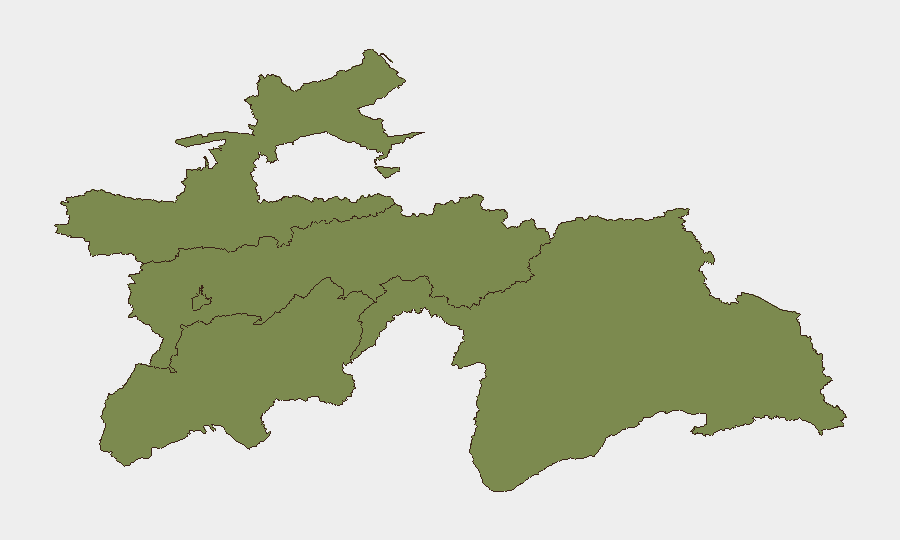
Dushanbe dominates the country's threat profile (risk score 32), reflecting its concentration of political activity, diplomatic presence, and standard urban crime vectors. The Districts of Republican Subordination (DRS)—the capital's surrounding administrative zone—carry moderate residual risk (score 17), likely reflecting the capital's peripheral security perimeter and informal settlement patterns. The peripheral regions of Sughd, Khatlon, and Gorno-Badakhshan all score 2, indicating lower baseline incident frequency; however, GBAO's geographic remoteness, limited state capacity, and proximity to Afghanistan warrant persistent monitoring despite its low current event count.
How GeoBit Would Assist
Security teams should employ Intel Sweep and multi-language OSINT to maintain 24–48 hour situational awareness in Dushanbe and surrounding areas, supported by X/Twitter and Telegram OSINT to detect early signals of unrest or incident precursors. AOI Monitoring & Early Warning pinned to Dushanbe, the DRS, and key border regions (notably GBAO/Afghan frontier) provides persistent surveillance and automated alerting on emerging threats. For personnel and supply operations affected by the mudflow advisory and seasonal hazards, Routing & Network Analysis supports alternative journey planning and real-time risk reassessment.
7-Day Outlook
No significant escalation is anticipated over the next seven days. Mudflow risk should diminish as the 23–24 June window closes and weather patterns normalize; however, seasonal hazards will remain a minor operational constraint through the summer months. The diplomatic calendar (ongoing think-tank activities) poses negligible security risk and should not drive protective posture changes in-country.
Highest-Risk Areas — Ranked
| # | State / Region | Risk |
|---|---|---|
| 1 | Dushanbe | 32 |
| 2 | Districts of Republican Subordination | 17 |
| 3 | Sughd Region | 2 |
| 4 | Khatlon Region | 2 |
| 5 | Gorno-Badakhshan Autonomous Region | 2 |
Sources
Previous Daily Briefs
A new Tajikistan brief is written every day — each with its own risk map and downloadable CSV. Here's the last week; use the calendar to go further back.
📅 Browse every day by calendar →
Highlighted days have a brief. Tap a day for that day's map & analysis, or “csv” for that day's dataset ($5).