Situation Summary
The United Arab Emirates remains internally stable with no confirmed security incidents, infrastructure damage, or civil unrest reported within the last 24–48 hours. However, the regional security environment has deteriorated sharply due to renewed Iranian attacks on Kuwait and Jordan, and the UAE continues to assess risks to critical infrastructure and maritime traffic following the late-July drone strike on the Barakah nuclear plant. Dubai carries elevated risk (31.3) relative to other emirates, driven by its role as a major commercial and aviation hub; all other emirates register minimal composite threat scores (1.3). The trajectory is one of external pressure and diplomatic tension rather than imminent internal instability.
Key Developments
- Abu Dhabi (federal level) – July 30, 2026 – UAE Ministry of Foreign Affairs issued a formal statement condemning renewed Iranian attacks on Kuwait and Jordan, reaffirming solidarity and support for both nations' security measures in response to regional escalation.
- Nationwide (UAE) – July 30, 2026 – UAE authorities publicly confirmed that internal security remains stable and under constant monitoring despite surrounding regional hostilities; no incidents reported inside UAE territory in the preceding 24 hours.
- Dubai & Abu Dhabi airports – July 30, 2026 – Both major international aviation hubs are operating normally with no passenger disruptions, signaling continuation of normal commercial activity despite wider Gulf tensions.
- Barakah Nuclear Power Plant, Al Dhafra region – July 29–30, 2026 – No new damage or subsequent strikes reported; focus has shifted to diplomatic reactions and IAEA-led safety assessments following the late-July drone strike that damaged an electrical generator but caused no injuries or radiation release.
- Nationwide (UAE) – July 30, 2026 – No new domestic security advisories, curfews, or restrictions announced; travel-risk guidance remains consistent with regional tensions rather than escalating UAE-specific threats.
Highest-Risk Areas
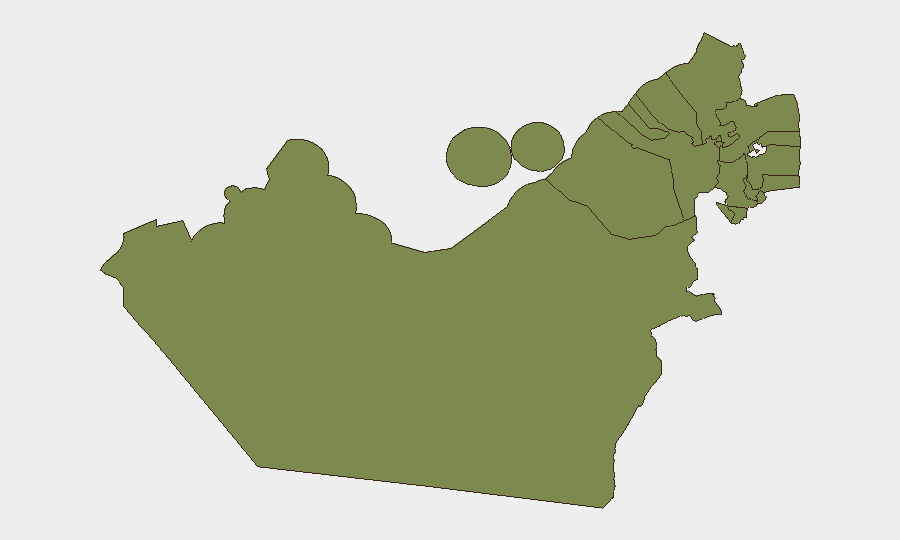
Dubai's risk score (31.3) significantly exceeds all other emirates, reflecting its status as the region's largest commercial, financial, and aviation center—making it a logical focus for diplomatic incidents, maritime incidents affecting trade corridors, and potential secondary effects from regional conflicts. The remaining six emirates (Sharjah, Ajman, Ras al-Khaimah, Fujairah, Umm al-Quwain, and Abu Dhabi) all register identical baseline risk (1.3), indicating broadly comparable, low threat profiles in the current assessment. This disparity underscores that concentration of corporate assets, personnel, and international activity in Dubai warrants proportionally heightened duty-of-care monitoring.
How GeoBit Would Assist
Security and duty-of-care teams should deploy AOI Monitoring & Early Warning to track Dubai airport operations, the Barakah facility, and key maritime chokepoints (e.g., near Dibba) for signs of escalation. Conflict & Military tracking combined with Network & Actor Analysis would enable continuous assessment of Iranian proxy capabilities and intent toward UAE infrastructure. Maritime & Aviation tracking should be paired with Intel Sweep and multi-language OSINT to detect emerging threats to shipping and commercial traffic before they materialize as confirmed incidents.
7-Day Outlook
Barring a major shift in Iran–US or Iran–Gulf state dynamics, the UAE is likely to maintain internal stability while absorbing diplomatic and economic spillover from regional attacks. Maritime risk will remain elevated; monitoring of Barakah safety posture and merchant-vessel incidents in UAE waters should continue as standing priorities. Any escalation involving direct Iranian action against UAE soil would likely manifest first in maritime or airspace incidents rather than ground-based terrorism.
Highest-Risk Areas — Ranked
| # | State / Region | Risk |
|---|---|---|
| 1 | Dubai | 31.3 |
| 2 | Sharjah Emirate | 1.3 |
| 3 | Ajman Emirate | 1.3 |
| 4 | Ras al-Khaimah | 1.3 |
| 5 | Fujairah Emirate | 1.3 |
| 6 | Umm al-Quwain | 1.3 |
| 7 | Abu Dhabi Emirate | 1.3 |
Sources
Previous Daily Briefs
A new United Arab Emirates brief is written every day — each with its own risk map and downloadable CSV. Here's the last week; use the calendar to go further back.
📅 Browse every day by calendar →
Highlighted days have a brief. Tap a day for that day's map & analysis, or “csv” for that day's dataset ($5).
Atlas — our AI intelligence desk — emails them this snapshot personally. Nothing else, no list.