Situation Summary
Uruguay maintains a low overall threat profile (composite score 7) with no clearly documented security incidents, civil unrest, or infrastructure disruptions reported in the last 24–48 hours. The security environment remains stable with routine urban crime concentrated in Montevideo and Canelones; no imminent escalation signals have translated into kinetic events. Bilateral diplomatic tensions with Colombia (noted 10 Jun) remain at the public-statement level with no reported spillover into Uruguayan territory.
Key Developments
- National – 11 Jun 2026 – No confirmed new security incidents
Open-source monitoring and social-media feeds have not identified time-stamped security incidents, crime spikes, or infrastructure disruptions affecting Uruguay in the last 24–48 hours.
- National – 11 Jun 2026 – Prison-related signal flagged, details undisclosed
A "prison-related rejection signal" was registered on 11 Jun; however, location and incident details remain undisclosed in open feeds and cannot be corroborated as a confirmed operational event at this time.
- National – 10 Jun 2026 – Uruguay–Colombia diplomatic statements, no kinetic spillover
Public statements regarding Uruguay–Colombia bilateral tensions were issued on 10 Jun at the diplomatic level; no protests, clashes, or operational incidents were reported in Uruguay in the surveillance window.
- Montevideo & Canelones – routine elevated baseline, no new specific incidents
These departments remain the highest-risk areas (urban crime, protest clustering); however, no new discrete incidents were documented in the last 24–48 hours beyond the established baseline.
Highest-Risk Areas
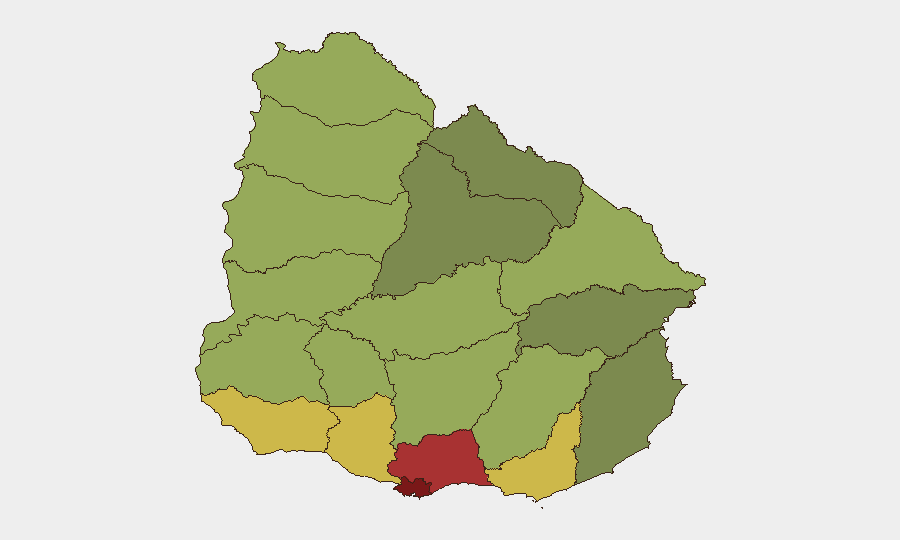
Montevideo (risk 92) and Canelones (risk 78) drive the country's composite risk profile, driven by urban crime concentration, gang activity, and periodic protest activity in the capital and surrounding metropolitan area. Maldonado (68), San José (64), and Colonia (62) represent secondary risk corridors, primarily linked to crime and transnational criminal logistics. The interior departments (Soriano, Río Negro, Salto, Artigas, Paysandú) remain lower-risk but are tracked for border-region vulnerabilities and organized-crime activity.
How GeoBit Would Assist
Intel Sweep and multi-language OSINT fusion enable continuous monitoring of Uruguayan media, social platforms, and event feeds to detect emerging security incidents, protest signals, and crime escalation in real time. AOI Monitoring & Early Warning would allow security teams to establish persistent geographic watches on Montevideo, Canelones, and other high-risk departments with automated alerting for unrest, blockades, or infrastructure disruptions. Network & Actor Analysis and regime-stability assessment capabilities support tracking of organized-crime networks, political instability drivers, and transnational criminal activity that may affect corporate assets or personnel.
7-Day Outlook
No imminent security escalation is forecast for the next 7 days. The prison-related signal and diplomatic tensions merit continued monitoring, but current trajectory suggests both will remain contained at routine operational levels. Risk teams should maintain standard duty-of-care protocols in Montevideo and Canelones while monitoring for any escalation of the undisclosed prison issue or sudden diplomatic deterioration.
Report date: 2026-06-12 | Confidence: Routine monitoring | Next update: 2026-06-13
Highest-Risk Areas — Ranked
| # | State / Region | Risk |
|---|---|---|
| 1 | Montevideo | 92 |
| 2 | Canelones | 78 |
| 3 | Maldonado | 68 |
| 4 | San José | 64 |
| 5 | Colonia | 62 |
| 6 | Soriano | 58 |
| 7 | Río Negro | 56 |
| 8 | Salto | 54 |
| 9 | Artigas | 52 |
| 10 | Paysandú | 50 |
| 11 | Florida | 48 |
| 12 | Flores | 46 |
Previous Daily Briefs
A new Uruguay brief is written every day — each with its own risk map and downloadable CSV. Here's the last week; use the calendar to go further back.
📅 Browse every day by calendar →
Highlighted days have a brief. Tap a day for that day's map & analysis, or “csv” for that day's dataset ($5).