Situation Summary
Armenia remains classified as a moderate-risk jurisdiction (global rank #164, composite score 4) with concentrated volatility in the capital and southwestern provinces. The past 48 hours reflect ongoing political tensions around the Armenia-Azerbaijan normalization process, military activity, and civil-military friction—notably the airport detention of former president Kocharyan and judicial extension of Archbishop Galstanyan's house arrest. While no mass-casualty incidents or border incursions have been confirmed in the immediate reporting window, the convergence of political opposition to peace talks, U.S.-Armenian military exercises (Eagle Partner 2026), and Russian diplomatic protests signals sustained underlying instability.
Key Developments
- Zvartnots International Airport, Yerevan — 2026-06-19: Former President Robert Kocharyan was prevented from departing Armenia; his office stated the reason was unclear. PM Pashinyan subsequently commented on the incident, indicating possible political use of travel restrictions or judicial complications.
- Yerevan (national) — 2026-06-19: PM Pashinyan publicly called for resistance to parliamentary forces opposing Armenia-Azerbaijan normalization, underscoring continued factional tension over the peace process trajectory.
- Dilijan — 2026-06-17: Armenia's Security Council Secretary Armen Grigoryan met Azerbaijan's Hikmet Hajiyev; stated aim was to restore momentum to bilateral peace negotiations.
- Multiple locations — 2026-06-17 to 2026-06-25: Eagle Partner 2026 joint military exercises began involving Armenian and U.S. personnel. Russian officials publicly criticized the drills in the context of Armenia's suspended CSTO (Collective Security Treaty Organization) membership, signaling geopolitical friction over Armenia's military alignment.
- Gyumri — 2026-06-18/19: Russia lodged a diplomatic protest with Armenia over reported desecration of a memorial to WWII-era Soviet casualties, indicating sensitivity over historical/memorial security and Russian-Armenian relations.
- Yerevan (judicial) — 2026-06-19: A court extended house arrest for Archbishop Bagrat Galstanyan by three months in connection with an alleged attempted seizure of power case, reflecting ongoing civil-military or church-state tension.
Highest-Risk Areas
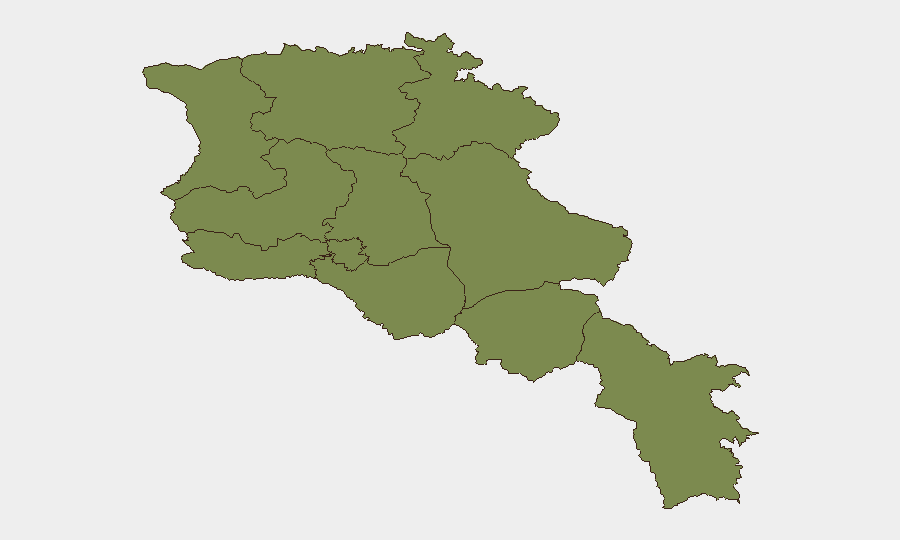
Yerevan dominates the risk profile (31.4), driven by political decision-making, detention/judicial events, and military command infrastructure. Ararat Province (26.1) follows at a significant distance, likely reflecting proximity to sensitive border zones and historical conflict footprint. All other provinces cluster at or near baseline risk (1.4–4.9), indicating that Armenia's near-term security challenge is concentrated in the capital and its immediate periphery rather than dispersed across the country. The steep drop-off after Ararat Province suggests that tactical military or criminal incidents outside Yerevan remain episodic rather than systemic.
How GeoBit Would Assist
Security teams with personnel or assets in Armenia would benefit from AOI Monitoring & Early Warning on Yerevan and Ararat Province to track political gatherings, military movements, and police/judicial activity in real time. Network & Actor Analysis would help map relationships among parliamentary factions, security services, and religious authorities to anticipate factional escalation around the normalization process. Intel Sweep (multi-language social media, local news, and OSINT fusion) would provide 24-hour coverage of protest sentiment, military exercise scope, and diplomatic statements—critical for duty-of-care decisions on staff movement or asset exposure.
7-Day Outlook
The Eagle Partner exercises are scheduled through 2026-06-25 and will likely sustain Russian diplomatic friction and domestic political opposition. Judicial proceedings against high-profile figures (Kocharyan, Galstanyan) may generate unpredictable street mobilization. Unless a border incident or mass-arrest event occurs, risk should remain concentrated in Yerevan political and judicial spaces rather than escalating to general insecurity.
Highest-Risk Areas — Ranked
| # | State / Region | Risk |
|---|---|---|
| 1 | Yerevan | 31.4 |
| 2 | Ararat Province | 26.1 |
| 3 | Syunik Province | 4.9 |
| 4 | Lori Province | 1.4 |
| 5 | Tavush Province | 1.4 |
| 6 | Kotayk Province | 1.4 |
| 7 | Gegharkunik Province | 1.4 |
| 8 | Vayots Dzor Province | 1.4 |
| 9 | Shirak Province | 1.4 |
| 10 | Aragatsotn Province | 1.4 |
| 11 | Armavir Province | 1.4 |
Sources
Previous Daily Briefs
A new Armenia brief is written every day — each with its own risk map and downloadable CSV. Here's the last week; use the calendar to go further back.
📅 Browse every day by calendar →
Highlighted days have a brief. Tap a day for that day's map & analysis, or “csv” for that day's dataset ($5).