Situation Summary
Botswana remains a low-threat environment (global rank #162, composite score 7) with no tracked security incidents during the reporting week. The country's stable political and institutional framework continues to support a permissive security posture. However, cross-border crime—particularly human trafficking, illegal entry, and smuggling—remains an endemic challenge in northern border zones, evidenced by ongoing law-enforcement activity near the Zimbabwe frontier.
Key Developments
- Francistown / Shashe-Mooke area — 13 September arrest (reported 16–17 September): Botswana Police Service arrested a 28-year-old Zimbabwean national for illegal border entry through an undesignated crossing point. The suspect was remanded in custody pending bail determination; court reporting during the seven-day window confirmed ongoing detention and a scheduled bail hearing on 18 September. The arrest underscores persistent cross-border mobility and immigration enforcement activity in the north.
- Francistown — 18 September: The accused appeared in court for bail proceedings; no new security incident was reported, but the court appearance reflects active judicial processing of cross-border crime cases.
- Botswana–South Africa liaison — 16 September: Botswana Police Service Commissioner Dinah Marathe met South Africa's acting national police commissioner in Pretoria to coordinate cross-border crime prevention. This cooperation initiative reflects institutional commitment to address transnational smuggling, trafficking, and irregular migration.
Assessment: No new attacks, civil disturbances, infrastructure failures, or political violence occurred during 16–23 September 2026. The reported developments are routine law-enforcement and diplomatic activities associated with border management and regional security cooperation.
Highest-Risk Areas
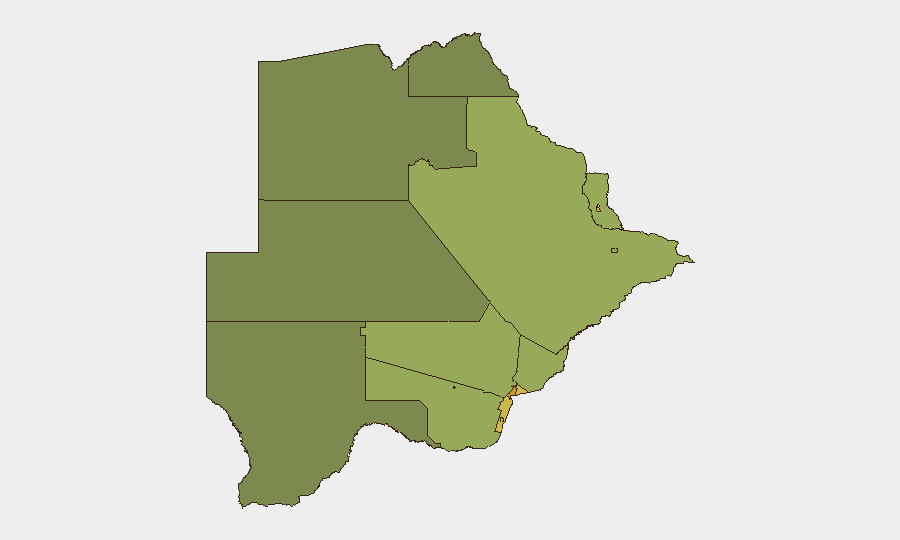
Gaborone (risk 72), South-East District (68), and Lobatse (65) drive the country's composite risk profile, likely reflecting urban crime concentration, cross-border proximity, and trafficking corridors. Francistown (62) and Jwaneng (61) follow, tied to northern border volatility and mining-sector activity. These five locations account for the bulk of Botswana's recorded incidents and warrant priority monitoring for personnel and asset exposure. Central, North-West, and North-East districts remain lower-risk but should not be dismissed; risk scores above 38 indicate background petty crime and administrative instability typical of regional cities.
How GeoBit Would Assist
Security and risk teams should deploy Area-of-Interest (AOI) Monitoring & Early Warning to maintain persistent watch on Gaborone, Francistown, and South-East District for emerging protests, crime spikes, or cross-border incidents. Intel Sweep and OSINT Fusion (social media, local news, police reports, and Telegram channels) would provide real-time situational awareness and corroborate unconfirmed incidents before they escalate. Routing & Network Analysis and GIS & Spatial Analysis can identify safer transit corridors and safe-house locations, particularly for personnel transiting between Gaborone and northern cities or crossing into South Africa.
7-Day Outlook
No imminent security escalation is forecast. Botswana's institutional stability and low political polarization suggest the operating environment will remain permissive. However, cross-border crime and irregular migration will continue to generate routine law-enforcement activity and occasional incidents in northern districts; security teams should maintain baseline vigilance and adjust travel routing based on real-time developments in Francistown and Shashe-Mooke areas.
Highest-Risk Areas — Ranked
| # | State / Region | Risk |
|---|---|---|
| 1 | Gaborone | 72 |
| 2 | South-East District | 68 |
| 3 | Lobatse | 65 |
| 4 | Francistown | 62 |
| 5 | Jwaneng | 61 |
| 6 | Selebi Phikwe | 58 |
| 7 | Southern District | 55 |
| 8 | Kgatleng District | 50 |
| 9 | Kweneng District | 48 |
| 10 | North-East District | 45 |
| 11 | Central District | 42 |
| 12 | North-West District | 38 |
Sources
Previous Weekly Briefs
A new Botswana brief is written every Monday, covering the week — each with its own risk map and downloadable CSV. Use the calendar to go further back.
- September 16, 2026
- September 9, 2026
- September 3, 2026
- August 31, 2026
- August 29, 2026
- August 26, 2026
- August 24, 2026
📅 Browse past briefs by calendar →
Highlighted days have a brief. Tap a day for that day's map & analysis, or “csv” for that day's dataset ($5).
Atlas — our AI intelligence desk — emails them this snapshot personally. Nothing else, no list.