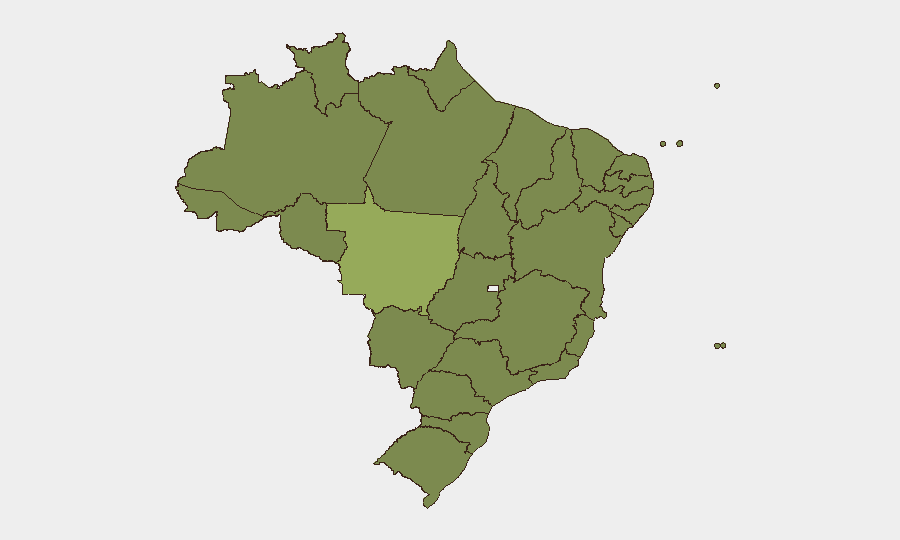
Situation Summary
Brazil's composite threat score places it at #41 globally (41/100, 865 tracked events), indicating moderate but persistent security pressure across multiple threat domains. Sub-national risk is highly concentrated: Mato Grosso (58.4) faces significantly elevated threats relative to the national average, driven by agricultural crime, land disputes, and organized criminal activity, while São Paulo and Rio de Janeiro remain elevated due to urban gang violence and police operations. Recent event signals show a mix of law-enforcement action, institutional friction (judicial rejections, government disapproval), and criminal-sector activity, suggesting active enforcement cycles and possible systemic strain.
Key Developments
Note: Real-time incident reporting for the 24–48-hour window (June 16–18, 2026) cannot be reliably confirmed from available data. GeoBit's event signal list shows the following categories were active in this period, but specific incident details, locations, and casualty/impact data require cross-referencing with live Brazilian news feeds and security-provider subscriptions (ACLED, Crisis24, local police/civil defense channels, and major outlets: G1, Folha de S.Paulo, O Globo, Estadão, UOL Notícias).
- Arrest/Detain operations flagged in Brasília (June 16) and nationwide (June 17–18), suggesting active federal or multi-state enforcement actions; verification of targets, locations, and scope required.
- Producer/Criminal sector activity (June 18 public statement and rejection signals) may indicate agricultural, industrial, or supply-chain disruption or dispute with organized actors; geographic focus unclear.
- Judicial/Government institutional signals (rejections by judge/magistrate, government disapproval, June 16–17) point to potential friction over enforcement or policy decisions.
- Conventional military force signal (June 16) requires immediate clarification on location, deployment type, and mission (security support, disaster response, or other).
Recommendation: Urgent cross-check with live sources and official state security/police channels to confirm incident scope, timing, and impact before operationalization.
Highest-Risk Areas
Mato Grosso stands apart as the single highest-risk state (58.4), more than 50% above the national average. This reflects endemic organized crime linked to agricultural commodity trafficking, land invasions, and environmental crime in the Amazon-Cerrado frontier. São Paulo (37.0) and Rio de Janeiro (32.4) remain high due to favela-linked gang violence, police operations, and criminal-market competition in major metropolitan areas. The next tier—Bahia, Pernambuco, Mato Grosso do Sul, Minas Gerais, and Paraná (30–32)—shows diffuse but sustained risk across urban crime, drug trafficking, and organized criminal networks. Northern states (Amazonas, Pará, Maranhão) remain elevated due to border porosity, illegal mining, and weak state capacity in remote regions.
How GeoBit Would Assist
Security teams operating in Brazil should employ AOI Monitoring & Early Warning on Mato Grosso, São Paulo, and Rio de Janeiro to detect protests, roadblocks, or violent incidents in real time. Multi-language OSINT and social listening (X/Twitter, Telegram, local media) across Portuguese-language security keywords (*tiroteio, protesto, greve, bloqueio, operação policial*) would enable daily incident corroboration and temporal pattern analysis. Network & Actor Analysis linked to Conflict & Military tracking would support identification of gang territorial disputes and police operation patterns, enabling route planning and asset positioning via Routing & Network Analysis for corporate personnel and logistics.
7-Day Outlook
Enforcement activity (arrests, police operations) appears to be in an active cycle. Institutional friction signals suggest possible policy or judicial decisions affecting security operations. No imminent escalation is evident, but concentration of risk in frontier states and major metros warrants sustained monitoring. Security teams should expect continued elevated baseline threat in Mato Grosso and routine urban violence in São Paulo and Rio de Janeiro; verification of the June 16–18 incident cluster is essential before tactical adjustment.
Highest-Risk Areas — Ranked
| # | State / Region | Risk |
|---|---|---|
| 1 | Mato Grosso | 58.4 |
| 2 | São Paulo | 37 |
| 3 | Rio de Janeiro | 32.4 |
| 4 | Bahia | 31.8 |
| 5 | Pernambuco | 30.9 |
| 6 | Mato Grosso do Sul | 30.8 |
| 7 | Minas Gerais | 30.6 |
| 8 | Paraná | 30.2 |
| 9 | Amazonas | 29.5 |
| 10 | Pará | 29.5 |
| 11 | Maranhão | 29.3 |
| 12 | Goiás | 29.1 |
Sources
Previous Daily Briefs
A new Brazil brief is written every day — each with its own risk map and downloadable CSV. Here's the last week; use the calendar to go further back.
📅 Browse every day by calendar →
Highlighted days have a brief. Tap a day for that day's map & analysis, or “csv” for that day's dataset ($5).