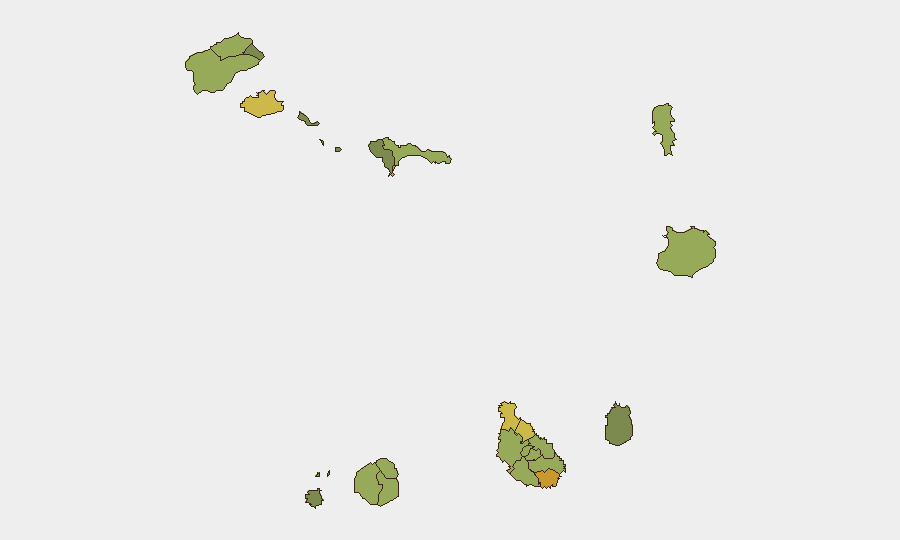
Situation Summary
Cape Verde remains a low-threat environment (global rank #173; composite threat score 5) with no tracked security incidents in the current week. The archipelago faced weather disruption from Tropical Storm Gonzalo (September 25–26), which prompted civil-protection alerts and emergency response across multiple islands. Justice-sector reporting indicates rising rates of gender-based violence and sexual crime year-over-year, a concern for duty-of-care teams; separately, a major EU defense commitment signals focus on maritime security and Coast Guard capability.
Key Developments
- Sal Island (Santa Maria) — September 25: Tropical Storm Gonzalo caused flooding and infrastructure damage affecting luxury hotel properties. National Police, Municipal Police, and firefighting units deployed for emergency monitoring and response. Civil-protection authorities maintained alert status through September 26 as the storm weakened.
- Cape Verde (Archipelago-wide) — September 26: Authorities sustained civil-protection alert status post-Gonzalo, warning residents and businesses to exercise caution near sea areas and damaged infrastructure following storm passage.
- Cape Verde (National) — September 28: The European Union approved €60 million in defense assistance for Cape Verdean armed forces, prioritizing Coast Guard capacity, maritime security, logistics, communications infrastructure, training, and surveillance systems.
- Cape Verde (National) — September 25 (reported): The Public Prosecutor's Office released judicial-year statistics (2025–26) documenting 11% increase in gender-based-violence cases and 20% increase in sexual-crime cases compared to the prior period. This reflects ongoing justice-system burden rather than a discrete incident event.
Highest-Risk Areas
Praia (risk 72) and São Miguel (risk 68) drive the sub-national ranking, likely reflecting concentration of urban populations, port activity, and associated petty crime and gang presence typical of capital and secondary urban centers. São Vicente (65) and Tarrafal (62) follow, suggesting distributed vulnerability across population centers and peripheral zones. The risk profile is consistent with a low-income, island-based economy with limited law-enforcement capacity and known challenges in gender-based violence prosecution. Tourism infrastructure on Sal (risk 48) and other resort islands presents secondary exposure to weather, theft, and organized crime targeting foreign nationals.
How GeoBit Would Assist
Teams with personnel or assets in Cape Verde should deploy AOI Monitoring & Early Warning on Praia, São Miguel, and resort zones (Sal, Santa Maria) to detect escalations in petty crime, theft, or civil unrest. Environmental & Health monitoring would provide early alert to tropical weather systems and infrastructure vulnerability, complementing national civil-protection systems. Maritime & Aviation tracking combined with Network & Actor Analysis would enable visibility into irregular migration flows, trafficking indicators, and organized-crime networks operating across the archipelago and broader Atlantic corridors.
7-Day Outlook
Post-storm recovery and assessment will occupy authorities through the coming week, with potential for secondary flooding or infrastructure-access complications. No new discrete security threats are forecast; the baseline low-threat environment is expected to hold. Gender-based violence remains an endemic justice-sector concern warranting duty-of-care awareness for female expatriate staff; no acute incident catalyst is evident.
Highest-Risk Areas — Ranked
| # | State / Region | Risk |
|---|---|---|
| 1 | Praia | 72 |
| 2 | São Miguel | 68 |
| 3 | São Vicente | 65 |
| 4 | Tarrafal | 62 |
| 5 | São Filipe | 58 |
| 6 | Santa Catarina | 58 |
| 7 | Santa Cruz | 55 |
| 8 | Mosteiros | 52 |
| 9 | São Salvador do Mundo | 52 |
| 10 | Ribeira Grande | 50 |
| 11 | Porto Novo | 48 |
| 12 | Sal | 48 |
Sources
Previous Weekly Briefs
A new Cape Verde brief is written every Monday, covering the week — each with its own risk map and downloadable CSV. Use the calendar to go further back.
- September 22, 2026
- September 15, 2026
- September 8, 2026
- September 2, 2026
- August 30, 2026
- August 27, 2026
- August 24, 2026
📅 Browse past briefs by calendar →
Highlighted days have a brief. Tap a day for that day's map & analysis, or “csv” for that day's dataset ($5).
Atlas — our AI intelligence desk — emails them this snapshot personally. Nothing else, no list.