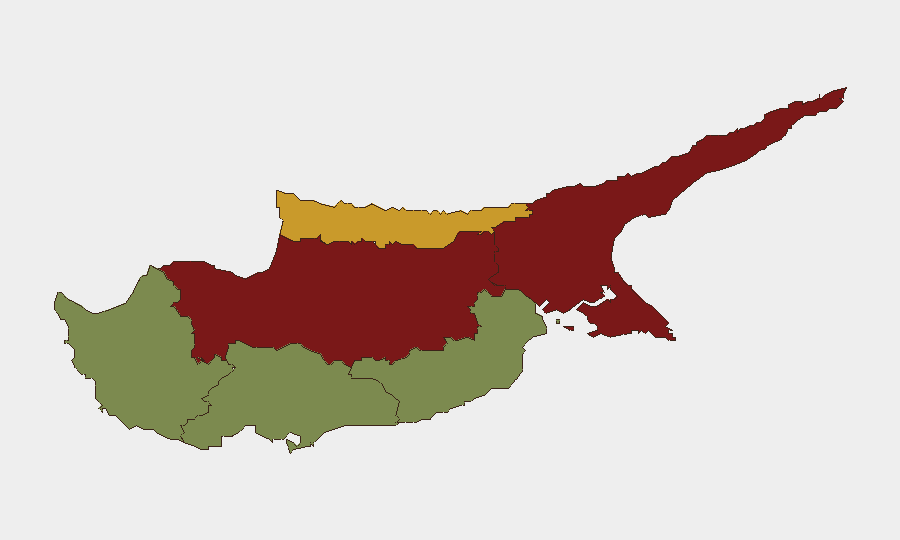
Situation Summary
Cyprus remains a low-threat environment globally (rank #169, composite score 6) with no significant security incidents recorded in the current tracking window. However, sub-national risk is sharply concentrated in the divided north—Nicosia (92), Famagusta (88), and Kyrenia (72)—driven by buffer-zone tensions, military presence, and political division, while the southern tourist and commercial zones (Limassol, Larnaca, Paphos) present materially lower risk. The past week saw routine law-enforcement activity, a minor incident in the buffer zone, and new regional-security exposure at RAF Akrotiri; overall trajectory remains stable.
Key Developments
- Deneia buffer zone, west of Nicosia — September 23: Turkish forces prevented Greek Cypriot farmers from ploughing fields, prompting an altercation. UN peacekeepers intervened and restored calm, illustrating persistent low-level friction in the demilitarised zone.[3][8]
- RAF Akrotiri — announced September 22: The United Kingdom announced use of the base to support Saudi Arabia with defensive air-to-air refuelling operations in response to missile and drone threats from Yemen's Houthi movement. This represents new regional-security exposure for the base and surrounding area, though reported activity was support-related rather than offensive.[9]
- Limassol — September 23: Police arrested a 34-year-old driver following a pursuit that included a collision with a patrol vehicle, officer strike, and reported gunfire. Investigation remained ongoing.[11]
- Larnaca — September 28: A fire at a car-rental office (02:18 local time) destroyed three vehicles and personal effects; cause undetermined pending examination by police and fire services.[1][2]
- Cyprus-wide — overnight September 22–23: Police arrested six individuals for assaults on officers, resisting arrest, drug possession, burglary, theft, illegal tobacco, and illegal residence. Officers stopped 517 vehicles and issued 291 traffic-related reports (speeding, drink-driving).[5]
- Nicosia and Larnaca — September 23: Two school-bus routes resumed service after suspension linked to vandalism and security concerns; authorities planned further discussions on permanent security protocols.[13]
- Cairo trilateral agreement — September 22: Cyprus, Greece, and Egypt agreed to strengthen cooperation on supply-chain protection, offshore energy infrastructure, counter-terrorism, smuggling interdiction, irregular migration, human trafficking, and organised-crime suppression in the Eastern Mediterranean.[12]
Highest-Risk Areas
Nicosia, Famagusta, and Kyrenia drive the sub-national risk ranking due to their location in the Turkish-controlled north, proximity to the UN buffer zone, ongoing political division, and military presence. Low-level buffer-zone friction (as evidenced by the September 23 incident) is endemic; these areas also face higher exposure to irregular migration, smuggling, and organised crime linked to the broader Eastern Mediterranean migration corridor. Southern zones (Limassol, Larnaca, Paphos) benefit from stronger state control, EU integration, and economic stability, limiting risk to routine crime and accident hazards.
How GeoBit Would Assist
Security teams operating in Cyprus would employ AOI Monitoring & Early Warning on Nicosia and the buffer zone to track friction incidents and military activity; Intelligence & OSINT (X/Twitter, Telegram, multi-language search, sentiment analysis) to detect smuggling, irregular migration, and organised-crime networks; and Routing & Network Analysis to identify safe alternative travel corridors for personnel and assets, particularly in high-risk northern districts and near the demilitarised zone.
7-Day Outlook
No significant escalation is forecast. Buffer-zone incidents are expected to remain sporadic and low-intensity, managed by UN peacekeepers. Regional exposure at RAF Akrotiri may attract low-probability opportunistic attention but poses minimal direct threat to civilian operations. Routine law-enforcement activity and minor crime will continue across urban centers.
Highest-Risk Areas — Ranked
| # | State / Region | Risk |
|---|---|---|
| 1 | Nicosia | 92 |
| 2 | Famagusta | 88 |
| 3 | Kyrenia | 72 |
| 4 | Larnaca | 28 |
| 5 | Limassol | 22 |
| 6 | Paphos | 18 |
Sources
Previous Weekly Briefs
A new Cyprus brief is written every Monday, covering the week — each with its own risk map and downloadable CSV. Use the calendar to go further back.
- September 21, 2026
- September 14, 2026
- September 7, 2026
- August 31, 2026
- August 29, 2026
- August 26, 2026
- August 23, 2026
📅 Browse past briefs by calendar →
Highlighted days have a brief. Tap a day for that day's map & analysis, or “csv” for that day's dataset ($5).
Atlas — our AI intelligence desk — emails them this snapshot personally. Nothing else, no list.