Situation Summary
Estonia maintains a low overall threat profile (global rank #131, composite score 7) with no verified acute security incidents, civil unrest, infrastructure disruptions, or travel-risk developments reported in the last 24–48 hours. The security environment remains stable across the country, though historical risk drivers—NATO airspace violations and cross-border incidents—warrant continued monitoring. Regional reporting from neighboring jurisdictions confirms no spillover of significant instability into Estonian territory during the current window.
Key Developments
- No verified new security incidents in Estonia (June 30–July 2, 2026). Open web sources, social media monitoring, and regional security briefs have recorded no confirmed acute events, civil unrest, major crime spikes, or infrastructure disruptions affecting Estonia in the last 24–48 hours.
- Regional stability assessment reflects broader Eastern European baseline. Monitoring of Belarus and neighboring regions in the same timeframe shows no major security events with potential cross-border spillover into Estonia, consistent with routine threat posture in the region.
- NATO air-policing operations continue as standard. Estonian airspace remains under NATO protection; no new violations or incidents have been reported in the current 24–48h window, though historical precedent (including a reported Russian airspace incursion earlier in 2026 and occasional Ukrainian drone activity) indicates continued need for airspace vigilance.
- Diplomatic and military operations remain routine. U.S. and allied personnel continue standard NATO training and readiness activities at bases such as Tapa (Lääne-Viru County); no security incidents or force-protection concerns have emerged from these installations in the last 24–48 hours.
- No new cyber incidents or law-enforcement actions reported within Estonia. While a dual U.S.–Estonian citizen was extradited this week on cybercrime charges (unrelated to incidents in Estonia), no new cyber attacks, data breaches, or criminal activity have been confirmed on Estonian soil in the current reporting window.
Highest-Risk Areas
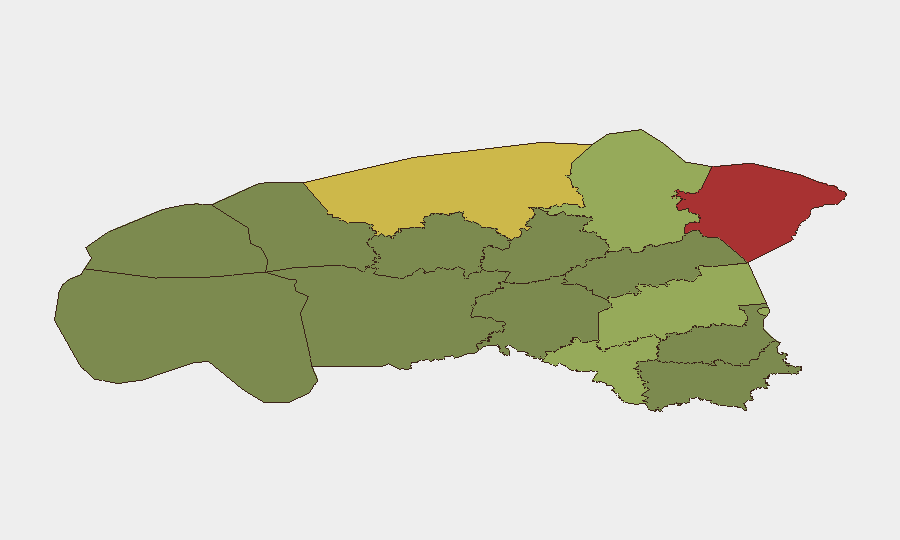
Ida-Viru County (risk 78) and Harju County (risk 68) emerge as the two highest-risk sub-national zones, driven primarily by proximity to the Russian border and concentration of critical infrastructure, energy assets, and NATO installations. Ida-Viru's elevated score reflects its location in the northeast, adjacent to Russia, where airspace violations, cross-border tensions, and potential hybrid threats remain persistent concerns despite current stability. Harju County, which includes Tallinn and the capital region, concentrates government, financial, and telecommunications infrastructure alongside heavy NATO and EU presence, elevating its exposure to cyber activity, political targeting, and diplomatic incidents. Tartu County (risk 58) and Valga County (risk 55) occupy secondary risk tiers, reflecting their positions in south-central and southern Estonia respectively, where cross-border dynamics with Russia and regional instability can still cascade. Lower-risk counties (Võru, Põlva, Viljandi) in the southwest maintain minimal threat profiles.
How GeoBit Would Assist
Security teams operating in Estonia should use GeoBit's AOI (Area-of-Interest) Monitoring & Early Warning capability to maintain persistent watch over Ida-Viru and Harju counties for airspace violations, border incidents, and infrastructure threats, with automated alerting for any sudden developments. Intel Sweep and multi-language OSINT fusion on Estonian government channels, NATO air-policing reports, and local media would provide real-time corroboration of any emerging threats, while Network & Actor Analysis would map diplomatic and hybrid threat actors with potential presence in-country. Routing & Network Analysis can support duty-of-care teams in identifying safe transit corridors and alternative routes around highest-risk regions if operational movement becomes necessary.
7-Day Outlook
Estonia's security environment is expected to remain stable over the next seven days absent new regional escalation or NATO–Russia incidents. Continued monitoring of Russian military activity, airspace compliance, and cyber targeting—particularly against critical infrastructure in Harju and Ida-Viru—remains prudent for corporate risk teams. No material change in travel or operational risk posture is anticipated unless new cross-border or hybrid incidents emerge.
Highest-Risk Areas — Ranked
| # | State / Region | Risk |
|---|---|---|
| 1 | Ida-Viru County | 78 |
| 2 | Harju County | 68 |
| 3 | Tartu County | 58 |
| 4 | Valga County | 55 |
| 5 | Lääne-Viru County | 52 |
| 6 | Pärnu County | 35 |
| 7 | Rapla County | 32 |
| 8 | Jõgeva County | 30 |
| 9 | Järva County | 28 |
| 10 | Viljandi County | 25 |
| 11 | Põlva County | 22 |
| 12 | Võru County | 18 |
Sources
Previous Daily Briefs
A new Estonia brief is written every day — each with its own risk map and downloadable CSV. Here's the last week; use the calendar to go further back.
📅 Browse every day by calendar →
Highlighted days have a brief. Tap a day for that day's map & analysis, or “csv” for that day's dataset ($5).