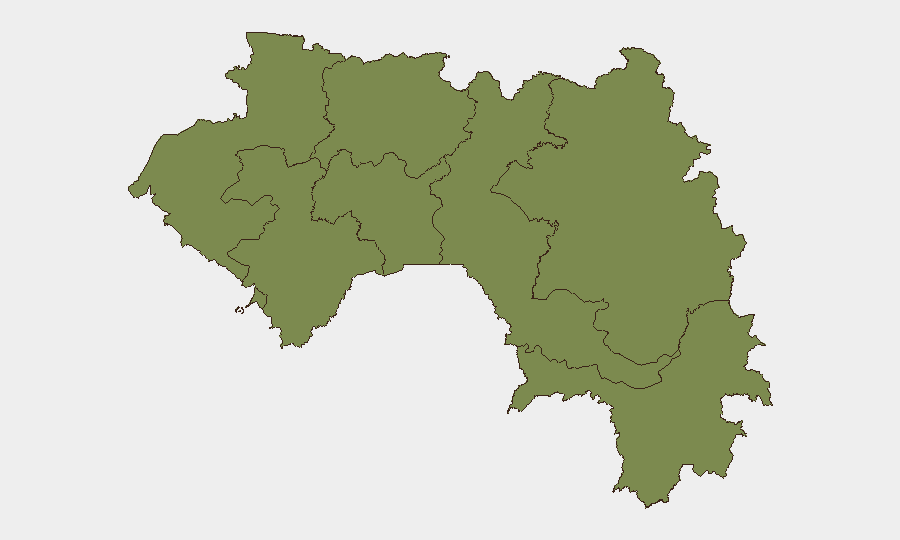
Situation Summary
Guinea remains a low-to-moderate security concern globally (rank #75, composite score 9) with 55 tracked threat events. Kankan Region dominates the risk profile with a composite score of 36—six times higher than any other region—driven by historical instability, border dynamics, and localized armed activity. Open-source reporting from the last 24–48 hours does not surface major acute incidents (coup, nationwide blackout, mass violence), though the absence of indexed web coverage does not confirm stability; local and francophone media channels require parallel monitoring for ground-truth validation.
Key Developments
- No major incidents confirmed in open web sources (24–48h window). Indexed news feeds, Twitter/X, and regional outlets do not report large-scale security events, coup attempts, or widespread violence in Guinea or Conakry as of 17 June 2026. However, open-source silence does not exclude localized incidents in remote areas or unindexed Telegram/WhatsApp channels.
- Shigellosis cases reported. A waterborne disease outbreak signal appears in disease-surveillance feeds; verification of geographic extent, caseload, and affected populations is required via health ministries and NGO field networks.
- Kankan Region remains the primary locus of instability. The region's risk score (36) reflects chronic border tensions, smuggling networks, and historical armed-group activity. Without specific dated incident reports in the last 48 hours, the ranking reflects rolling background threat rather than an acute escalation.
- Conakry and secondary regions holding steady. Risk scores of 6 across Boké, Labé, Kindia, Mamou, Faranah, and Nzérékoré suggest distributed, lower-level instability—criminality, localized resource disputes, or periodic civil unrest—rather than concentrated conflict.
Highest-Risk Areas
Kankan Region (score 36) is the outlier driver of national risk, likely reflecting smuggling-corridor activity, border instability with Mali and Côte d'Ivoire, and historical armed-group presence. All other regions (Boké, Labé, Kindia, Mamou, Faranah, Nzérékoré, and Conakry) cluster at score 6, indicating baseline criminality, urban protests, or episodic tensions that do not yet rise to acute conflict. Corporate security teams with personnel in Kankan should prioritize border-zone awareness and road-interdiction protocols; those in Conakry and other urban centers should monitor petty crime, civil unrest, and localized demonstrations.
How GeoBit Would Assist
Security teams should employ multi-language OSINT fusion (Twitter, Telegram, local Guinean radio and francophone outlets) to capture ground-truth signals missed by English-language feeds. Area-of-interest (AOI) monitoring with alerting on Kankan Region, border crossings, and Conakry transit hubs will provide persistent, near-real-time early warning for escalation or humanitarian crises. Network and actor analysis of smuggling corridors and armed-group affiliations offers context for assessing threat proximity to corporate assets and staff travel routes.
7-Day Outlook
No imminent national-level destabilization is signaled by available data. Kankan Region instability is likely to persist at current levels absent external shocks (cross-border escalation, resource crisis). Security teams should maintain baseline vigilance, refresh staff travel briefings, and activate incident-reporting chains; a 48-hour news void does not warrant alert downgrade.
Highest-Risk Areas — Ranked
| # | State / Region | Risk |
|---|---|---|
| 1 | Kankan Region | 36 |
| 2 | Boké Region | 6 |
| 3 | Labé Region | 6 |
| 4 | Kindia Region | 6 |
| 5 | Conakry | 6 |
| 6 | Mamou Region | 6 |
| 7 | Faranah Region | 6 |
| 8 | Nzérékoré Region | 6 |
Sources
Previous Daily Briefs
A new Guinea brief is written every day — each with its own risk map and downloadable CSV. Here's the last week; use the calendar to go further back.
📅 Browse every day by calendar →
Highlighted days have a brief. Tap a day for that day's map & analysis, or “csv” for that day's dataset ($5).