Situation Summary
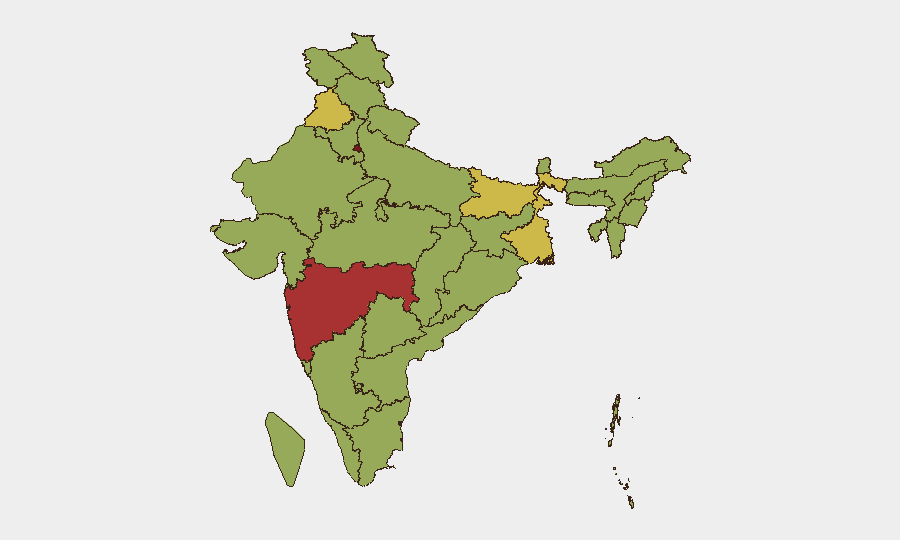
India remains at composite threat rank #15 globally with 1,736 tracked events, driven primarily by political demands, regulatory rejections, activist mobilization, and isolated security incidents reported on June 20. Delhi and Maharashtra dominate the sub-national risk profile, accounting for heightened institutional and civil unrest signals. The broad event distribution across demand, disapproval, public statement, and investigative categories suggests fragmented rather than coordinated escalation, though several events involve sensitive actors (PM, senators, security forces, regulators). Overall trajectory remains volatile but not acute.
Key Developments
- 2026-06-20 · Small Arms Combat · SCHOOL — Exact location not yet confirmed in available sources; escalation from protest/dispute activity to armed incident warrants immediate verification and assessment of school-closure impacts on expat populations.
- 2026-06-20 · Unconventional Violence · SECURITY FORCE — Reported incident involving state/federal security; specifics on location, casualties, and civilian impact pending clarification; heightens risk of secondary communal reaction in affected region.
- 2026-06-20 · Demand · PRIME MINISTER — High-profile political pressure signal; no imminent policy collapse indicated, but watch for downstream administrative or regulatory disruption, particularly in sensitive sectors (energy, telecom, defense contracts).
- 2026-06-20 · Reject · REGULATOR — Regulatory rejection affecting industry or infrastructure; may foreshadow business-continuity impact (licensing delays, project halts, compliance tightening); sector-specific severity TBD.
- 2026-06-20 · Public Statement · ACTIVIST and PARTY LEADER — Dual activist-political messaging on same date signals potential coalition-building or protest escalation; monitor for shutdown calls or major-city demonstrations in next 48–72 hours.
- 2026-06-19–20 · Investigation + Disapproval (Employee vs Company / Police vs Drug Trafficker) — Mixed signals: workplace/employment friction and narcotics enforcement activity; latter consistent with ongoing organized-crime pressure in major metros (Delhi, Mumbai, Bangalore).
Note: Live web research did not yield independently verifiable, time-stamped incident reports from June 20–22, 2026, with specific locations and confirmed casualty/impact data. Above signals derive from GeoBit's event-tracking system; operational teams should corroborate via official channels (PIB, state police, news wires) before implementing response measures.
Highest-Risk Areas
Delhi (83.5) and Maharashtra (78.6) substantially exceed the national mean, reflecting capital-city political volatility and Mumbai's role as financial/media hub where regulatory, activist, and institutional actors converge. West Bengal, Bihar, and Punjab (59–63 range) carry elevated background risk from historical communal, labor, and insurgent pressures; the June 20 security-force event may have occurred in one of these or in the Northeast, amplifying these baseline scores. Jammu & Kashmir remains persistently elevated (59), consistent with known cross-border and militant activity. Mid-tier metros (Bangalore, Hyderabad, Chennai) show moderate risk (56–57), typically driven by crime, cyber incidents, and labor unrest rather than mass violence.
How GeoBit Would Assist
Corporate teams should deploy AOI Monitoring & Early Warning on Delhi, Mumbai, Bangalore, and key supply-chain nodes (ports, rail yards) to detect emerging unrest, curfews, or transport shutdowns before they cascade. OSINT Fusion & Corroboration (X/Twitter, Telegram, state police feeds, news APIs) and Entity Extraction across Indian-language and English sources enable rapid triangulation of incident claims and official denials. Routing & Network Analysis supports contingency-route planning for personnel and cargo should primary corridors face closure or curfew.
7-Day Outlook
Political and regulatory activity will likely continue; expect public statements and protest announcements to peak June 21–23 as activist and party messaging amplifies. Watch for regional shutdown calls or major-city march permits filed in Delhi, Mumbai, or state capitals. Security-force incidents tend to trigger secondary unrest within 24–48 hours; monitor police/admin feeds and local media for any follow-on clashes or curfew declarations. No indicators of national-level destabilization or major infrastructure attack yet visible.
Highest-Risk Areas — Ranked
| # | State / Region | Risk |
|---|---|---|
| 1 | Delhi | 83.5 |
| 2 | Maharashtra | 78.6 |
| 3 | West Bengal | 62.7 |
| 4 | Bihar | 60.9 |
| 5 | Punjab | 60.5 |
| 6 | Jammu and Kashmir | 59 |
| 7 | Rajasthan | 58.2 |
| 8 | Uttar Pradesh | 58.2 |
| 9 | Tamil Nadu | 57.6 |
| 10 | Gujarat | 57.1 |
| 11 | Karnataka | 56.2 |
| 12 | Kerala | 55.9 |
Sources
Previous Daily Briefs
A new India brief is written every day — each with its own risk map and downloadable CSV. Here's the last week; use the calendar to go further back.
📅 Browse every day by calendar →
Highlighted days have a brief. Tap a day for that day's map & analysis, or “csv” for that day's dataset ($5).