Situation Summary
Malaysia remains a composite threat level 6 (rank #145 globally) with diffuse event activity concentrated in urban centres and specific states. Recent 24–48 hour signals reflect domestic political and administrative tension alongside a confirmed cyber incident affecting government infrastructure; no mass-casualty or acute security event has been corroborated in the immediate reporting window. The threat environment is characterized by institutional stress rather than acute instability, though concentrated risk in Kuala Lumpur and Johor warrants continuous monitoring.
Key Developments
- Malaysia, government websites — 2026-06-27/28 (early weekend) — Hacking group *Mushroow* conducted a cyber operation against multiple Malaysian federal government portals, including the Health Ministry website; NACSA confirmed several systems were affected and initiated containment and remediation protocols. No confirmed data breach or sensitive-information exfiltration has been reported to date.
- Malaysia, Health Ministry website — Late June 2026 — The Health Ministry took its official website offline to implement emergency cybersecurity hardening following the cyber incident; the ministry confirmed healthcare service delivery remained unaffected and stated no evidence of patient-data compromise has emerged.
- Domestic political/administrative signalling — 2026-06-28 to 2026-06-30 — Multiple public statements and demands were registered from government, civil-society, and industry sources; signals included a formal government rejection on an unspecified matter (2026-06-28), a citizen demand (2026-06-29), and a demand directed at the Malaysian monarchy (2026-06-30). These reflect ongoing domestic institutional and civic friction; specific underlying issues remain unconfirmed in open reporting.
- Regional diplomatic signal — 2026-06-29 — A public statement was attributed to Singapore in relation to a voter-engagement matter; separately, a "reduce relations" signal was attributed to Islam-vs-Malaysia positioning. Context and specific grievances remain unclear from available open sources.
- Ministry investigation trigger — 2026-06-30 — An unspecified ministry launched an investigation; scope and subject matter are not confirmed in accessible reporting.
Highest-Risk Areas
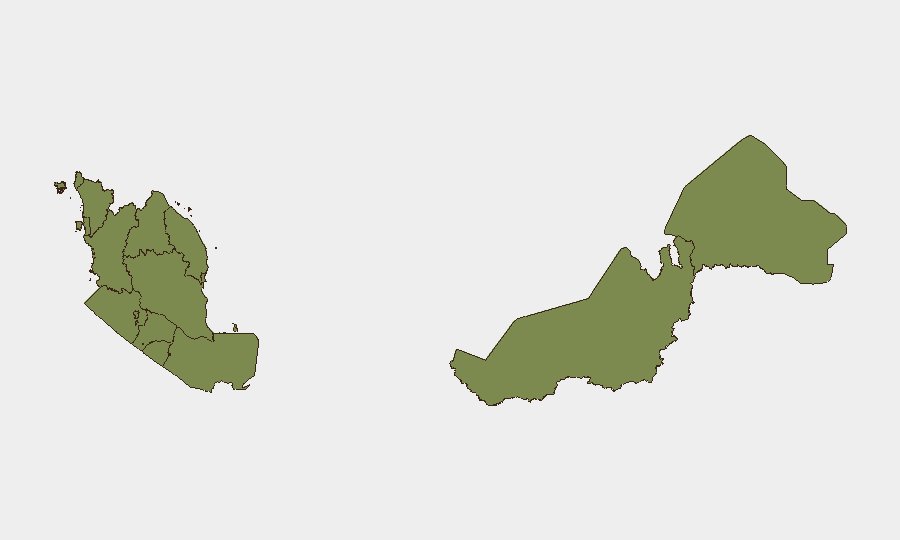
Kuala Lumpur (31.8) and Johor (28.8) together account for the majority of tracked risk events and represent the primary threat-concentration zones. Kuala Lumpur's risk profile reflects its role as the capital and economic hub, where political signalling, cybercrime targeting, and institutional friction naturally concentrate. Johor's elevated ranking suggests secondary institutional or criminal-activity clustering, likely linked to cross-border dynamics with Singapore and port/maritime infrastructure. Kedah (19.8) shows a tertiary risk elevation; Sarawak (15.2) carries noteworthy risk, possibly reflecting resource-sector or indigenous-governance sensitivities. Lower-risk states (Penang, Perak, Kelantan all at 1.8) and the smaller federal territories show minimal event footprint.
How GeoBit Would Assist
Security teams operating in Malaysia should employ AOI Monitoring & Early Warning on Kuala Lumpur and Johor to detect emerging political, cyber, or security-force activity in real time. Intel Sweep and multi-language OSINT fusion (X/Twitter, Telegram, government statements) would provide early corroboration of domestic institutional developments and cross-border diplomatic friction. Cyber-incident tracking and network-actor analysis would enable continuous situational awareness of threat groups targeting Malaysian federal infrastructure and supply-chain systems.
7-Day Outlook
Near-term trajectory suggests continued low-level institutional and civic friction without acute escalation risk. Cyber-targeting of government systems may persist; health and administrative services should anticipate possible disruption or access delays. The political signalling environment warrants close watch for any Malaysia–Singapore escalation or religious-identity-linked mobilization, though current indicators do not signal imminent acute risk.
Highest-Risk Areas — Ranked
| # | State / Region | Risk |
|---|---|---|
| 1 | Kuala Lumpur | 31.8 |
| 2 | Johor | 28.8 |
| 3 | Kedah | 19.8 |
| 4 | Sarawak | 15.2 |
| 5 | Perlis | 4.8 |
| 6 | Sabah | 4.8 |
| 7 | Pahang | 3.2 |
| 8 | Labuan | 3.2 |
| 9 | Negeri Sembilan | 3.2 |
| 10 | Penang | 1.8 |
| 11 | Perak | 1.8 |
| 12 | Kelantan | 1.8 |
Sources
Previous Daily Briefs
A new Malaysia brief is written every day — each with its own risk map and downloadable CSV. Here's the last week; use the calendar to go further back.
📅 Browse every day by calendar →
Highlighted days have a brief. Tap a day for that day's map & analysis, or “csv” for that day's dataset ($5).