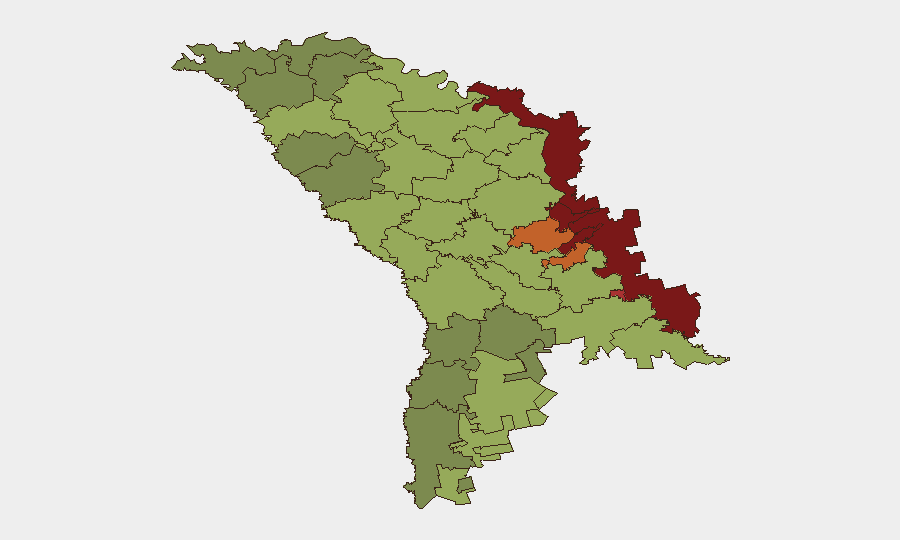
Situation Summary
Moldova remains at low global rank (#99, composite threat score 10) but exhibits sharp internal geographic fragmentation, with the Transnistrian left-bank region and surrounding frontier districts commanding elevated risk. State institutions continue to navigate competing pressures from Russia-aligned breakaway authorities and EU-integration constituencies; no acute security incidents have been confirmed in the past 24–48 hours. The security picture reflects chronic rather than acute instability, though border and regional tensions retain potential for rapid escalation.
Key Developments
Note: Live web research for the past 24–48 hours did not yield confirmed Moldova-specific security incidents independent of platform event signals. The most recent GEOBIT event citations (2026-07-08) relate to public statements by representatives and opposition actors but lack sufficient open-source detail to report as actionable developments. No independent corroboration of incident type, location, or operational impact is available at this time. Security teams should monitor next 48–72 hours for emergence of verified incidents in border zones (Dubăsari, Bender, Criuleni) and the Left Bank administrative cluster, where risk scores remain critically elevated.
Highest-Risk Areas
The Left Bank Dniester administrative units (risk 85) and Dubăsari (82) dominate the risk landscape, reflecting frozen-conflict dynamics, weak rule of law, smuggling networks, and Russian security-force presence. Bender (79), Criuleni (75), and Rezina (58) form a secondary risk arc along the Dniester corridor and northern border. These areas have historically experienced contraband movement, paramilitary activity, and political violence; proximity to Russia and the breakaway Transnistrian region amplifies both state-capacity gaps and external-actor leverage. By contrast, Chișinău (49), despite being the capital and largest urban center, ranks 12th, suggesting that localized institutional control and international visibility provide relative stability compared to rural frontier zones.
How GeoBit Would Assist
Security teams with personnel or assets in Moldova should deploy AOI (Area-of-Interest) Monitoring & Early Warning on the northern border districts (Soroca, Rezina), the Dniester corridor, and Transnistrian-adjacent towns to detect mobilization, checkpoint activity, or cross-border movement anomalies. Multi-language OSINT (X/Twitter, Telegram, local news feeds) and sentiment analysis would flag emerging political or security rhetoric in Russian and Romanian-language communities ahead of public statements. Border & disputed-territory search, conflict mapping, and network/actor analysis enable teams to track key officials, security chiefs, and opposition figures whose statements or movements often precede policy shifts or localized unrest.
7-Day Outlook
No imminent acute crisis is signaled in available intelligence, but the 2026 electoral cycle and ongoing EU–Russia competition for influence sustain baseline volatility. Monitoring should intensify around any statements from Transnistrian leadership, Russian security deployments, or announced government policy changes on autonomy or federalization—each has historically triggered opposition rallies or minor border incidents. Duty-of-care teams should ensure staff in Dubăsari, Bender, and the Left Bank have updated emergency protocols and communication redundancy.
Highest-Risk Areas — Ranked
| # | State / Region | Risk |
|---|---|---|
| 1 | Administrative-Territorial Units of the Left Bank of the Dniester | 85 |
| 2 | Dubăsari | 82 |
| 3 | Bender | 79 |
| 4 | Criuleni | 75 |
| 5 | Rezina | 58 |
| 6 | Taraclia | 55 |
| 7 | Gagauzia | 54 |
| 8 | Căușeni | 53 |
| 9 | Soroca | 52 |
| 10 | Ștefan Vodă | 51 |
| 11 | Orhei | 50 |
| 12 | Chișinău | 49 |
Sources
Previous Daily Briefs
A new Moldova brief is written every day — each with its own risk map and downloadable CSV. Here's the last week; use the calendar to go further back.
📅 Browse every day by calendar →
Highlighted days have a brief. Tap a day for that day's map & analysis, or “csv” for that day's dataset ($5).
Atlas — our AI intelligence desk — emails them this snapshot personally. Nothing else, no list.