Situation Summary
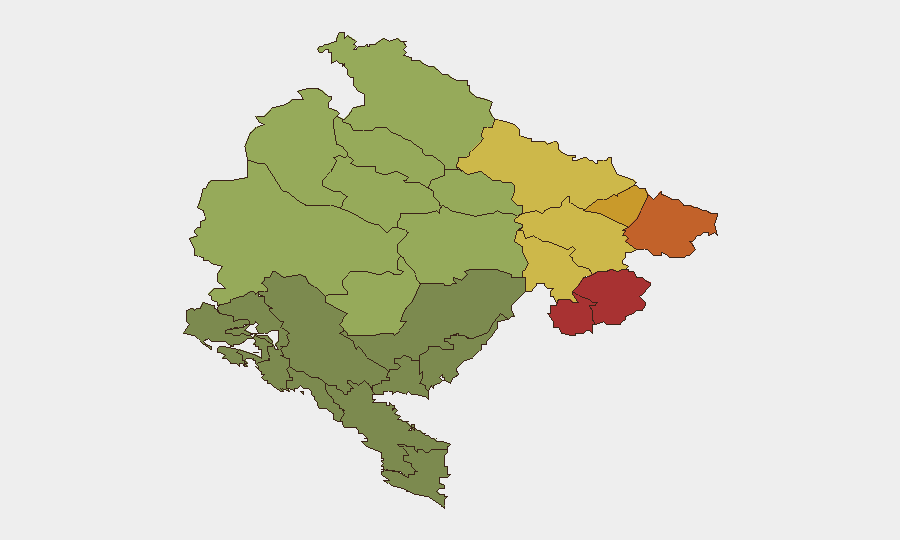
Montenegro remains a low-threat environment overall (composite threat score 6; ranked #158 globally), with no discrete security events recorded in the current tracking window. However, structural vulnerabilities persist: northern municipalities bordering Serbia and Kosovo continue to exhibit elevated risk scores (Plav, Gusinje, Rožaje, Petnjica all >70), reflecting long-standing ethnic tension, organized crime networks, and porous border control. Recent statements by Prime Minister Spajić (27 August) flagging coordinated hybrid threats tied to EU accession disputes indicate concern about regional state-level interference, though no operational incidents have materialized to date.
Key Developments
No verified security incidents were recorded in Montenegro during 24–48 hours preceding 29 August 2026.
Live web research and event signal monitoring returned no new discrete events (attacks, unrest, accidents, crimes, or infrastructure disruptions) with confirmed timestamps of 27–29 August. Historical developments from earlier in August—including the 22 August €500,000 reward for drug-trafficking fugitive Radoje Zvicer, the 25 August cyber-crime raid in Mareza, and 24 August ethnic incident in Tuzi—remain relevant context for threat posture but fall outside the current 24–48h reporting window.
Recommendation: Duty-of-care teams should monitor for delayed reporting or emerging secondary incidents tied to earlier operations (e.g., organized-crime enforcement fallout), as Montenegro's organized crime and corruption networks often generate reactive violence or destabilization weeks after law-enforcement action.
Highest-Risk Areas
The top five municipalities—Plav (78), Gusinje (76), Rožaje (74), Petnjica (72), and Andrijevica (68)—cluster in Montenegro's northeastern highlands, all bordering Serbia and Kosovo. Risk in this corridor reflects overlapping vulnerabilities: porous border management, entrenched smuggling and drug-trafficking routes, residual ethnic tensions tied to the 1990s Balkans conflicts, and limited state capacity for policing remote areas. Bijelo Polje (65), Berane (62), and Plužine (58) form a secondary risk band along similar trafficking corridors and ethnic fault lines. Central and coastal municipalities (Kolašin, Žabljak, Podgorica proper) score substantially lower, indicating that risk is geographically concentrated in the north and that the capital remains relatively stable.
How GeoBit Would Assist
Security teams with personnel or assets in Montenegro should deploy AOI Monitoring & Early Warning on Plav, Gusinje, and Rožaje municipalities to detect emerging unrest, border incidents, or trafficking activity before they escalate. Network & Actor Analysis and multi-language OSINT (targeting Serbian, Albanian, and local Montenegrin sources) would track organized-crime, ethnic, and hybrid-threat actors across the region and neighboring borders. Routing & Network Analysis can identify alternative supply-chain and personnel-movement routes that avoid high-risk municipalities during periods of elevated volatility.
7-Day Outlook
No imminent security shock is anticipated in Montenegro over the next seven days. However, the intersection of EU accession disputes (cited by Spajić on 27 August) and ongoing organized-crime enforcement activity creates latent risk for secondary incidents—retaliatory violence, border provocation, or coordinated destabilization by foreign actors—by mid-September. Continued monitoring of political rhetoric regarding EU chapters and organized-crime prosecution outcomes will signal whether hybrid-threat risk materializes operationally.
Highest-Risk Areas — Ranked
| # | State / Region | Risk |
|---|---|---|
| 1 | Plav Municipality | 78 |
| 2 | Gusinje Municipality | 76 |
| 3 | Rožaje Municipality | 74 |
| 4 | Petnjica Municipality | 72 |
| 5 | Andrijevica Municipality | 68 |
| 6 | Bijelo Polje Municipality | 65 |
| 7 | Berane Municipality | 62 |
| 8 | Plužine Municipality | 58 |
| 9 | Pljevlja Municipality | 55 |
| 10 | Šavnik Municipality | 52 |
| 11 | Žabljak Municipality | 50 |
| 12 | Kolašin Municipality | 48 |
Sources
Previous Daily Briefs
A new Montenegro brief is written every day — each with its own risk map and downloadable CSV. Here's the last week; use the calendar to go further back.
- August 26, 2026
- August 24, 2026
- August 22, 2026
- August 20, 2026
- August 18, 2026
- August 15, 2026
- August 13, 2026
📅 Browse every day by calendar →
Highlighted days have a brief. Tap a day for that day's map & analysis, or “csv” for that day's dataset ($5).
Atlas — our AI intelligence desk — emails them this snapshot personally. Nothing else, no list.