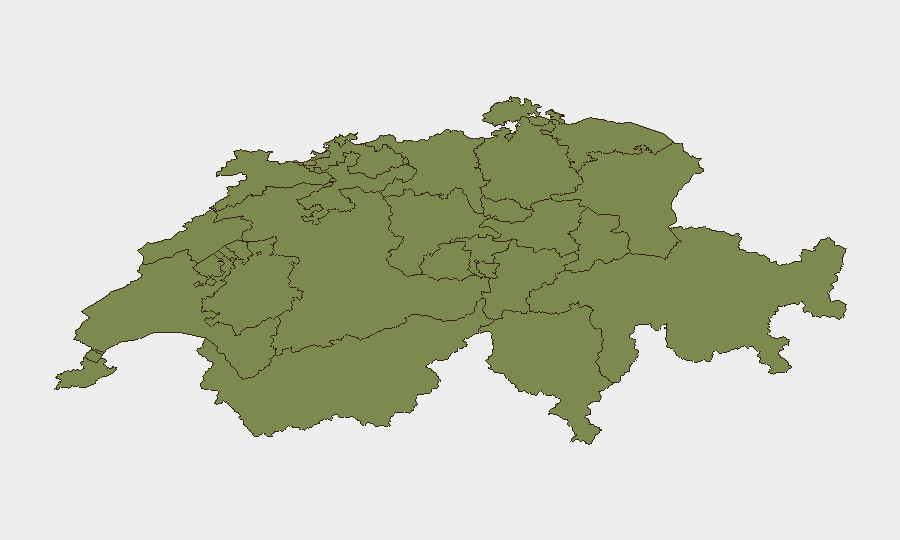
Situation Summary
Switzerland maintains a composite threat score of 4 (global rank #173), indicating low-to-moderate overall security risk. However, sub-national variation is pronounced: Lucerne's risk score of 31.4 substantially exceeds all other cantons, signaling localized volatility that warrants targeted monitoring. Recent event signals include diplomatic statements, ecclesiastical disputes, and international military developments with tangential Swiss nexus; no confirmed acute security incidents affecting Swiss territory or residents have been corroborated in the last 24–48 hours.
Key Developments
- 2026-07-05 · Iran–Israel Military Activity: Conventional military-force signals between Iran and Israel registered in GeoBit's Swiss monitoring footprint. Potential for escalation or secondary effects on Swiss financial markets, diaspora communities, and diplomatic posture; no direct territorial impact confirmed.
- 2026-07-04 · Ecclesiastical & Diplomatic Statements: Public statements by advocates and rejection signals from Haitian actors flagged. Context involves Vatican–Bishop tensions (2026-07-03); no violence or direct Swiss domestic implication confirmed, but watch for diplomatic friction.
- 2026-07-03 · Cross-Border Statement (Switzerland vs. France): Swiss government issued public statement regarding France; nature and scope not fully clarified in available signal data. Monitor for trade, migration, or security-cooperation implications.
- 2026-07-03 · Russia–Ukraine Signal (Reject): Russian rejection of Kyiv positions; secondary relevance to Swiss neutrality posture and potential sanctions-enforcement or financial-crime compliance burden.
- Lucerne Spike Unresolved: Lucerne's risk score (31.4) is an order of magnitude above peers; underlying drivers (protest activity, organized crime, infrastructure threat, or data-aggregation artifact) require urgent clarification via targeted OSINT and local-source validation.
Note: Open-source web research (last 24 h) has not yielded corroborated incident reports from Swiss law enforcement, media, or humanitarian sources for the 48-hour window. The signals above derive from GeoBit's event-feed aggregation; real-time confirmation via local Swiss police, cantonal authorities, or Swiss media outlets is recommended before escalating internal protocols.
Highest-Risk Areas
Lucerne's extreme elevation (31.4) relative to Wallis (3.8), Geneva (3), and Bern (3) suggests either a genuine acute threat cluster or a signal-aggregation anomaly requiring immediate analysis. Geneva and Bern—traditional diplomatic and political centers—carry baseline risk commensurate with their roles as UN hubs, federal seats, and banking nodes; this is expected. Zurich, Schwyz, Grisons, and the Basel/Jura/Solothurn corridor carry minimal scores (1.4–2.2), consistent with Switzerland's overall stability. Priority action: Validate Lucerne risk drivers through OSINT fusion, local-authority liaison, and temporal-analysis to distinguish genuine incidents from data artifacts.
How GeoBit Would Assist
Security teams should deploy Intel Sweep and multi-language OSINT fusion to corroborate the Lucerne spike and clarify the Iran–Israel and Vatican–Bishop signals' Swiss relevance. Area-of-Interest (AOI) Monitoring & Early Warning on Lucerne, Geneva, and Bern will provide persistent, real-time alerting for protest activity, security incidents, or diplomatic developments. Entity extraction and network analysis will map connections between Swiss actors, ecclesiastical bodies, and international stakeholders cited in recent event signals.
7-Day Outlook
No major escalation is forecast for Swiss territory in the near term; however, the Lucerne anomaly and international tensions (Iran–Israel, Ukraine) warrant continuous monitoring. Expect sustained diplomatic activity around sanctions compliance and financial-crime prevention. Recommend baseline heightened vigilance in Lucerne and Geneva pending signal clarification.
Highest-Risk Areas — Ranked
| # | State / Region | Risk |
|---|---|---|
| 1 | Lucerne | 31.4 |
| 2 | Wallis | 3.8 |
| 3 | Geneva | 3 |
| 4 | Bern | 3 |
| 5 | Zurich | 2.2 |
| 6 | Schwyz | 2.2 |
| 7 | Grisons | 2.2 |
| 8 | Basel-City | 1.4 |
| 9 | Jura | 1.4 |
| 10 | Basel-Landschaft | 1.4 |
| 11 | Solothurn | 1.4 |
| 12 | Aargau | 1.4 |
Sources
Previous Daily Briefs
A new Switzerland brief is written every day — each with its own risk map and downloadable CSV. Here's the last week; use the calendar to go further back.
📅 Browse every day by calendar →
Highlighted days have a brief. Tap a day for that day's map & analysis, or “csv” for that day's dataset ($5).
Atlas — our AI intelligence desk — emails them this snapshot personally. Nothing else, no list.