Situation Summary
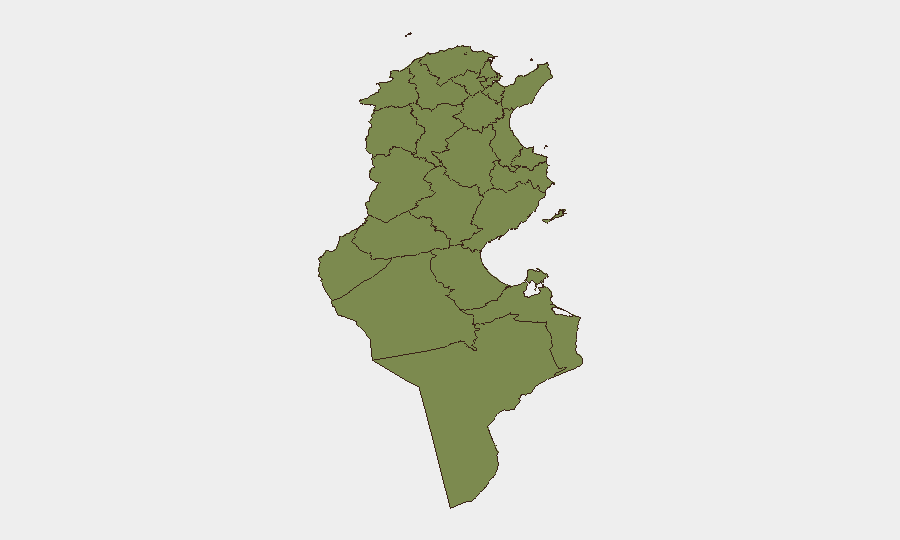
Tunisia remains under a state of emergency with a composite threat score of 23 and seven tracked events. Recent diplomatic tensions with Egypt and protest activity against immigrant communities, coupled with a flooding incident, underscore ongoing civil and natural-hazard pressures. The threat landscape is concentrated geographically: Kébili governorate exhibits substantially elevated risk (31.3), while most other regions score uniformly low (1.3), suggesting localized rather than nationwide instability.
Key Developments
- 2026-06-23 · Diplomatic Relations Downgrade: Tunisia announced a reduction of relations with Egypt. Context and mechanisms remain unclear from available reporting; monitor for maritime boundary, trade, or political grievances.
- 2026-06-23 · Public Statement on Financial Sector: Tunisia issued a public statement concerning banking institutions; specific nature and trigger require clarification via financial-sector and regime-stability monitoring.
- 2026-06-22 · Diplomatic Signal: Tunisia registered a disapproval signal; scope and target require further corroboration.
- 2026-06-21 · Protest Activity: Demonstration or rally activity occurred in Tunisia directed against immigrant communities. Scale, location, and law-enforcement response not yet specified.
- 2026-06-22 · Reduce Relations Signal: Tunisia broadcast a general reduction-of-relations signal; additional context required.
- Recent · Natural Hazard: A flood event affected an unspecified location in Tunisia (reference ID 1103945). Extent of infrastructure or humanitarian impact remains unconfirmed.
Note: Available open-source reporting does not provide granular incident details (times, precise locations, casualty/damage figures, or named officials) for the last 48 hours. Tactical corporate teams should supplement with direct liaison to local security partners and real-time commercial intelligence feeds.
Highest-Risk Areas
Kébili governorate (south-central, near the Sahara and Libyan border) dominates the risk landscape at 31.3, a tenfold differential above the second-ranked Kairouan (5.5). The remaining ten tracked regions cluster uniformly at 1.3, indicating that identified threat vectors—whether terrorism, organized crime, or civil unrest—are sharply concentrated in Kébili rather than diffused. Border-adjacent location, historical militant activity, and limited state presence likely explain the outlier profile. Kairouan's secondary elevation warrants monitoring for sectarian, protest, or trafficking dynamics; most of northern and central Tunisia scores low, consistent with urban stability and security-force density.
How GeoBit Would Assist
Corporate security teams with personnel or assets in Tunisia should prioritize AOI Monitoring & Early Warning on Kébili, Kairouan, and border regions to detect changes in militant or trafficking indicators before they affect supply chains or staff safety. Conflict & Military and Network & Actor Analysis capabilities would clarify the nature of the Egypt diplomatic downgrade and internal regime stability signals, which directly affect business continuity. Sentiment & Temporal Analysis on social-media and Telegram channels would provide early detection of protest escalation or civil unrest vectors before they spread from current demonstration sites.
7-Day Outlook
The diplomatic rift with Egypt, combined with flood-recovery demands and ongoing protest activity, will likely constrain state bandwidth for security operations in the near term. Kébili's persistently elevated risk profile suggests continued monitoring is essential for any cross-border operations or supply-chain routes transiting southern Tunisia. Absence of major escalatory signals in the last 48 hours does not indicate risk reduction, only that threshold events have not yet materialized.
Highest-Risk Areas — Ranked
| # | State / Region | Risk |
|---|---|---|
| 1 | Kébili | 31.3 |
| 2 | Kairouan | 5.5 |
| 3 | Tataouine | 1.3 |
| 4 | Nabeul | 1.3 |
| 5 | Monastir | 1.3 |
| 6 | Sfax | 1.3 |
| 7 | Mahdia | 1.3 |
| 8 | Médenine | 1.3 |
| 9 | Jendouba | 1.3 |
| 10 | Béja | 1.3 |
| 11 | Bizerte | 1.3 |
| 12 | Ariana | 1.3 |
Sources
Previous Daily Briefs
A new Tunisia brief is written every day — each with its own risk map and downloadable CSV. Here's the last week; use the calendar to go further back.
📅 Browse every day by calendar →
Highlighted days have a brief. Tap a day for that day's map & analysis, or “csv” for that day's dataset ($5).