Most security and intelligence products own one piece of the work: a feed, a mapping tool, a report, a room of analysts. We run the whole job, from seed to output. You hand us a question, a list of sites or a new market; we run the system and hand back checked alerts, briefs, maps and assessments. You make the call. We do everything around it.
The short version. Each is a service you can hire on its own, and each comes with the whole system and the people who run it. The longer version is the capabilities brief.
Everything in between is ours: the reading, the checking, the mapping, the writing and the sending. The one thing in the middle that stays yours is the decision.
A question that matters never lives in one place. The answer is only as good as the slowest hand-off between the systems and people it touches.
Ask whether a site is safe to open on Monday and the honest answer touches a dozen places at once: the incidents near it, the local press in another language, government advisories, the site's own history, the people travelling in, the route, the weather, the escalation tree, and the template your leadership reads.
Most vendors own one of those places. A feed owns the alerts. A mapping tool owns the layers. A consultancy owns the report, a week later. A watch room owns the shift. Each can be good at its slice, and the work between the slices lands on your team.
GeoBit was built to own the arc. One system reads all of it, a named person on your account stands behind it, and the output arrives finished: checked, mapped, written, sent and logged.
That is what an AI-native company can do that a tool cannot. Not a better slice. The whole job, done, with your person making the call.
The same question, run two ways. Every time the work changes hands, someone waits, something gets retyped, and context leaks. On GeoBit the work stays in one lane and only leaves it for the decision.
Twelve steps between a signal and a closed file. Each kind of vendor owns a few of them well. GeoBit owns all of them except the decision, and prepares that one for you: the recommendation, the evidence and the options on one screen.
Categories of vendor, not named companies. The point is not that slices are bad; it is how many of them your team has to stitch.
| The step | A data feed | A mapping tool | A consulting report | A staffed watch room | GeoBit |
|---|---|---|---|---|---|
| Collect | |||||
| Read local languages | |||||
| Corroborate | |||||
| Place, with precision | |||||
| Assess | |||||
| Map | |||||
| Write | |||||
| Alert and escalate | |||||
| Decide | Yours | Yours | Yours | Yours | Yourswe prepare it |
| Act on the decision | |||||
| Log, name and time | |||||
| After-action, learn |
Nobody on your side has to learn a tool. The machine does the reading and collection around the clock, our people turn it into product on your hours, and you keep the decision.
Collection, translation, corroboration, mapping and first drafts, around the clock, across about 130 countries in about 30 languages.
A named operator or desk lead on your channels, the engineers who built the platform, and vetted specialists from our bench when the job needs them.
Your standards, templates and reporting lines. Every recommendation arrives with its evidence; every decision is logged with a name and a time.
Four charts. The first three are built from things we have already published; the last one is labelled for what it is, an illustration of how an account moves.
A country-level assessment that took a security firm two to five business days was completed on GeoBit in under ten minutes, and periodic reports became near-continuous monitoring.
Source: Deloitte, The Space Edge. Logarithmic time axis.A named operator is on your channels the next business day after signature, fully onboarded in three to five business days: sites and areas loaded, escalation tree set, templates agreed.
From our service terms. The hiring line has no end on purpose: it varies, and it is measured in months.From our datacenter business case: a portfolio of 41 datacenter sites on five continents, watched by the system, ranked worst-first, and carried all the way to a staffing decision. Five words in, a decision out, and every step in between owned by one system.
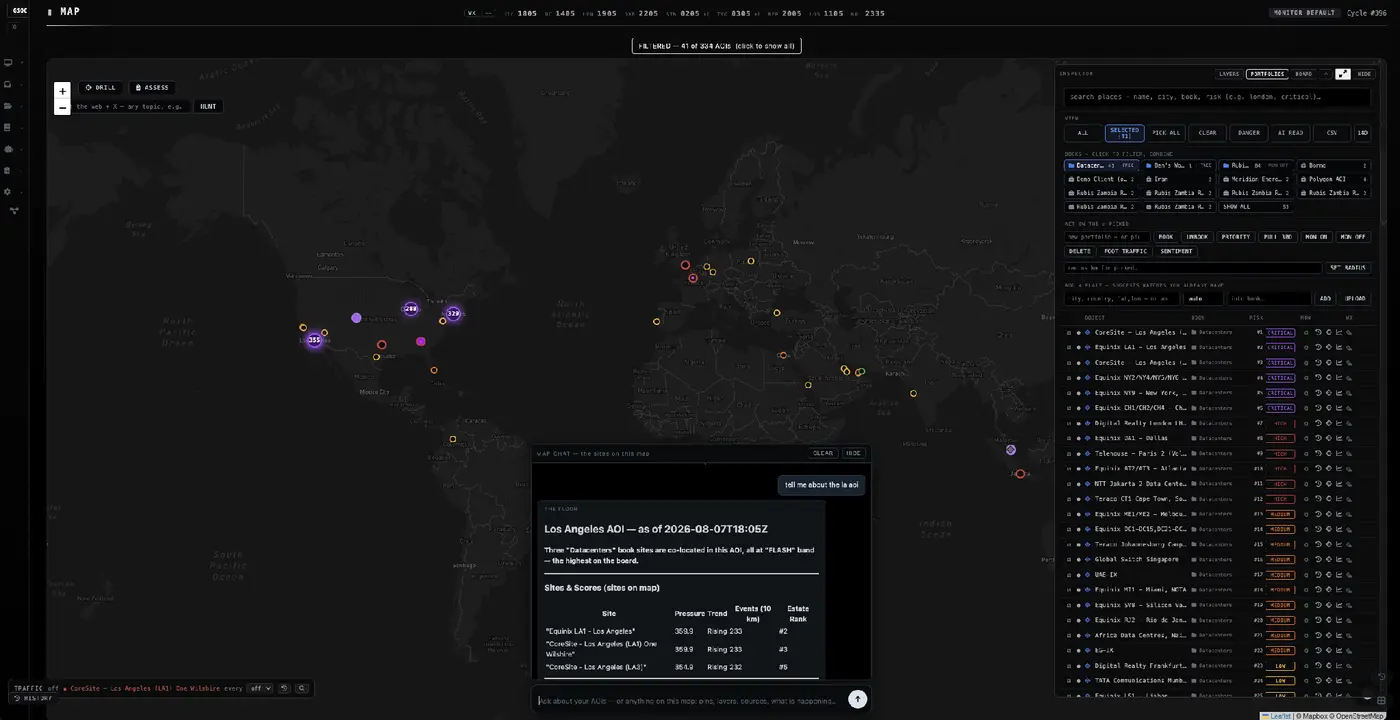
An operator types "tell me about the LA AOI". The floor answers, timestamped to the minute: three Los Angeles sites at the highest band on the board, the busiest at pressure 359.9 and rising, 233 events inside ten kilometres, ranked second across the estate.
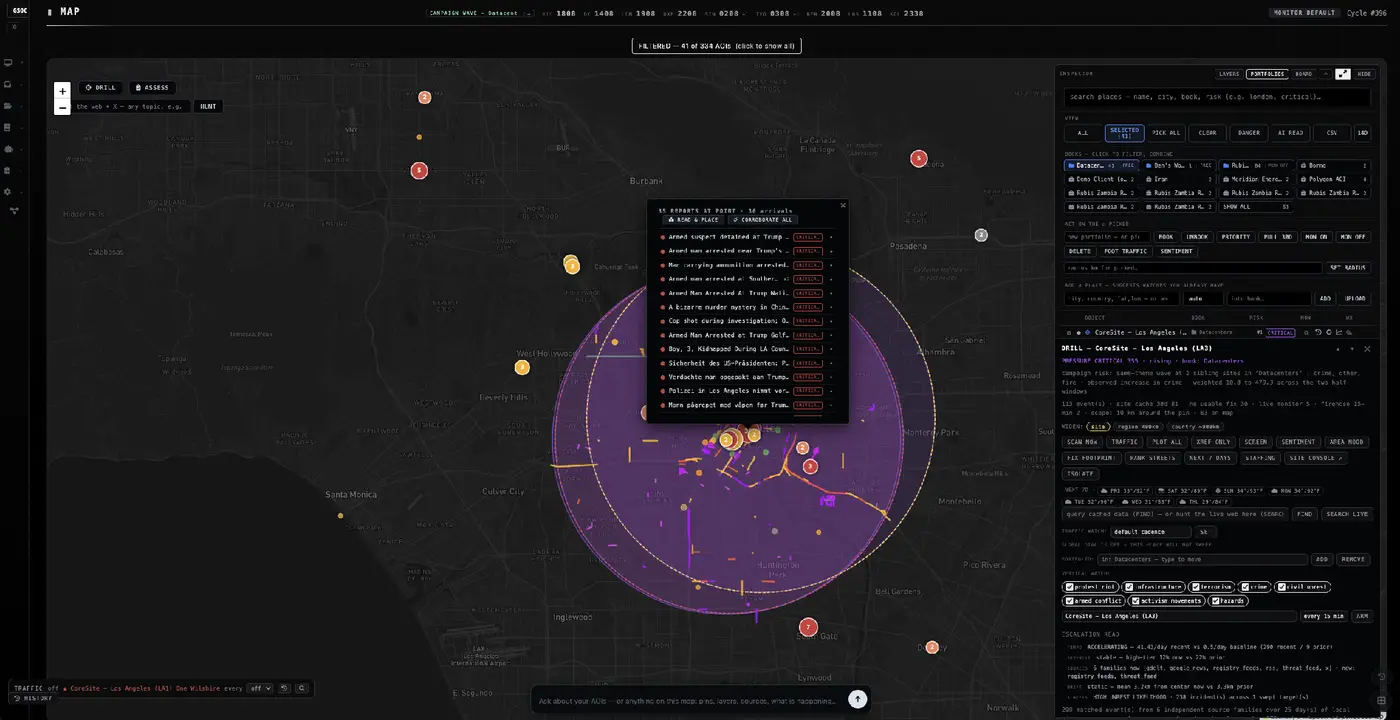
One click deeper: dozens of reports at one point, already read, placed and graded, each carrying its severity and sources, cross-checked across six independent source families. Reports below the three-source bar are held, not asserted.
Every facility ranked by a severity- and recency-weighted score, with the drivers in plain sentences and the reports behind each rank. Thin data reads NO SCORE, never a guess.
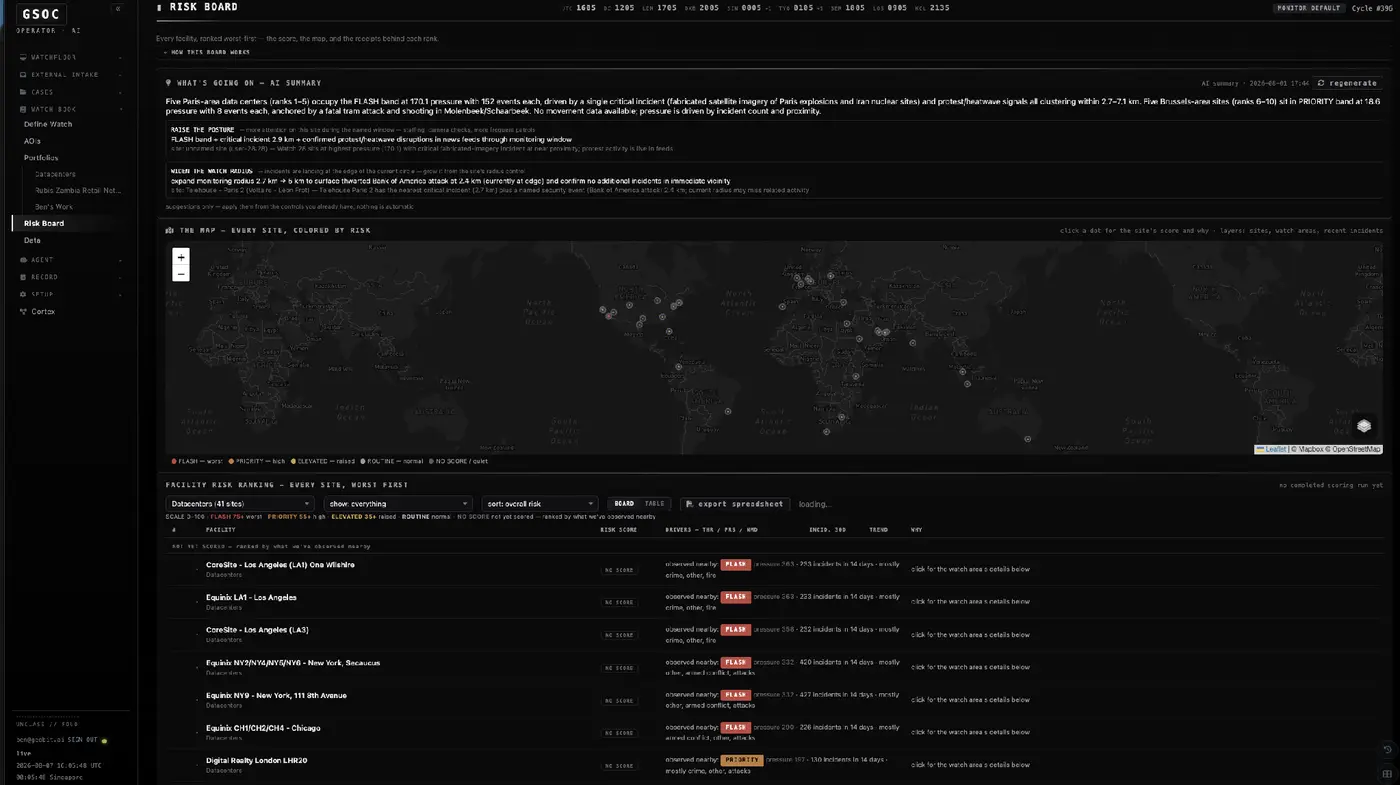
The top of the board is a staffing decision: where surge coverage, escorts and a seat at the next zoning meeting are warranted this week. Recommended by AI, decided by a named human, logged with the name and the time.
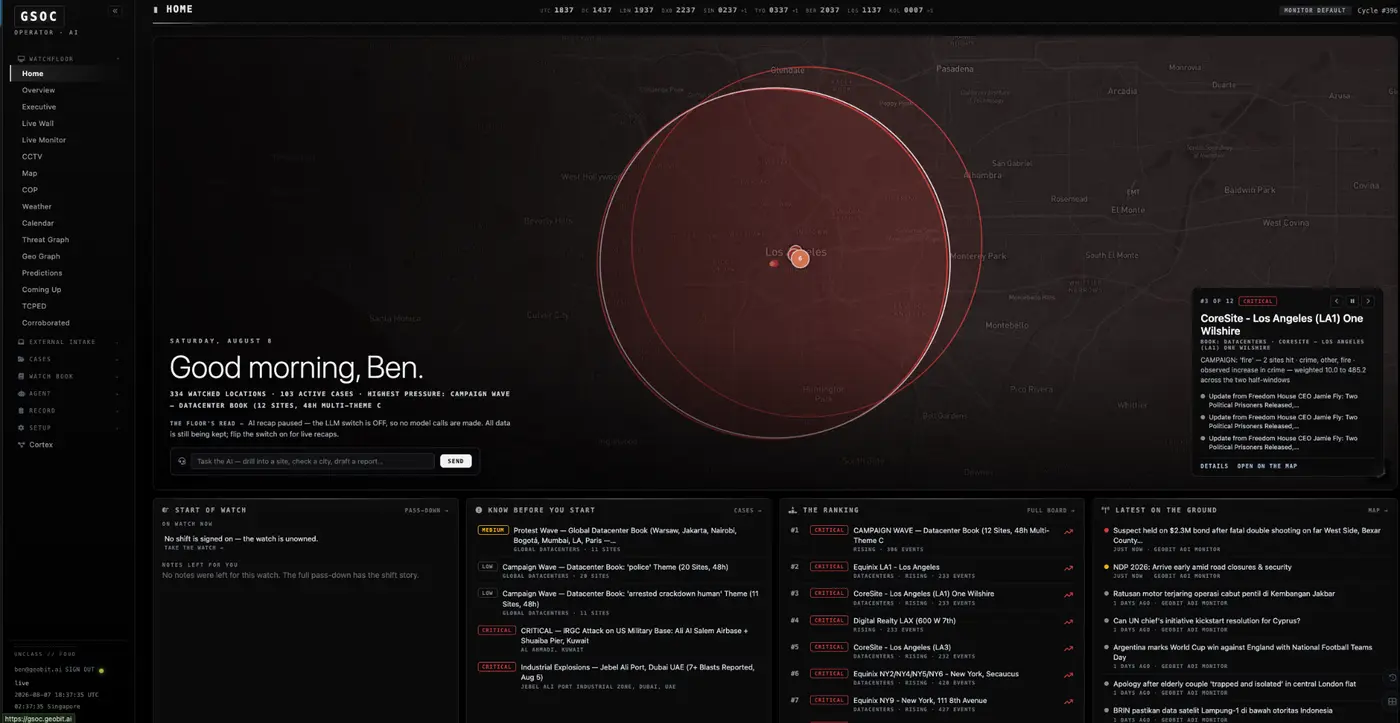
The morning brief on the highest-threat locations, and area briefing maps drawn by the system itself: headline, legend, verified incidents, severity zones. A named operator reviews and sends.
Three ways to use a company that owns the whole job. Switch between them to see which parts of your organization we take on, which we act as, and which stay yours.
Whole divisions come off your org chart and arrive as output: the alerts, the briefs, the maps, the plans. Your people keep the standards and the decision.
A region, a client or a line of business you have no people for yet. For the first stretch we act as your regional security office, your intelligence desk, your travel desk, your crisis office and your mapping team, all at once, on one system. Scale it when it pays; stand it down when it does not.
An illustration, not a client: one operator, then a second as a new region opens, five through an election month, back to steady, then more as a white-label client comes on. Operators are added or stood down month by month, with no requisition and no ramp.
An election, an evacuation, a storm, a strike. The desk already exists, so the surge is a phone call, not a hiring plan.
New sites, new regions, new clients. One to ten operators on the same system, scaled month by month.
The machine watches around the clock; named people work your hours and get paged above threshold.
For security and risk firms: we act as your delivery division. GeoBit watch, maps and briefs under your brand; you keep the relationship.
End to end does not mean out of your hands. The system prepares every decision with the evidence attached, a named person on your account recommends, your person decides, and we carry it out and write it down. Your standards, your reporting lines, your guard force or protection provider on the same picture.
You do not have to hire a desk to start. Pick one fixed first thing, or describe something else entirely, tell us where and when, and a person comes back within one working day with a scope, the date it lands, and the quote. Say yes and the work starts the next business day.
Hire any desk on this site and the platform, the watch, the other desks and the people come with it. Nothing is a module.
The whole system, everything included. Every chair comes with all of it.
We build your maps for you — daily or weekly — and deliver them.
Draw your areas; our AI watches them 24/7 and alerts you.
An AI-driven Global Security Operations Center for your org.
An engineer embedded with your team, deployed anywhere.
A named analyst on your channels, with the whole system behind them.
Hire the team and get the output: one to ten operators, every offering included.
A piece of intelligence work, done for you and delivered on a date.
How exposed a site is, from the fence line outward, with ranked fixes.
Who would do it and could they: actors placed by intent and capability.
What could go wrong, how likely, how bad, and what moves the score.
Find the pathway before the act: subjects assessed, places watched, cases filed.
Plans and drills before, a response desk in minutes during, after-action after.
Physical and control-system posture together, the dependency graph, the cascade.
Tell us the division you want run, the market you are entering, or the surge you need covered. We come back within one working day with a scope, a start date and a quote.