Situation Summary
Armenia's composite threat score of 14 reflects a moderate risk environment dominated by concentrated volatility in the capital, Yerevan. Recent event signals (8 tracked incidents over 48 hours) indicate ongoing civil–institutional friction, chiefly involving defense ministry, religious authority, and journalistic actors, alongside active investigative activity by authorities and international stakeholders. The sub-national risk distribution is heavily skewed: Yerevan accounts for approximately 71% of national risk, suggesting capital-centric instability with limited spillover to provincial areas. No imminent large-scale security deterioration is evident, but institutional tensions warrant continued monitoring.
Key Developments
- 2026-06-23 · Yerevan – Public statement conflict between Defense Ministry and religious clergy; administrative sanctions imposed against priest by Armenian authorities and Russian counterparts, suggesting cross-border institutional coordination around a domestic religious figure. Underlying dispute remains unconfirmed in available reporting.
- 2026-06-23 · Yerevan – Public statement confrontation documented between journalist and clergy; administrative sanctions action taken by Armenian authorities, indicating potential media–religion institutional strain.
- 2026-06-23 · Yerevan – Multiple public statements issued by Armenian state and unidentified religious authority; investigative action initiated by authorities, suggesting fact-finding on contested claims.
- 2026-06-22 · Armenia (location unspecified) – Rejection action recorded; nature of rejected item, actor, and location not clarified in available signals.
- 2026-06-21 · Armenia (nationwide scope) – Investigative activity by Armenian authorities; scope and subject matter not detailed in live research.
- 2026-06-21 · Armenia (nationwide scope) – Investigative interest expressed by United States toward Armenia; substance not confirmed in available reporting.
*Note:* Verifiable detail on specific incident locations (beyond Yerevan) and triggering events remains limited in live web research as of 2026-06-24 0600 UTC. Administrative sanctions and public statements suggest institutional or inter-agency friction rather than street-level civil disorder or criminal escalation.
Highest-Risk Areas
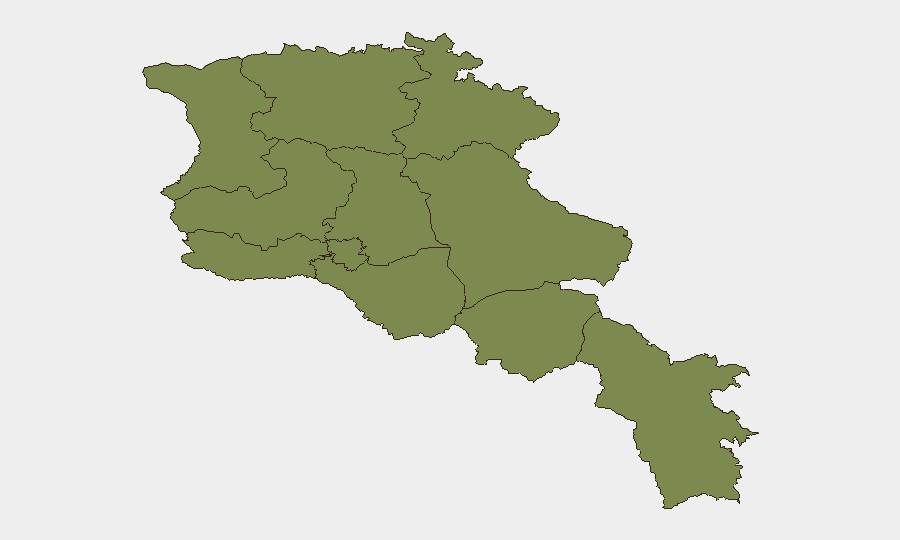
Yerevan dominates the risk profile with a composite score of 31.2—more than 2.5 times the next-highest region (Ararat Province, 12.4). This concentration reflects the capital's role as the locus of state institutions, media, and politically sensitive populations; recent signals point to inter-institutional disputes (defense, religious, journalistic) rather than territorial or community-level instability. Ararat Province (south-central, bordering Iran and the Nakhchivan exclave) carries secondary risk (12.4), likely reflecting historical sensitivities around border security and cross-border movement, though no current incidents are reported. All remaining provinces score at or below 4.9, indicating substantially lower operational risk; Syunik Province (southern border region) merits monitoring as a potential vulnerability corridor but is currently ranked below provincial baseline.
How GeoBit Would Assist
Security teams should deploy AOI Monitoring & Early Warning on Yerevan (capital institutions, media venues, religious sites) to detect escalation in civil–institutional friction before operational impact. Network & Actor Analysis would map relationships among defense ministry, clergy, journalistic, and investigative entities to anticipate secondary friction points or coordinated action. Multi-language OSINT (Armenian, Russian) and X/Twitter & Telegram intelligence would capture grassroots sentiment and unofficial actor positioning 12–48 hours ahead of public statements, enabling proactive duty-of-care decisions for personnel in sensitive sectors.
7-Day Outlook
Current trajectory suggests continued institutional friction at official level (public statements, administrative sanctions) without immediate escalation to street-level unrest or security service action. However, the involvement of international actors (US investigation interest, Russian sanctions coordination) and the religious dimension create unpredictability. Monitoring should remain elevated; material change in rhetoric, detention patterns, or cross-border coordination would signal higher risk to personnel and asset security in Yerevan.
Highest-Risk Areas — Ranked
| # | State / Region | Risk |
|---|---|---|
| 1 | Yerevan | 31.2 |
| 2 | Ararat Province | 12.4 |
| 3 | Syunik Province | 4.9 |
| 4 | Lori Province | 1.2 |
| 5 | Tavush Province | 1.2 |
| 6 | Kotayk Province | 1.2 |
| 7 | Gegharkunik Province | 1.2 |
| 8 | Vayots Dzor Province | 1.2 |
| 9 | Shirak Province | 1.2 |
| 10 | Aragatsotn Province | 1.2 |
| 11 | Armavir Province | 1.2 |
Sources
Previous Daily Briefs
A new Armenia brief is written every day — each with its own risk map and downloadable CSV. Here's the last week; use the calendar to go further back.
📅 Browse every day by calendar →
Highlighted days have a brief. Tap a day for that day's map & analysis, or “csv” for that day's dataset ($5).