Situation Summary
Belarus remains a secondary but strategically volatile security concern for Western corporate and diplomatic interests, ranking 86th globally with a composite threat score of 13. The country's stability is underpinned by Lukashenko's careful balancing act: maintaining alignment with Moscow while publicly resisting direct conscription into the Ukraine war and signaling restraint to Ukraine's leadership. Recent developments show tactical shifts in cross-border military infrastructure and intensified diplomatic messaging aimed at reassuring both Russian and Ukrainian stakeholders of Belarus' controlled posture—a delicate equilibrium vulnerable to external pressure or miscalculation.
Key Developments
- Gomel and Brest Regions, Belarus–Ukraine Border (June 22–25): Russian-installed signal repeater sites used to guide long-range drone strikes into western Ukraine went offline on June 22 and remained non-operational through June 25, following Ukrainian President Zelensky's June 19 ultimatum demanding their shutdown by June 26. This shutdown was publicly confirmed by Zelensky on June 24 and corroborated by ISW analysts, representing a significant Belarusian adjustment in passive military support to Russia.
- Minsk (June 25): President Lukashenko stated he had recently met representatives of Ukrainian President Zelensky in Minsk and warned that attempts to "drag Belarus into war" would "change the nature of the war instantly," signaling intent to resist escalation while maintaining Moscow alignment.
- Minsk / Union State Structures (June 25): Kremlin spokesperson Dmitry Peskov publicly denied Russian pressure on Belarus to broaden its war role, reaffirming Belarus as Russia's "closest ally" and emphasizing continued integration—a statement likely aimed at managing Western and Ukrainian concerns over deeper Belarusian involvement.
- Minsk, Forum of Regions (June 25): Lukashenko met with senior Russian officials and reaffirmed Belarus would "stand with Russia," reinforcing the dual messaging of political loyalty to Moscow coupled with resistance to direct combat participation.
- Vilnius / Lithuanian Border (June 25): Lithuania extended airspace restrictions along its Belarus border for six months, citing balloon incursions and drone-related incidents originating from or near Belarusian territory, indicating cross-border aviation risks persist.
Highest-Risk Areas
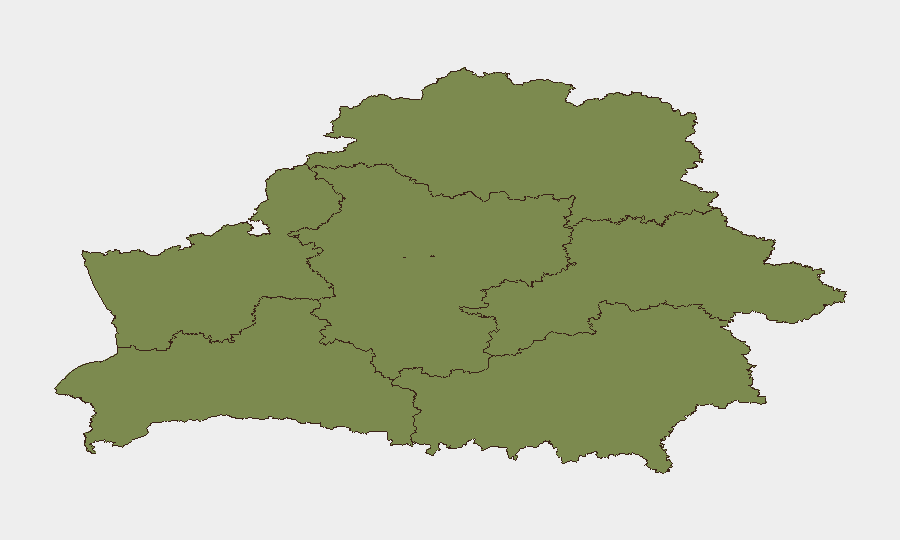
Minsk dominates the risk landscape with a composite score of 31.9, reflecting the concentration of political decision-making, diplomatic activity, and state security apparatus in the capital. Minsk Region (27.9) extends this risk profile into the metropolitan periphery. The remaining regional divisions—Brest, Vitsebsk, Hrodna, Mahilyow, and Homyel—each score below 2.0, indicating that organized threat activity, protest dynamics, and security incidents remain heavily centralized in and around Minsk. Border regions (Brest and Gomel) show elevated operational significance due to cross-border military infrastructure, but political and civil unrest risks remain minimal outside the capital.
How GeoBit Would Assist
Corporate security teams should deploy AOI Monitoring & Early Warning on Minsk and Minsk Region to track political, diplomatic, and regime-stability signals in real time. Network & Actor Analysis combined with Intel Sweep (OSINT fusion, Telegram/X monitoring, multi-language feeds) enables continuous assessment of Lukashenko's balancing act and Russian pressure points. Border & Disputed-Territory Search and Conflict & Military capabilities (force structure, cross-border infrastructure tracking) provide early warning of escalation in Brest and Gomel regions, critical for supply-chain and personnel-safety planning in western Belarus.
7-Day Outlook
The June 26 deadline for signal repeater shutdown has effectively passed, with Belarusian compliance already achieved by June 22. Near-term risk remains moderate and stable, contingent on Lukashenko's ability to maintain the current dual-messaging posture toward Moscow and Kyiv. If Russian pressure intensifies or Ukraine escalates drone strikes into Belarusian airspace, the current equilibrium could fracture rapidly, raising the risk profile for Minsk and border regions within days.
Highest-Risk Areas — Ranked
| # | State / Region | Risk |
|---|---|---|
| 1 | Minsk | 31.9 |
| 2 | Minsk Region | 27.9 |
| 3 | Brest Region | 10 |
| 4 | Vitsebsk Region | 1.9 |
| 5 | Hrodna Region | 1.9 |
| 6 | Mahilyow Region | 1.9 |
| 7 | Homyel Region | 1.9 |
Sources
Previous Daily Briefs
A new Belarus brief is written every day — each with its own risk map and downloadable CSV. Here's the last week; use the calendar to go further back.
📅 Browse every day by calendar →
Highlighted days have a brief. Tap a day for that day's map & analysis, or “csv” for that day's dataset ($5).