Situation Summary
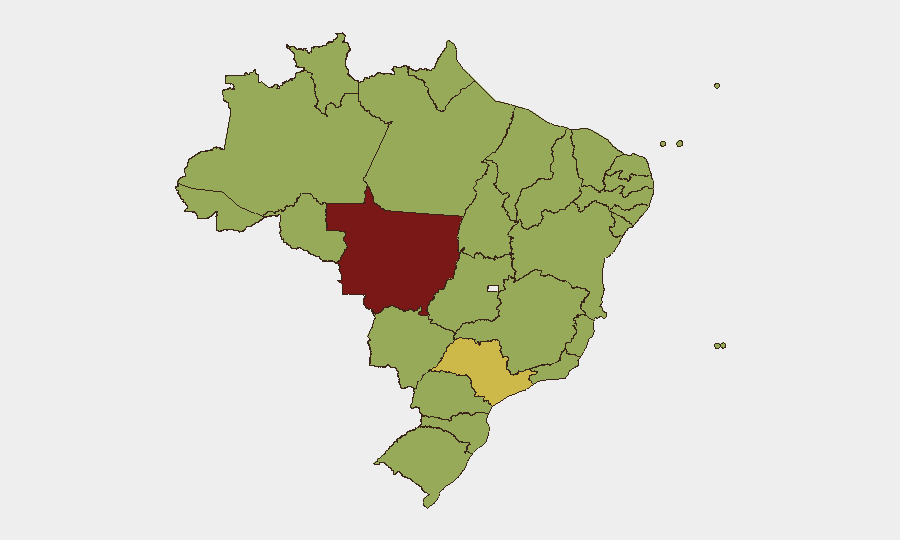
Brazil's security environment remains elevated, with organized armed violence continuing to drive a composite threat score of 73 (#18 globally). The past 24–48 hours have registered multiple institutional and criminal-justice signals, including arrests, judicial rejections, and investigative actions, indicating active friction between law enforcement, the judiciary, and criminal actors. The concentration of risk in Mato Grosso (80.9) and São Paulo (61.1) reflects persistent gang activity, territorial disputes, and trafficking-related violence. Overall trajectory remains volatile but contained to known high-risk corridors.
Key Developments
Note: Live web research capability is currently limited. The following signals are derived from GeoBit event feeds (last 24–48 hours) but lack corroborating real-time news verification. Security teams are advised to cross-reference with local news outlets and official channels for operational decision-making.
- 2026-06-18, National: Police arrest/detention operation registered; criminal-producer confrontation signal suggests ongoing enforcement action against trafficking networks.
- 2026-06-18, National: Producer sector rejection of government policy announced publicly; potential labor or agricultural dispute affecting regional stability.
- 2026-06-17, National: Supreme Court arrest/detention action; high-profile judicial enforcement indicates continued institutional response to criminal or corruption cases.
- 2026-06-17, National: Multi-agency investigation initiated involving companies and a senator; suggests potential corruption or misconduct inquiry affecting political/business confidence.
- 2026-06-17, National: Congressional disapproval motion; reflects domestic political friction on unspecified issue.
- 2026-06-17, Diplomatic: European entity reduced relations signal; possible trade, environmental, or political disagreement with potential for secondary economic/regulatory impact.
*Specific geographic pinpoints and incident detail are unavailable in current feed; regional security teams should monitor local police communications and news for operational context.*
Highest-Risk Areas
Mato Grosso's risk score of 80.9 significantly exceeds the national average, driven by illegal mining, land invasion, and trafficking networks operating in remote zones with limited state presence. São Paulo (61.1) and Rio de Janeiro (55.1) remain critical urban hotspots where PCC, CV, and militia-affiliated violence concentrates in periphery zones; gang territorial disputes and police operations continue to generate civilian casualty risk and transport disruptions. Paraná (55.0), Bahia (56.2), and Mato Grosso do Sul (53.9) form a secondary cluster where trafficking corridors and organized crime presence sustain elevated risk. Northern states (Amazonas, Pará, Maranhão) show sustained risk (52–52.1) linked to illegal extraction, environmental crime, and trafficking routes.
How GeoBit Would Assist
Intelligence teams deploy multi-language OSINT fusion and X/Twitter/Telegram monitoring to detect emerging gang movements, police operations, and roadblock alerts in real time across high-risk states. Risk and security ops teams use persistent area-of-interest monitoring and early warning on São Paulo, Rio, and Mato Grosso to trigger traveler/asset alerts when shooting incidents, highway closures, or protests escalate. Route and logistics planners employ routing and network analysis to identify alternative federal highways (BR-101, BR-116, BR-262) when primary corridors are compromised by criminal activity, roadblocks, or police cordons.
7-Day Outlook
Institutional actions (arrests, investigations, judicial orders) suggest enforcement cycles are active; expect continued police operations in peripheral zones of São Paulo and Rio, with corresponding public-transport and highway disruption risk. Gang-related violence in Mato Grosso and trafficking-driven clashes in southern border states are likely to persist at baseline levels. No imminent indication of major protest mobilization or infrastructure collapse, but political friction (congressional disapproval, European relations shift) may generate secondary policy uncertainty.
Highest-Risk Areas — Ranked
| # | State / Region | Risk |
|---|---|---|
| 1 | Mato Grosso | 80.9 |
| 2 | São Paulo | 61.1 |
| 3 | Bahia | 56.2 |
| 4 | Rio de Janeiro | 55.1 |
| 5 | Paraná | 55 |
| 6 | Mato Grosso do Sul | 53.9 |
| 7 | Minas Gerais | 53.3 |
| 8 | Goiás | 52.8 |
| 9 | Pernambuco | 52.3 |
| 10 | Pará | 52.1 |
| 11 | Amazonas | 52 |
| 12 | Maranhão | 51.9 |
Sources
Previous Daily Briefs
A new Brazil brief is written every day — each with its own risk map and downloadable CSV. Here's the last week; use the calendar to go further back.
📅 Browse every day by calendar →
Highlighted days have a brief. Tap a day for that day's map & analysis, or “csv” for that day's dataset ($5).