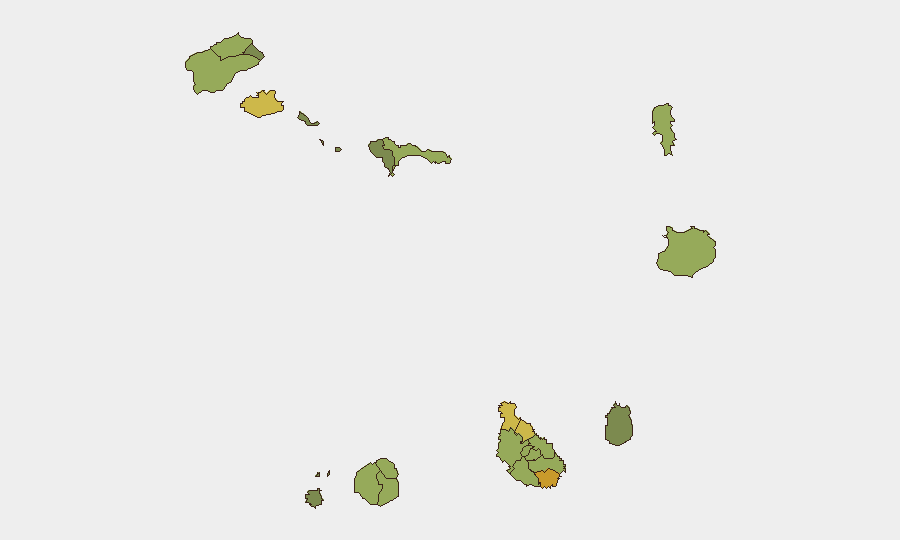
Situation Summary
Cape Verde remains a low-threat jurisdiction (rank 176 globally) with no tracked security incidents during the reporting period. The country's composite threat score reflects its relative stability as a democratic island nation with functional civil institutions. However, residual infrastructure damage from Tropical Storm Gonzalo (late September) continues to affect Sal Island, and sub-national risk concentration in urban centers—particularly Praia—warrants targeted monitoring of crowd-management scenarios and localized service disruptions.
Key Developments
- Sal Island — September 25 (reported ongoing): Tropical Storm Gonzalo caused flooding and infrastructure damage; civil-protection and emergency services remain deployed for response and recovery operations. Disruptions to utilities and transportation links persist, though no security incidents have been corroborated.
- Praia — September 29–30: Cape Verde national football team lost 1–2 to Rwanda in a 2027 Africa Cup of Nations qualifier at the national stadium. While the match itself is sports-related, the result could generate localized crowd-management requirements in the capital; no unrest has been reported.
- Cape Verde (overseas) — September 30: Prime Minister Francisco Carvalho attended an official ceremony in Exeter, Rhode Island, honoring Cape Verdean veterans. This was routine diplomatic travel with no domestic security implications.
- Cape Verde (national) — September 30: MpD party leader Paulo Veiga issued a statement calling for the party to rebuild public trust and increase support ahead of future municipal elections. The statement reflects routine domestic political discourse; no protest, violence, or instability was reported.
Highest-Risk Areas
Praia (risk 72), São Miguel (68), and São Vicente (65) significantly outrank other municipalities and drive the country's sub-national threat profile. Praia's elevated score reflects its role as the capital and administrative hub—concentrating population, government assets, and commercial activity—combined with typical urban vulnerabilities to petty crime and crowd-related incidents. São Miguel and São Vicente show similar patterns as secondary urban centers. The 20-point differential between Praia and lower-ranked regions indicates that security management should prioritize capital-city operations and personnel; peripheral and rural areas present substantially lower risk.
How GeoBit Would Assist
Security teams managing Cape Verde operations should deploy AOI Monitoring & Early Warning on Praia, São Vicente, and post-storm Sal Island to detect emerging incidents in near-real time. Intel Sweep and X/Twitter OSINT would provide continuous visibility into crowd dynamics around political events, sports fixtures, and infrastructure recovery; sentiment & temporal analysis can flag anomalies before they escalate. Routing & Network Analysis supports duty-of-care planning for personnel movement through Praia during high-risk periods (e.g., election cycles, large gatherings), and Environmental & Health monitoring tracks lingering storm-recovery impacts on utilities and transport.
7-Day Outlook
No imminent security threats are forecast for Cape Verde during the coming week. Storm-recovery efforts on Sal Island are expected to continue without major incident, and post-match sentiment following the Rwanda fixture should remain contained to sports commentary. Monitoring should remain routine but persistent, with particular attention to Praia during any scheduled political or public events.
Highest-Risk Areas — Ranked
| # | State / Region | Risk |
|---|---|---|
| 1 | Praia | 72 |
| 2 | São Miguel | 68 |
| 3 | São Vicente | 65 |
| 4 | Tarrafal | 62 |
| 5 | São Filipe | 58 |
| 6 | Santa Catarina | 58 |
| 7 | Santa Cruz | 55 |
| 8 | Mosteiros | 52 |
| 9 | São Salvador do Mundo | 52 |
| 10 | Ribeira Grande | 50 |
| 11 | Porto Novo | 48 |
| 12 | Sal | 48 |
Sources
Previous Weekly Briefs
A new Cape Verde brief is written every Monday, covering the week — each with its own risk map and downloadable CSV. Use the calendar to go further back.
- September 29, 2026
- September 22, 2026
- September 15, 2026
- September 8, 2026
- September 2, 2026
- August 30, 2026
- August 27, 2026
📅 Browse past briefs by calendar →
Highlighted days have a brief. Tap a day for that day's map & analysis, or “csv” for that day's dataset ($5).
Atlas — our AI intelligence desk — emails them this snapshot personally. Nothing else, no list.