Situation Summary
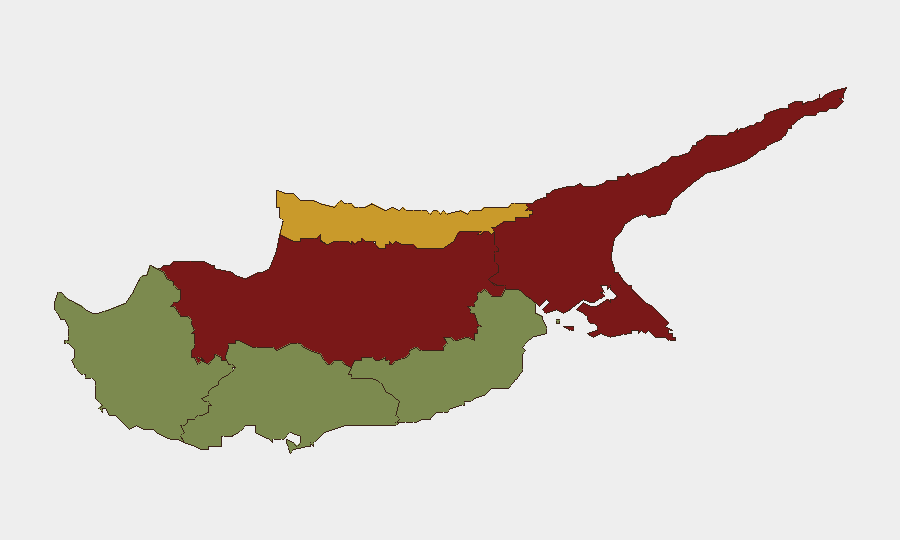
Cyprus remains a lower-tier global security concern (rank #171, composite score 6) but continues to experience localized volatility concentrated in the divided northern territories and buffer-zone management. The past week has seen routine police enforcement operations yielding moderate arrest and traffic violation counts, a discovery of an unexploded improvised explosive device in Limassol, and ongoing tensions over buffer-zone agricultural access near Nicosia. The security picture is broadly stable, though northern risk zones (Nicosia, Famagusta, Kyrenia) remain significantly elevated relative to southern population centers.
Key Developments
- Limassol, Mesa Geitonia — September 30: Police discovered an unexplosed improvised explosive device outside a business building during early-morning operations following a suspicious motorcycle report. The device did not detonate and circumstances remain under investigation.
- Across Cyprus — October 3–4: Overnight police operations targeting serious and organized crime resulted in 12 arrests (illegal residence, drug possession, drunk driving). Officers checked 724 vehicles, 924 occupants, and 76 premises, recording 319 traffic offences and confiscating 26 vehicles.
- Across Cyprus — October 2–3: Police conducted Friday-night enforcement operations, arresting six people and recording 280 traffic violations, with 11 vehicles confiscated.
- Across Cyprus — September 29: Overnight operations yielded four arrests for drug offences, illegal residence, and court-order violations. Police checked 397 drivers and 111 passengers, recording 199 traffic violations including 110 speeding offences.
- Limassol — October 5: Police opened an investigation into an assault on a delivery driver on Spyrou Kyprianou Road on October 2; video evidence circulated on social media, though no formal complaint had been filed at time of reporting.
- Larnaca — October 5: Residents of an apartment complex formally demanded police and immigration intervention over alleged illegal subletting, tampered utilities, hygiene violations, and building code breaches. Police and district authorities confirmed long-standing structural problems.
- Mitsero / Agios Ioannis–Kato Moni — October 4: Residents from eight communities protested planned asphalt-plant construction at the site and sought a court injunction to suspend works.
- Nicosia buffer zone — September 23: Turkish forces obstructed Greek Cypriot farmers from ploughing fields in the Deneia buffer zone west of Nicosia; UN peacekeepers intervened and resolved the incident.
- Cyprus — October 5: The Electricity Authority Employees Union announced a one-day general strike for October 5; operational and facility impact was not specified in available reporting.
Highest-Risk Areas
Nicosia (risk 92) and Famagusta (risk 88) drive the national risk profile due to their proximity to the UN buffer zone and ongoing inter-community tensions, including periodic access disputes and military posturing. Kyrenia (risk 72) remains elevated for similar geopolitical reasons. Southern coastal cities—Larnaca (28), Limassol (22), and Paphos (18)—carry significantly lower composite scores but have recorded localized crime incidents (assault, IED discovery, building code violations) requiring sectoral attention. Risk concentration in the north reflects the Cyprus division and UN peacekeeping presence; southern risk is primarily infrastructure and street-level crime.
How GeoBit Would Assist
Teams managing personnel or assets across Cyprus should deploy AOI Monitoring & Early Warning on Nicosia and Famagusta to detect buffer-zone incidents and military activity with lead time. OSINT fusion (X/Twitter, Telegram, local news feeds) provides rapid intelligence on protest activity, police operations, and emerging infrastructure disputes—as demonstrated by the apartment-complex and asphalt-plant incidents. Risk & Threat Assessment and Network & Actor Analysis help distinguish between organized crime patterns and localized criminal incidents, informing duty-of-care protocols for staff movement and asset placement.
7-Day Outlook
Near-term risk is expected to remain stable but fragmented: routine police enforcement will continue, buffer-zone tensions may spike around seasonal agricultural activity, and localized crime—particularly in Limassol—warrants heightened awareness. The October 5 electricity strike may cause service disruptions affecting business continuity, though impact scope is currently undefined.
Highest-Risk Areas — Ranked
| # | State / Region | Risk |
|---|---|---|
| 1 | Nicosia | 92 |
| 2 | Famagusta | 88 |
| 3 | Kyrenia | 72 |
| 4 | Larnaca | 28 |
| 5 | Limassol | 22 |
| 6 | Paphos | 18 |
Sources
Previous Weekly Briefs
A new Cyprus brief is written every Monday, covering the week — each with its own risk map and downloadable CSV. Use the calendar to go further back.
- September 28, 2026
- September 21, 2026
- September 14, 2026
- September 7, 2026
- August 31, 2026
- August 29, 2026
- August 26, 2026
📅 Browse past briefs by calendar →
Highlighted days have a brief. Tap a day for that day's map & analysis, or “csv” for that day's dataset ($5).
Atlas — our AI intelligence desk — emails them this snapshot personally. Nothing else, no list.