Situation Summary
Finland remains a low-threat environment globally (composite score 6/255), with no active tracked security events at the national level as of 26 August 2026. The most significant near-term driver is strategic: Finnish and Nordic governments have publicly framed Russian hybrid-threat escalation (sabotage, infrastructure targeting, psychological operations) as an ongoing concern tied to Finland's NATO alignment and role in supporting Ukraine. A single suspected arson incident in Helsinki on the morning of 26 August is under active police investigation but remains isolated and without confirmed motive.
Key Developments
- Suspected arson – Helsinki (Puistola district), 26 August, 05:00+
Carport and multiple vehicles caught fire adjacent to a residential building; Helsinki police are investigating as suspected arson (tuhotyö) but have not ruled out accidental electrical or vehicle-related cause. No arrests reported. Active witness appeal issued; investigation ongoing.
- Government hybrid-threat warning – Finland (national), 25 August
Prime Minister Petteri Orpo and Finnish authorities publicly characterized Russian hybrid operations across Europe—including sabotage and covert action—as an escalating threat aimed at intimidating NATO supporters and disrupting military assistance flows. Framed as strategic concern rather than discrete incident response.
- Enhanced police traffic enforcement – Finland (nationwide), concluded 25 August
Multi-day enforcement operation (10–21 August) completed with heightened police presence and activity across the country; reflects ongoing operational posture around back-to-school period but is not incident-specific.
- No additional discrete security incidents reported in the 24–48-hour window beyond the Helsinki fire. Open reporting on Finland-specific security matters for 25–26 August is limited.
Highest-Risk Areas
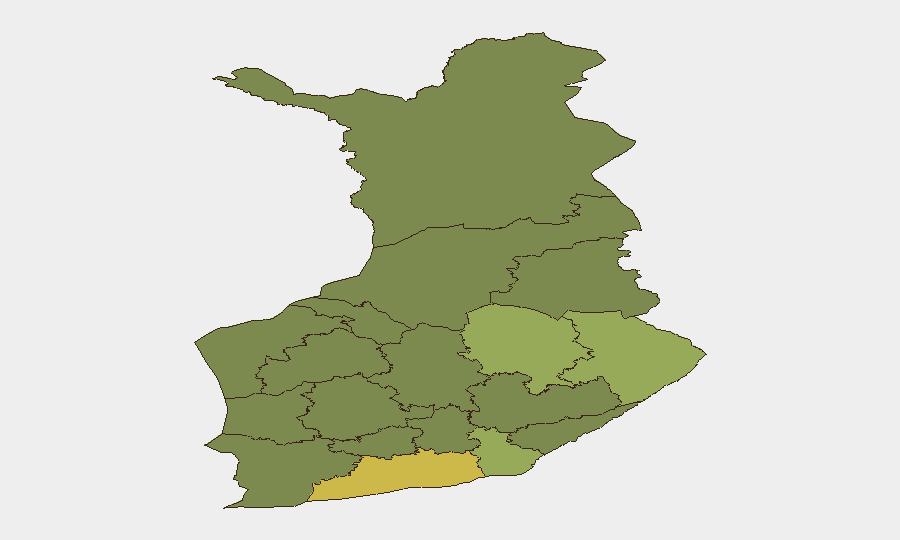
Uusimaa (Helsinki metropolitan area) dominates the sub-national risk profile at composite score 65, nearly 50% above the second-ranked region. This reflects the region's concentration of population, critical infrastructure, government institutions, and international attention, as well as proximity to Russian territory and maritime approaches. North Karelia (44), Kymenlaakso (42), and North Savo (40) form a secondary cluster of elevated risk, all positioned in eastern Finland's border zone or transit corridors; these regions are historically more sensitive to Russian activity, cross-border movement, and hybrid-threat targeting. The gradient from east to west (Uusimaa aside) is typical for Finland and reflects geopolitical proximity. Organizations with personnel or assets in Uusimaa should maintain heightened situational awareness; eastern border regions warrant monitoring for infrastructure-targeting or transnational criminal activity.
How GeoBit Would Assist
Security teams in Finland would benefit from Intel Sweep and multi-language OSINT to track emerging hybrid-threat narratives, Russian military/security signaling, and upstream indicators of sabotage or infrastructure targeting across the Nordic region. AOI Monitoring & Early Warning on critical assets in Uusimaa and eastern border regions (transport, energy, telecommunications) would provide persistent watch and rapid alerting if suspicious activity develops. Network & Actor Analysis linked to open reporting on Russian state and proxy operations in Europe would support attribution and pattern recognition, helping teams distinguish isolated incidents (e.g., the Helsinki fire) from coordinated campaigns.
7-Day Outlook
No imminent acute threat escalation is signaled by available open reporting, but the baseline threat posture remains elevated due to ongoing Russian hybrid-threat activity across Europe and Finland's NATO status. The Helsinki arson investigation will likely conclude within days; if linked to organized sabotage or political motivation, risk perception may shift upward. Continued monitoring of Russian diplomatic, military, and cyber signaling, along with border and infrastructure incident reporting, is warranted as the standard operating tempo.
Highest-Risk Areas — Ranked
| # | State / Region | Risk |
|---|---|---|
| 1 | Uusimaa | 65 |
| 2 | North Karelia | 44 |
| 3 | Kymenlaakso | 42 |
| 4 | North Savo | 40 |
| 5 | South Karelia | 38 |
| 6 | Kainuu | 36 |
| 7 | Päijät-Häme | 35 |
| 8 | South Savo | 32 |
| 9 | Kanta-Häme | 30 |
| 10 | Pirkanmaa | 28 |
| 11 | Central Finland | 26 |
| 12 | Southwest Finland | 25 |
Sources
Previous Daily Briefs
A new Finland brief is written every day — each with its own risk map and downloadable CSV. Here's the last week; use the calendar to go further back.
- August 24, 2026
- August 22, 2026
- August 20, 2026
- August 18, 2026
- August 16, 2026
- August 14, 2026
- August 12, 2026
📅 Browse every day by calendar →
Highlighted days have a brief. Tap a day for that day's map & analysis, or “csv” for that day's dataset ($5).
Atlas — our AI intelligence desk — emails them this snapshot personally. Nothing else, no list.