Situation Summary
Grenada remains a stable, low-threat environment with a composite threat score of 5 and no tracked security incidents in the current assessment window. No acute armed violence, organized crime surges, civil unrest, political instability, or infrastructure disruptions were detected in the past 24–48 hours. The security trajectory is flat, with routine law-enforcement operations and normal critical-infrastructure function across all parishes.
Key Developments
- Nationwide, 4–6 August 2026 — Open-source monitoring confirmed zero armed robbery, homicide, or gang-violence incidents across Grenada during the current 24–48-hour window.
- Saint George's / nationwide, 4–6 August 2026 — Political activity continued without violence or organized unrest; routine governance and civic processes proceeded normally.
- All parishes, 4–6 August 2026 — Royal Grenada Police Force maintained standard checkpoint and border-control operations with no emergency-response surge or unusual deployment.
- Critical infrastructure nationwide, 4–6 August 2026 — Power, communications, and transport systems operated normally; no cyber incidents, outages, or disruptions were identified.
- Eastern Caribbean region, 4–6 August 2026 — No cross-border criminal spillover, smuggling escalation, or regional terrorism threats affecting Grenada were detected.
*Note:* A fatal boating incident occurred on 8 August at Grand Anse Beach (two fatalities); this falls outside the 24–48-hour window but may warrant duty-of-care review for maritime-activity participants.
Highest-Risk Areas
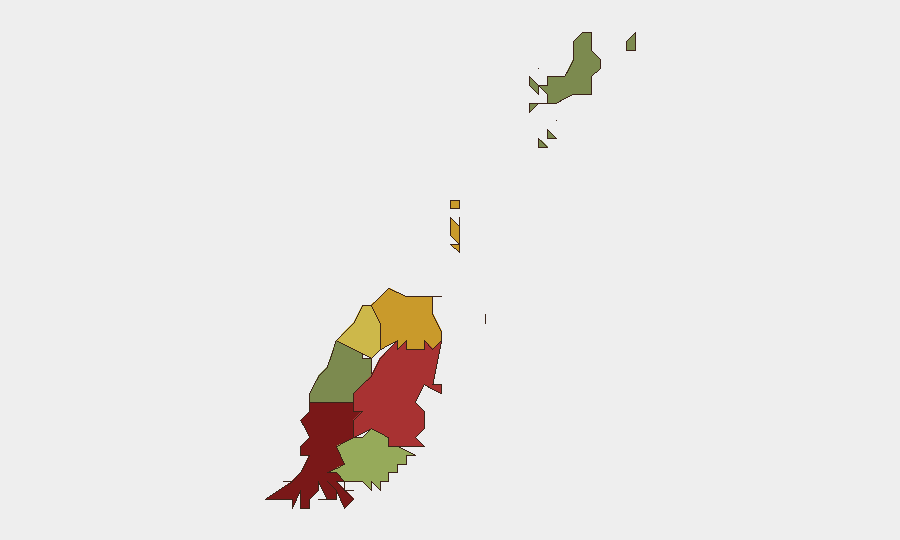
Saint George (risk 92) and Saint Andrew (risk 78) drive the nation's risk profile, likely reflecting higher population density, economic activity, and routine urban crime exposure in the capital and its environs. Saint Patrick (71) and Saint Mark (64) follow, suggesting secondary urban and mixed rural-urban areas carry elevated baseline risk. The northern parish of Carriacou and Petite Martinique (risk 12) and southern Saint John (38) remain substantially lower-risk, reflecting isolation, smaller population, or lower incident prevalence. Overall risk remains manageable and does not indicate a volatile or deteriorating trend.
How GeoBit Would Assist
A security team protecting people or assets in Grenada would deploy AOI Monitoring & Early Warning for Saint George and Saint Andrew parishes to establish persistent watch with alerting on civil unrest, crime spikes, or infrastructure disruptions. Intel Sweep and global event feeds combined with multi-language OSINT (including X, Telegram, and local radio SIGINT) would provide real-time detection of emerging political instability, maritime incidents, or cross-border threats. Risk & Threat Assessment and network/actor analysis would support duty-of-care protocols and incident response planning, particularly for maritime and aviation activities where recent fatalities underscore operational risk.
7-Day Outlook
No acute security developments are anticipated in the next seven days absent unforeseen political or natural events. Routine law-enforcement and critical-infrastructure operations are expected to continue without disruption. Organizations should maintain standard monitoring cadence and duty-of-care protocols, with particular attention to maritime-activity safety following the recent Grand Anse Beach incident.
Highest-Risk Areas — Ranked
| # | State / Region | Risk |
|---|---|---|
| 1 | Saint George | 92 |
| 2 | Saint Andrew | 78 |
| 3 | Saint Patrick | 71 |
| 4 | Saint Mark | 64 |
| 5 | Saint David | 52 |
| 6 | Saint John | 38 |
| 7 | Carriacou and Petite Martinique | 12 |
Sources
Previous Daily Briefs
A new Grenada brief is written every day — each with its own risk map and downloadable CSV. Here's the last week; use the calendar to go further back.
📅 Browse every day by calendar →
Highlighted days have a brief. Tap a day for that day's map & analysis, or “csv” for that day's dataset ($5).
Atlas — our AI intelligence desk — emails them this snapshot personally. Nothing else, no list.