Situation Summary
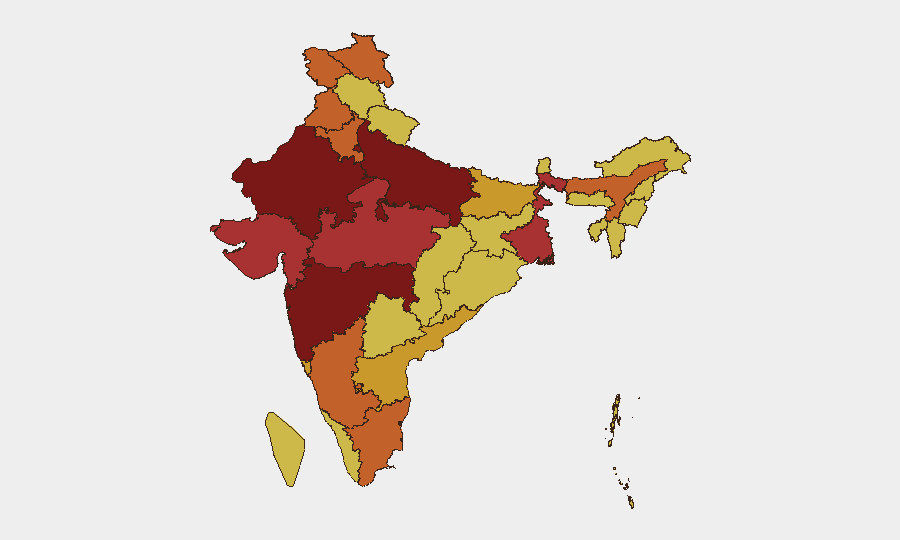
India remains the fourth-highest-threat country globally (composite score 100; 1,049 tracked events), with risk concentrated in five states—Maharashtra, Delhi, Uttar Pradesh, Rajasthan, and West Bengal—accounting for disproportionate civil unrest, physical assault, and administrative tension. Recent signal data (29 June–2 July) points to escalating public statements by officials, academics, and community stakeholders, alongside isolated physical assault incidents in Maharashtra. The overall trajectory reflects persistent structural vulnerabilities rather than acute systemic breakdown, though sub-national volatility warrants close monitoring.
Key Developments
Current-window event signals indicate activity across multiple threat categories, though specific incident detail and corroboration remain limited:
- 2 July · Public Statement (Authorities) – Central or state authorities issued formal statement; subject and context require targeted intelligence sweep to clarify operational implications.
- 1 July · Community Demand – Community-level demand articulated; geographic specificity and escalation risk unknown without deeper OSINT fusion.
- 1 July · Public Statement (Maharashtra Residents) – Maharashtra residents issued public statement on unspecified grievance; potential precursor to organized action requiring area-of-interest monitoring.
- 30 June · Physical Assault (Maharashtra) – Isolated physical assault incident documented in Maharashtra; part of elevated sub-national tension pattern but not indicative of coordinated violence at this time.
- 30 June · Multi-Actor Public Statements – Professor, Ministry official, Chief Minister, Ambassador, and US-India diplomatic figures made public statements (29–30 June); suggests political/academic friction and potential bilateral friction points. Specific topics require targeted X/Twitter and diplomatic-channel OSINT.
Note: Web research covering last 24–48 hours did not yield additional verifiable India security incidents. One cybersecurity incident (Bannari Amman Sugars, Tamil Nadu, 27 June) falls outside the requested window. Teams with access to real-time news feeds, social-media streams, or incident databases should cross-verify against those sources.
Highest-Risk Areas
Maharashtra (score 100) and Delhi (88.2) dominate the threat landscape, driven by physical assault, administrative friction, and high population density amplifying civil unrest impact. Uttar Pradesh (84.5) and Rajasthan (80.3) follow, reflecting persistent communal and governance tensions. The top five states account for nearly 40% of national event density, indicating that corporate and duty-of-care efforts should prioritize Mumbai, Delhi NCR, Lucknow, and Jaipur corridors for asset and personnel protection. West Bengal (79.9) rounds the highest-risk cluster, adding eastern India volatility to the geographic risk picture.
How GeoBit Would Assist
Security teams should deploy Intel Sweep and OSINT fusion (X/Twitter, Telegram, multi-language search) to track the public statements flagged above and extract intent/escalation signals. Persistent Area-of-Interest (AOI) monitoring and early-warning alerting on Maharashtra, Delhi, and Uttar Pradesh would capture civil unrest, protest, and assault precursors in real time. Network and actor analysis would map relationships between officials, academics, and community organizers involved in recent statements, enabling predictive risk modeling. Routing and network analysis can generate alternative journey/supply-chain paths to avoid highest-risk districts during escalation windows.
7-Day Outlook
No imminent systemic crisis is signaled, but the 29 June–2 July statement cluster suggests building political/administrative tension that could crystallize into localized unrest in Maharashtra and Delhi within 7 days. Personnel and asset movement planning should assume elevated friction in top-ranked states; routine security posture adjustments (movement timing, communication protocols, AOI avoidance) remain prudent. Continued daily monitoring of official statements and community-level demands is essential to detect escalation thresholds.
Highest-Risk Areas — Ranked
| # | State / Region | Risk |
|---|---|---|
| 1 | Maharashtra | 100 |
| 2 | Delhi | 88.2 |
| 3 | Uttar Pradesh | 84.5 |
| 4 | Rajasthan | 80.3 |
| 5 | West Bengal | 79.9 |
| 6 | Madhya Pradesh | 77 |
| 7 | Gujarat | 76.6 |
| 8 | Karnataka | 75.4 |
| 9 | Jammu and Kashmir | 74.8 |
| 10 | Haryana | 74.3 |
| 11 | Punjab | 74.2 |
| 12 | Assam | 73.9 |
Sources
Previous Daily Briefs
A new India brief is written every day — each with its own risk map and downloadable CSV. Here's the last week; use the calendar to go further back.
📅 Browse every day by calendar →
Highlighted days have a brief. Tap a day for that day's map & analysis, or “csv” for that day's dataset ($5).