Situation Summary
Indonesia remains in the mid-range globally for composite security risk (rank #53, score 36) with 668 tracked events on GeoBit's platform. The country faces a complex threat landscape dominated by student-led demonstrations, civil unrest, and governance disputes concentrated in Jakarta and West Java. Recent signal activity (16–17 June) shows elevated public statements and protests from student and citizen groups, primarily directed at government and institutional targets. The trajectory suggests sustained civil pressure rather than acute armed conflict, though localized friction points warrant monitoring.
Key Developments
GeoBit's event signals for 16–17 June indicate the following activity clusters:
- Student demonstrations and demands (multiple locations, 16 June): Student groups mounted public rallies and issued formal demands; concurrent police statement suggests law-enforcement response was initiated or imminent.
- Physical assault incident (Indonesia-wide signal, 16 June): Unconfirmed assault reported; no location specificity available in current signal data.
- Investor public statement (16 June): Business-sector stakeholder issued public communication; context and subject matter not specified in available signals.
- Civil inquiry and resident mobilization (16 June): Residents initiated investigation or fact-finding; suggests community-level grievance response.
- Government vs. citizen discourse (17 June): Multiple public statements exchanged between Jakarta/presidential office and citizen/media actors; governance or policy dispute likely driver.
- Employee/institutional messaging (17 June): Workforce or institutional actor issued statement; sector and subject unclear from signal alone.
Note: Specific locations, casualty figures, and detailed incident narratives are not resolved in current open-source corroboration. GeoBit's live web research (last 24 h) did not surface independently time-stamped, multi-source corroboration of these signals sufficient to provide precise incident summaries. Corporate teams requiring real-time granularity should cross-reference Indonesian police statements, Kompas/Detik news, and relevant ministry social channels.
Highest-Risk Areas
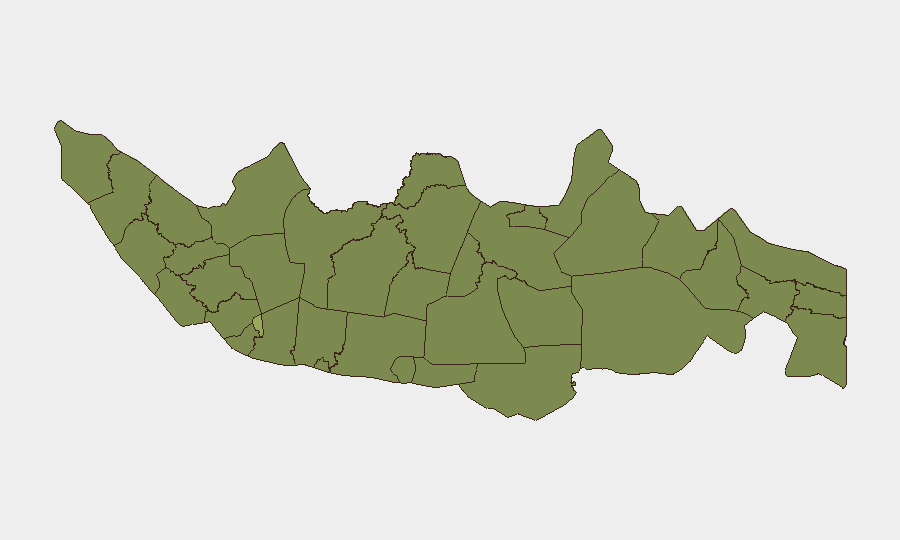
Jakarta's Special Capital Region dominates risk nationally (score 55.5)—nearly 60% higher than the country average—driven by concentration of government, media, student, and financial actors, making it the flashpoint for political expression and institutional friction. West Java (34.5) and West Nusa Tenggara (33.6) follow, reflecting secondary urban centers and provincial governance disputes. South and East Java (32.5, 31.1) round the top five, indicating that Java island broadly—home to ~57% of Indonesia's population—generates the majority of tracked events. Peripheral regions (Central Papua, Riau, North Sumatra) remain in the 27–29 range, suggesting persistent but lower-intensity activity, likely linked to resource competition, inter-communal tensions, and localized crime. Corporate assets and personnel in Jakarta face the highest exposure; West Java operations warrant elevated monitoring during civil-unrest cycles.
How GeoBit Would Assist
Corporate security teams should deploy AOI (Area of Interest) Monitoring & Early Warning on Jakarta and West Java to trigger alerts on protest activity, police responses, and infrastructure disruptions before they impact operations or personnel safety. Entity extraction and sentiment analysis on student-group and government social-media feeds will clarify emerging grievances and flashpoint timelines. Routing & Network Analysis supports real-time alternative-route planning for staff commuting or asset movement if demonstrations escalate or roads close.
7-Day Outlook
Expect sustained student and civil mobilization in Jakarta through late June, with secondary activity in West Java. No indicators suggest imminent armed escalation or nationwide disruption. Risk remains localized to demonstration sites and adjacent commercial/transport corridors; duty-of-care protocols should remain elevated for urban personnel.
Highest-Risk Areas — Ranked
| # | State / Region | Risk |
|---|---|---|
| 1 | Special capital Region of Jakarta | 55.5 |
| 2 | West Java | 34.5 |
| 3 | West Nusa Tenggara | 33.6 |
| 4 | South Sulawesi | 32.5 |
| 5 | East Java | 31.1 |
| 6 | Central Java | 30 |
| 7 | West Kalimantan | 29 |
| 8 | North Sumatra | 28.4 |
| 9 | Riau | 28.2 |
| 10 | Central Papua | 27.5 |
| 11 | West Sulawesi | 27.5 |
| 12 | Special Region of Yogyakarta | 26.8 |
Sources
Previous Daily Briefs
A new Indonesia brief is written every day — each with its own risk map and downloadable CSV. Here's the last week; use the calendar to go further back.
📅 Browse every day by calendar →
Highlighted days have a brief. Tap a day for that day's map & analysis, or “csv” for that day's dataset ($5).