Situation Summary
Mauritania remained in a stable security posture over the last 24–48 hours with no verified attacks, major civil unrest, or infrastructure crises. Political tensions persist in the capital and northern port city following late-July court rulings and alleged harassment of opposition figures, but these have not escalated into documented incidents as of 1 August. The threat environment is characterized by structural risks—organized crime, cyber activity, and Sahel-adjacent militant presence in remote border zones—rather than acute, imminent threats to major urban centers.
Key Developments
No verified incident-level events were recorded in Mauritania during 30–31 July 2026 by credible open sources. The most recent documented developments fall outside the 24–48-hour window:
- Nouadhibou, 28 July – Opposition MP and abolitionist leader Biram Dah Abeid reported near-collision with a vehicle allegedly linked to police; characterized as heightened state–opposition friction but with no follow-on clashes documented since.
- Nouakchott, 27 July – Court of Appeal upheld reduced prison terms for MPs Mariem Cheikh and Gamu Ashour while imposing five-year ban on civil and political rights; potential for supporter mobilization, but no mass protests or unrest corroborated in subsequent 24–48 hours.
Structural risk drivers (not acute incidents): Cyber-threat activity remains elevated, with Mauritania's PAFIID program reporting removal of over 10,000 threats in H1 2026. Organized crime and human-trafficking networks continue to operate in the capital and along borders.
Highest-Risk Areas
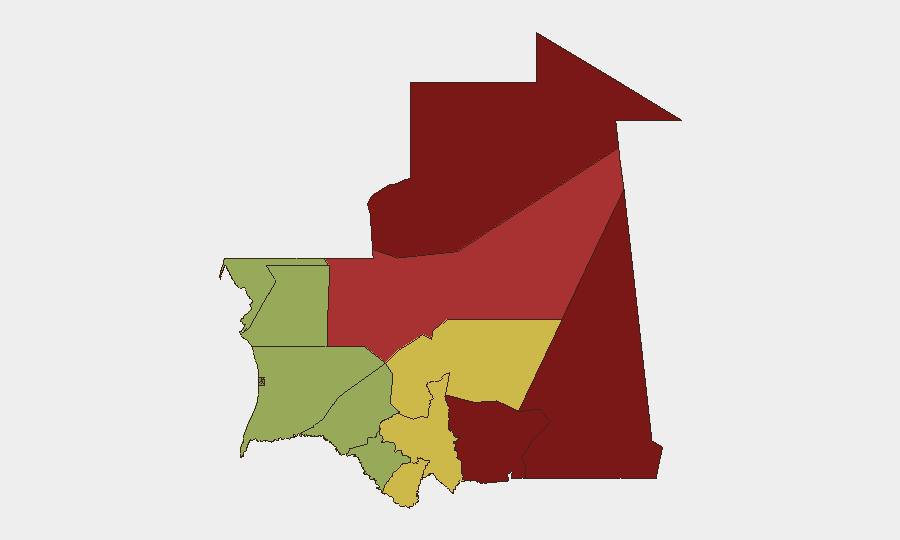
Tiris Zemmour (risk 95) and Hodh Ech Chargui (risk 85) dominate the sub-national risk profile, driven by proximity to the Mali border, weak state presence, and documented militant and criminal networks operating across disputed Sahel territories. Hodh El Gharbi, Adrar, and Tagant form a secondary high-risk band (68–80), reflecting similar cross-border vulnerabilities and sparse security infrastructure. By contrast, Nouakchott and Dakhlet Nouadhibou—the primary business and port nodes—carry lower scores (45–55 range) but remain vectors for organized crime, cyber intrusion, and political friction. Corporate and NGO assets in the capital should factor in political volatility; operations in the south and east should assume militant and criminal activity as ambient risks.
How GeoBit Would Assist
Security teams should deploy AOI Monitoring & Early Warning on Nouakchott (political triggers), Nouadhibou (opposition activity), and border zones in Tiris Zemmour and Hodh Ech Chargui (militant/criminal networks). Intel Sweep and multi-language OSINT fusion across Arabic, French, and Hassaniya-language sources, combined with Telegram and X/Twitter OSINT, will surface early signals of unrest, opposition mobilization, or security-force operations before mass-media reporting. Routing & Network Analysis can identify safe transit corridors around high-risk regions for personnel movement; Cyber risk assessment flags ongoing malware and phishing campaigns targeting government and corporate infrastructure.
7-Day Outlook
No acute security escalation is anticipated in the near term, though political tensions will likely remain elevated as courts process remaining opposition cases. Subsistence-level risks—cross-border militia activity in the south and east, organized crime in urban centers, and cyber operations—should be treated as persistent operating assumptions rather than imminent crisis drivers. Personnel and asset security postures should remain at baseline vigilance with contingency protocols ready for rapid deployment if late-July political friction spills into public disorder.
Highest-Risk Areas — Ranked
| # | State / Region | Risk |
|---|---|---|
| 1 | Tiris Zemmour | 95 |
| 2 | Hodh Ech Chargui | 85 |
| 3 | Hodh El Gharbi | 80 |
| 4 | Adrar | 78 |
| 5 | Tagant | 68 |
| 6 | Guidimaka | 65 |
| 7 | Assaba | 62 |
| 8 | Gorgol | 58 |
| 9 | Trarza | 55 |
| 10 | Inchiri | 52 |
| 11 | Brakna | 48 |
| 12 | Dakhlet Nouadhibou | 45 |
Sources
Previous Daily Briefs
A new Mauritania brief is written every day — each with its own risk map and downloadable CSV. Here's the last week; use the calendar to go further back.
📅 Browse every day by calendar →
Highlighted days have a brief. Tap a day for that day's map & analysis, or “csv” for that day's dataset ($5).
Atlas — our AI intelligence desk — emails them this snapshot personally. Nothing else, no list.