Situation Summary
Moldova faces a sustained uptick in airspace violations linked to Russian drone operations against Ukraine, with 39 recorded incursions since January 2026—more than double the full-year 2025 total. The Government has responded by ordering enhanced protection for energy infrastructure and requesting Parliamentary declaration of a state of emergency in the energy and water sectors, reflecting concern over both direct drone risk and secondary effects (reduced Dniester River flow). The threat environment remains elevated but non-kinetic; no attacks on Moldovan territory have been reported, and the country maintains a composite global threat ranking of #145.
Key Developments
- Airspace violations, nationwide (Sep 20–21): Moldovan authorities reported two drone incursions during Russian strikes on Ukraine. One object crossed from Vinnytsia area; a second entered from near Mayaki, Ukraine, transited toward Palanca in Ștefan Vodă district, then returned to Biliaivka. The Ministry of Defense investigated and restricted regional airspace temporarily.
- Unauthorized overflight (Sep 20): Foreign Affairs Ministry condemned an unidentified drone-like aircraft over Berezlogi, Orhei district, and Dereneu, Călărași district. Police opened formal inquiries.
- National Security Council directive (Sep 21–22): President Sandu's NSC ordered reinforced protection for energy infrastructure against drone and cyberattacks, citing the January–September incursion count (39 vs. 17 in all of 2025).
- Energy and water emergency declaration (Sep 21–22): Government proposed Parliamentary approval of a state of emergency in energy and hydrological sectors, citing drone-attack risk and sharply diminished Dniester River flow. Parliament convened in extraordinary session on Sep 22 to consider the measure.
- Airspace restrictions, Tabani area (Sep 17): National Army deployed for aerial-security inspection after a reported incident; 24-minute temporary airspace closure enforced.
- Border crossing closure, Ștefan Vodă (Sep 17): Palanca border crossing temporarily suspended due to communications-network failure, disrupting border operations and travel.
- Railway infrastructure program approved (Sep 22): Government approved a 2026–2030 national railway-development plan allocating 300 million lei, signaling long-term infrastructure hardening amid regional security concerns.
- OSCE formal protest (Sep 17): Moldova raised drone-incursion concerns at the OSCE Forum for Security Cooperation, citing incidents on Sep 8, 12, 14, and 17, and warning of civilian and aviation hazards.
Highest-Risk Areas
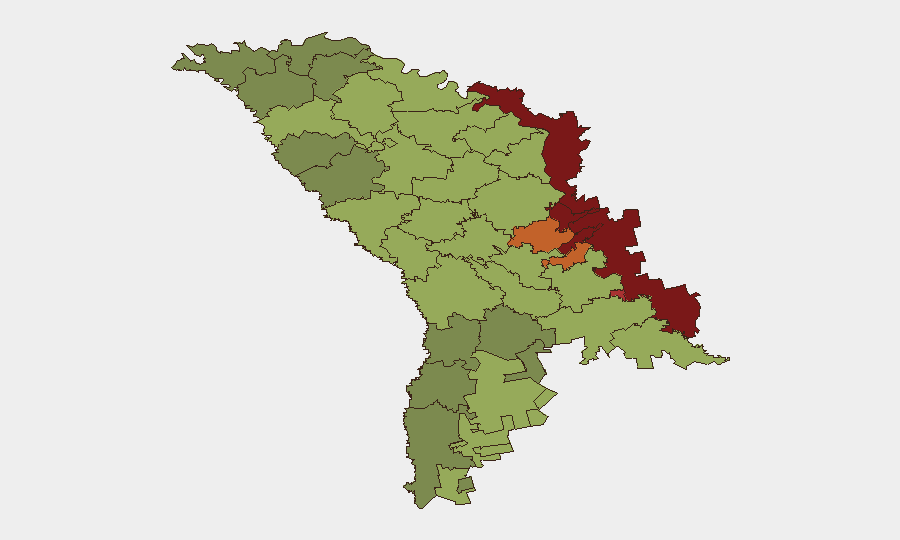
The Left Bank of the Dniester (risk 85) and Dubăsari (82) dominate the sub-national risk ranking, reflecting proximity to breakaway Transnistria and active conflict zones in Ukraine. Bender (79), Criuleni (75), and border districts including Ștefan Vodă (51) carry elevated risk from drone-transit corridors and limited air-defense capacity. Chișinău (49), despite mid-ranking placement, remains operationally critical; central-government and energy-infrastructure targets warrant continuous monitoring.
How GeoBit Would Assist
AOI Monitoring & Early Warning with persistent airspace tracking and alert thresholds would provide duty-of-care teams real-time notification of drone incursions near corporate or personnel assets. GIS & Spatial Analysis combined with Satellite & Imagery Analysis enables mapping of drone-transit corridors, energy infrastructure vulnerability, and safe routing for personnel movement. Network & Actor Analysis (including Telegram/X OSINT) would monitor authorities' communications and threat advisories to anticipate policy changes—e.g., emergency declarations, border closures—before they affect operations.
7-Day Outlook
Airspace violations are likely to persist through autumn as Russian operations against Ukraine continue. Parliamentary approval of the energy-emergency declaration is expected to proceed, triggering expanded air-defense deployments and possible restrictions on civilian aviation in border regions. Personnel and asset managers should expect tightened border protocols and temporary airspace closures around energy-critical areas, particularly in Ștefan Vodă and Orhei districts.
Highest-Risk Areas — Ranked
| # | State / Region | Risk |
|---|---|---|
| 1 | Administrative-Territorial Units of the Left Bank of the Dniester | 85 |
| 2 | Dubăsari | 82 |
| 3 | Bender | 79 |
| 4 | Criuleni | 75 |
| 5 | Rezina | 58 |
| 6 | Taraclia | 55 |
| 7 | Gagauzia | 54 |
| 8 | Căușeni | 53 |
| 9 | Soroca | 52 |
| 10 | Ștefan Vodă | 51 |
| 11 | Orhei | 50 |
| 12 | Chișinău | 49 |
Sources
Previous Weekly Briefs
A new Moldova brief is written every Monday, covering the week — each with its own risk map and downloadable CSV. Use the calendar to go further back.
- September 15, 2026
- September 8, 2026
- September 2, 2026
- August 31, 2026
- August 29, 2026
- August 26, 2026
- August 24, 2026
📅 Browse past briefs by calendar →
Highlighted days have a brief. Tap a day for that day's map & analysis, or “csv” for that day's dataset ($5).
Atlas — our AI intelligence desk — emails them this snapshot personally. Nothing else, no list.